
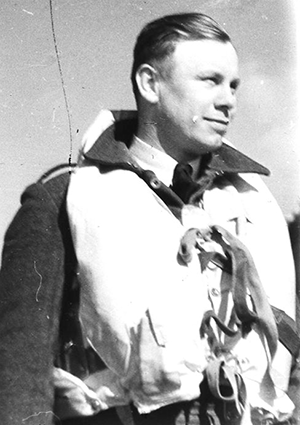
* 05.01.1912, Landsberg.
† 21.10.1999, Litoměřice.
Pre WW2
František Chábera was born on 5 January 1912, the son of Josef and Filomena. His father was employed as a train conductor and was a WW1 Legionnaire veteran who had served in Russia. At time of František’s birth, the family lived at Landsberg, now Gorzow, Poland, which was part of the Austro-Hungarian Empire and after WW1 it became part of the newly formed Germany. Shortly after his birth, the family moved to Litoměřice, a smalltown east of Ústí nad Labem in the north-east of Czechoslovakia. For his schooling there, he completed 5 classes of primary school and 3 years of middle school. He left school in 1926 and joined the J. Setner company, at Velké Březno, some 15km away, as an apprentice electrician.
Czechoslovak Air Force

Like many other Czechoslovak young men, František was enchanted by aviation and aspired to join that elite group of men. In 1930, aged 18, for his mandatory military service he applied to join the Škola leteckého dorostu [ŠLD] the cadet school at the Military Aviation Academy at Prostějov. His application was successful and he joined them that 1 October. Amongst his fellow pupils on that year’s intake were Otto Hanzlíček, Josef Kopřiva, Miroslav Mansfeld and Raimund Půda, who were later to join František in the RAF in England, and fly in the Battle of Britain.
At the cadet school he volunteered for pilot training and graduated from Prostějov, being awarded his Czechoslovak pilot’s wings, in 1932. František was then posted to the 7th observation squadron of the 2nd Air Regiment deployed at Olomouc. They were equipped with two-seater Letov Š-328 biplane reconnaissance aircraft. At that time, Czechoslovakia had one of the most modern and well-developed Air Forces in Central Europe. On completion of his mandatory military service, he decided to make the military his career.

On 1 October 1934 he was transferred to the 73rd squadron of the 4th Air Regiment who were stationed at Hradec Králové airbase, and on 1 February 1935, he was sent on a fighter pilot training course at the Military Aviation Academy, Prostějov. He graduated from that training in August 1935, and was posted to the 39th Fighter squadron of the 3rd ‘M R Štefánik’ Air Regiment, who were deployed at Vajnory airbase, Slovakia. In October 1935, he was posted to Hradec Králové airbase, serving with the 40th Fighter Squadron. Whilst there, he completed a night flying course.
Due to his excellent piloting skills, in August 1937, František was posted as a test pilot to the Vojenský technický a letecky ústav [VTLÚ], the Aeronautical Research Centre for the Czechoslovak Air Force, at Letňany airbase, Prague. By the time of the German occupation in March 1939, he had flown a total of 1,190 hours in numerous types of aircraft.
Mobilisation

The threatening overtures by neighbouring Nazi Germany regarding the Sudeten regions – the German speaking areas – of Czechoslovakia caused the Czechoslovak Government to declare a mobilisation on 23 September 1938.
Munich Dictat
Following this threat, Chamberlain, the British Prime Minister, Daladier, the French President, Hitler, the German Chancellor and Mussolini, the Italian Dictator, met in Munich. The outcome of this was the Munich Agreement of 30 September 1938 wherein the Sudeten regions were ceded to Germany. Eduard Beneš, the Czechoslovak President, was not invited to participate in the discussion concerning the future of his country; instead, he was merely told by Chamberlain and Daladier to either accept the agreement or Czechoslovakia would have to defend itself without any support from Britain and France, despite there being a tri-lateral defence agreement between the three countries. As a result of that Agreement, in addition to Germany being ceded the Sudeten regions, Poland and Hungary took this opportunity to take some Czechoslovak territory on ethnicity grounds. Thus, about 30% of Czechoslovakian territory had been lost, which included its border defences, and the new revised German border was now only some 30 km from Prague.
German Occupation

Despite assurances given by Hitler at the Munich Agreement, that he had no further interest in territorial gains for Germany, just a few months later he extended his demands that the remaining regions of Czechoslovakia become part of Germany.
On the evening before the occupation, on 14 March, 1939, Czechoslovak intelligence officers called a meeting where they announced that the threat of invasion was imminent and recommended measures which would prevent most important assets from falling into German hands. However, no orders were handed down until too late. The Chief of the Czechoslovak Air Force General Fajfr and his deputy General Vicherek ordered that no aircraft were allowed to take off. The Ministry of National Defence started organising the transfer of the aircraft to several airfields in Moravia with the intention of getting the airfleet to Romania and Yugoslavia. None of these plans were carried out.
The Germans occupied Czechoslovakia on 15 March 1939. Under pressure, Emil Hácha, the Czechoslovak President, had acceded to their demands, and in the early hours of that day, he had ordered all Czechoslovak military units to stand down, remain in their barracks and not resist the occupation. Germanisation of Bohemia and Moravia began immediately; they were now the Reich Protectorate of Bohemia and Moravia (Protektorat Böhmen und Mähren), while Slovakia, in return for its allegiance to Nazi Germany, had become the puppet ‘independent’ state of Slovakia.
Upon occupation, the Czechoslovak Air Force was disbanded by the Germans and all personnel dismissed.
Resistance

But just four days later internal resistance organisations were being established. On 19 March 1939, former Senior officers of the now-disbanded Czechoslovak military had started to form an underground army, known as Obrana Národa [Defence of the Nation]. Obrana Národa also worked in co-operation with Svaz Letců, the Airman Association of the Czechoslovak Republic. One of their objectives was to assist as many airmen and soldiers as possible to get to neighbouring Poland where they could be formed into military units to fight for the liberation of their homeland. These two organisations provided money, courier and other assistance to enable airmen to escape to Poland. Usually, this was by crossing the border from the Ostrava region into Poland. František, was one of the many Czechoslovak airmen and soldiers who clearly saw it was their duty to go to Poland from where they could participate in efforts to achieve the liberation of their homeland.
To Poland
On 9 June 1939, with the assistance of the two underground organisations, Josef travelled with fellow airmen František Cigoš and Václav Smrčka by train to Ostrava. There, at Vítkovice railway station they waited to meet their contact with whom they would catch the train to Frýdek-Místek, a small town about 24 km south of Ostrava and near the new Polish border. The contact arrived and identified himself by a pre-arranged signal, which the escape group acknowledged in the agreed way.. Keeping separate from their contact, they boarded the train to Frýdek-Místek.
At Frýdek-Místek, their contact walked away from the railway station into the forest, František and his two companions following at some distance behind. They went on an indirect route through the forest to the border, where they parted with their contact who returned back into Czechoslovakia having successfully guided another group of escaping Czechoslovak military to Poland. Now in Poland, František and his two fellow escapees continued walking through the forest until they reached a bus stop where they waited for a bus to take them to Český Těšín, 23 km away. On their arrival there, they went to the railway station from where they caught the train to Krákow. On reaching Krákow they reported for Duty at the Czechoslovak Consulate.

Polish Disappointment
However, whilst the Polish Authorities recognised the new puppet State of Slovakia, they showed little interest in the Czechoslovak military who were escaping across their border in groups and would not allow independent Czechoslovak units to be established on its territory as they were concerned about antagonising neighbouring Nazi Germany.
Instead, they learnt that the Czechoslovak Consul had, via his counterpart in Paris, negotiated with the French Government that the escaped Czechoslovak military would be permitted to travel to France. But there was a condition, as French Law did not permit foreign military personnel on its territory during peacetime The Czechoslovaks would be required to enlist in the French Foreign Legion for a period of five years – but with the assurance that in the event of war being declared, they would be released from the Legion and transferred into French military units. The alternative was that they would be sent back to Czechoslovakia, now a German Protectorate, where execution or deportation to a concentration camp would be the most likely outcome.

František, like most of the Czechoslovak escapees, decided that his best choice was to go to France. Initially he was transferred to Bronowice Małe, a derelict former Polish Army barracks from the Austro-Hungarian era, on the outskirts of Krákow which was then being utilised as a temporary transit camp for the escaped Czechoslovak military prior to their transfer to France. He arrived there on 23 June 1939, the 508th Czechoslovak escapee to arrive. The barracks, which were in poor condition, were already well inhabited by Czechoslovaks whilst arrangements were made for their transportation, by sea, to France.
To France

After a short stay at Bronowice Małe, František was one of the 547 Czechoslovak escapees who went by train to Gdynia where they boarded the MS ‘Chrobry’, a Polish trans-Atlantic passenger ship owned by the Gdynia-America Shipping Lines Ltd for their routes between Poland and South America. This was its maiden voyage to South America and it would stop in at Boulogne, France, so that the Czechoslovak escapees could disembark there. The MS ‘Chrobry’ arrived at Boulogne on the night of 31 July/1 August.

France
Early the following morning, František and his fellow escapees disembarked onto French soil. They were met at Boulogne by kapitán Jan Pernikář, the Air Attaché from the Czechoslovak Consulate, Paris. Each escapee was given 20 francs to cover their immediate needs, and after two days there, they boarded a train for the 13-hour journey to Gare du Nord railway station in Paris, where they were met by Štefan Osuský, the Czechoslovak Ambassador. From there they went by military truck to Place Balard, the Legion’s recruitment centre, to complete enlistment formalities and undertake medical examinations. By 26 August, these were completed and they were awaiting transfer to their training base at Sidi-bel-Abbès, Algeria. This time was to serve as a familiarisation period to learn the ways of the Legion and to study French crash-courses, and they took every opportunity to practise their new language skills with French girls that they met.
L’Armée de l’Air
Before František was transferred to the Legion’s training centre at Sidi-bel-Abbes, Algeria, Germany invaded Poland on 1 September 1939, and two days later, France and Britain declared war on Germany as their ultimatum to Germany to withdraw from Poland had been ignored. He was released from his Legion service and was transferred to the l’Armée de l’Air’s BA 117 recruitment centre at Base Aérienne de Dugny, Paris, with the rank of caporal-chef. On 11 September he was assigned to the Centre d’Instruction de Chasse at Chartres, the l’Armée de l’Air training airbase, about 50 miles South-West of Paris, for re-training on French Potez XXV and Morane-Saulnier MS.230 elementary trainers and then the Morane-Saulnier MS-406c fighter aircraft. At Chartres, František also undertook re-training on French fighter aircraft and took French language lessons.

On 2 December 1939, after only 13.09 hrs of retraining, František was awarded his L’Armée de l’Air pilot’s wings and posted to GC II/5 ‘La Fayette ’with fellow Czechoslovaks Josef Jaške, Josef Janeba, Otto Hanzlíček, Jan Klan and Ladislav Světlík. The unit was deployed at Croix-de-Metz airbase at Toul, some 160 miles east of Paris, and equipped with Curtis H-75c fighter aircraft.
The relative calm of the Phoney War ended at 05:35 on 10 May 1940 when ‘Fall Gelb’ – the German attack on Holland, Belgium, Luxembourg and France – took place. In France they came through the dense Ardennes Forest to skirt around the main defence of the Maginot line and swept Northwards towards the English Channel. The Battle of France had begun. On 18 May 1940, two more Czechoslovaks, Josef Burger and Josef Duda, were posted to GC II/5.

In the Battle of France this unit was to become one of the most successful French units: its pilots destroyed 76 Luftwaffe aircraft, 17 of which were downed by its Czechoslovak pilots.
With GC II/5, František achieved combat success:
| Date | Aircraft | Time | Action |
11.05.40 | H75-no 63 | 06:45 | a shared victory He III, 6km South of Mars-la-Tour. |
11.05.40 | H75-no 63 | 06:45 | a probable He III, 6km South of Mars-la-Tour. |
14.05.40 | H75-no 129 | 16:25 | a Me110, probable near Clouange, 12 km South-East of Met. |
24.05.40 | H75-no 63 | 19:10 | a shared Me109 probable near Languyon. |
05.06.40 | H75 no 63 | 15:00 | a He 113 shared victory near Chaulnes |
08.06.40 | H75 no 46 | 11:00 | a Me109 victory near Poix. |
08.06.40 | H75 no 46 | 13:00 | a Hs 126 victory, East of Rethondes. |
František was highly regarded by his French superiors: “An excellent fighter pilot, he did not fail any test, he always volunteered for even the most dangerous missions,” said the citation for one of the Croix de Guerre palms he was awarded.
Evacuation from France
The rapid advance of the German Blitzkrieg caused GC II/5 to keep retreating westward to avoid capture. By 16 June, they were now at La Salanque airbase at Perpignan in south-west France, their 11th redeployment westwards since Germany had invaded on 10 May. The French authorities had by now realised that the war on mainland France was lost and sought to evacuate as much of their military to Algeria as they could.
By the time GC II/5 arrived at La Salanque airbase, there were some 250 aircraft from other units that had already congregated there en-route to Algeria. There everything was very chaotic, and with few ground-crew available, the pilots of GC II/5 had to refuel their aircraft themselves. On 20 June they flew from France, over the Mediterranean to Maison Blanche airbase, Algeria.
There they learned that that France had capitulated on 22 June and that Winston Churchill, the British Prime Minister, was appealing to all the evacuated Czechoslovak airmen to come to Britain and continue the fight from there.
In l’Armée de l’Air service, František had flown 50.30 operational hours during the Battle of France.
Evacuation to England

With France capitulated, the Czechoslovak airmen were released from l’Armée de l’Air service. On 4 July, František and other Czechoslovak airmen travelled by train for four days to Casablanca, Morocco. Here they boarded the MV ‘Royal Scotsman’, a passenger and cargo ferry, which sailed on 9 July for Gibraltar arriving the next day. On 21 July 1940, they embarked on the MV ‘David Livingstone’ which was part of a convoy of 69 vessels. They sailed for the UK, arriving in Cardiff on 5 August 1940.
RAF
On arrival in England, after security vetting and medical checks, like most of the Czechoslovaks, František’s path first led to the Czechoslovak resettlement camp at Cholmondeley Park, near Chester. The Battle of Britain was now in progress and there was an urgent need for fighter pilots and on 10 August, František was transferred to the Czechoslovak Depot, at RAF Cosford.
On 2 August, as a trained fighter pilot he was quickly admitted to the voluntary reserves of the RAF, swore his oath of allegiance to King George VI and was commissioned at the rank of Sgt. As when joining l’Armée de L’air the previous year in France, the Czechoslovak airmen were given theoretical aviation training and language lessons, this time for British aircraft and the language was English.

On 5 September, after some basic English lessons, František, along with fellow P/O’s Jindřich Bartoš, Josef Duda, Alois Hlobil, Josef Jaške, Alois Vašátko, Vlastimil Veselý, Adolf Vrána, Tomáš Výbíral and Sgt’s Josef Keprt, Josef Stehlík, Václav Šlouf, and Jan Truhlář, was posted to RAF Duxford. With these and 78 other ranks he was posted to the newly formed 312 (Czechoslovak) Sqn which was deployed at RAF Duxford and was equipped with Hawker Hurricane Mk I fighter aircraft, becoming one of its founding members. There, František and his fellow Czechoslovak pilots were immediately re-trained to fly Hurricanes by British RAF officers who were the flying instructors. F/O Ladislav Češek, a Briton of Czech origin, was engaged as an interpreter to assist in overcoming the language barrier and English lessons were provided by Mr G H Booty to enable at least elementary radio communication to the required RAF standard.

Battle of Britain
On 26 September, 312 Sqn, now an operational unit, were re-deployed to RAF Speke airfield, now John Lennon airport, at Liverpool, which was part of 9 Group RAF Fighter Command. There their role was the defence of the city and its docks from Luftwaffe air raids. Initially, however, poor weather hampered further training of the pilots on their Hurricanes.
František made his first operational flight on 4 October – a scramble flying Hurricane Mk I H1740, taking off at 10:50 and returning at 11:35 with no Luftwaffe encountered.
He made a further three scrambles, also uneventful, thus achieving 3hrs 15 min of operational flying during the Battle, but with no combat success achieved.
After the Battle

Whilst the Battle was regarded as finishing on 31 October 1940, the Liverpool docks had become a vital lifeline to Britain’s war effort, with some 90% of all war materials and food from North America arriving there. Thus, it became a prime target for Luftwaffe attacks, causing it to be the most bombed city after London. In early December 1940, Air Vice-Marshal McClaughry – Air Officer Commanding (AOC) of No. 9 Group RAF Fighter Command – decided to strengthen the night fighter defence of the Liverpool and Manchester area.
F/O Vlastimil Veselý had been the first 312 Sqn pilot to volunteer for posting to 96 Sqn for night-fighter duties. On 1 March 1941, František was promoted to the rank of F/Sgt. as a trained night-fighter. On 23 March 1941, he volunteered with fellow 312 Sqn Czechoslovak pilots. 2 Sqn Josef Keprt and Josef Kloboučník were also posted to 96 Sqn. They were joined by air gunners Karel Bednařík and Oldřich Kanňovský, from the Czechoslovak Depot at RAF Cosford.
96 Sqn was a multinational RAF squadron comprised of British, Commonwealth and now Czechoslovak aircrew. The squadron was deployed at RAF Cranage, some 30km south of Manchester and equipped with Hurricane Mk I’s and Boulton-Paul Defiants. The squadron’s role was the night defence of the industrial Midlands and the Liverpool docks.
68 Sqn
On 20 September 1941, František was posted to 68 Sqn, a night fighter squadron deployed at RAF High Ercall, near Shrewsbury, Shropshire, and equipped with Bristol Beaufighter Mk.IF twin-engined fighter aircraft. He was assigned to the squadron’s B Flight – otherwise known as the Czechoslovak Flight as it was manned by Czechoslovak aircrew.

Although whilst with 96 Sqn and then 68 Sqn, František flew a total of 50 operational hours on night patrols, 17 hours in Defiant aircraft and 33 hours in Beaufighters, he achieved no combat success. On 20 December 1941, he was commissioned at the rank of P/O.

Czechoslovak Inspectorate General
On completion of his operational tour, for his rest period, on 26 May 1942, František was posted to the Czechoslovak Inspectorate General, where he remained until 1 August 1942.
312 Sqn
František then returned to operational flying duties and returned to 312 Sqn, now deployed at RAF Harrowbeer, Devon, and equipped with Supermarine Spitfires MK Vc’s. On 1 October he was promoted to the rank of F/O.
Whilst at RAF Harrowbeer, 312 Sqn were primarily involved, with other fighter squadrons, in providing cover for Allied bombers on raids over northern occupied France. These raids, known as ‘Ramrods’ were primarily intended to destroy a ground target and also inflict losses by the escorts on German fighters trying to intervene. František remained with 312 Sqn until 1 February 1944.

Volunteers for Russia
In November 1943, W/Cmdr František Doležal, the current commanding officer of the Czechoslovak Wing, asked the pilots of that Wing for volunteers to go to the Eastern Front and fly for Russia. A total of 21 volunteers comprising pilots from 310, 312 and 313 Sqns were finally selected. František was one of them, his reason for that was that he sought a more active role in the war and that he would be fighting the Luftwaffe nearer his homeland and so would get home sooner. This was a common sentiment shared by the other 20 as well. There had been two other volunteers, but due to their open anti-Soviet stance, failed their NKVD – Narodnyy Komissariat Vnutrennikh Del – the Soviet Secret Police screening and were not granted visas for entry to Russia. On 20 December 1943, František was promoted to the rank of F/Ltd but he resigned his RAF commission on 1 February 1944 and was released from his RAF service in preparation for going to Russia.
To Russia
On 21 February 1944, with 20 other volunteer Czechoslovak former RAF pilots, František sailed from Glasgow aboard the ‘Reina del Pacifico’ to Gibraltar and then onto Port Said, Egypt. From there to Cairo where they went by train to Damascus, Syria. From there by coach to RAF Habbányia near Bagdad, then by train to Tehran, Persia. From Tehran they were then flown to Ivanovo airbase, 325 km east of Moscow. On this journey, many of them took the opportunity to learn some Russian, the 3rd language they were having to learn since they left their homeland in 1939. It would also be the 4th Air Force they had served in during that period.
Eastern Front

On arrival at Ivanovo airbase, about 180 km north-east of Moscow, they began their re-training on the Soviet Lavochkin La-5FN fighter aircraft, one of the Soviet Air Force’s most capable fighter aircraft. Apart from cultural differences, one of the main problems these RAF encountered in Soviet Russia was the constant distrust of the NKVD, which made their lives unpleasant as they were always under observation. At Ivanovo, they were surrounded by nice Soviet girls, who, however, worked for the NKVD and so had to be careful about any opinions they expressed. On completion of their training, the unit was declared operational on 3 May 1944 and renamed 1st Czechoslovak Independent Fighter Aviation Regiment. On 3 May 1944, František was assigned to the 128 Czechoslovak Independent Fighter Squadron based at Kubinka airbase. Following reorganisation, the unit was then renamed the 1st Czechoslovak Air Regiment which was fully subordinate to the Soviets. On 1 June 1944, František was appointed commanding officer of the regiment’s 2nd Fighter Sqn. On July 20, 1944, the regiment moved to Proskurov in the area close to the front.
The Slovak National Uprising against the Nazis had broken out on 29 August 1944, and after news of the uprising, the High Command in Moscow then ordered the regiment to redeploy to Stubno, Poland, on 5th September, to be closer to the front line. On 15 September, the first four of the regiment’s La-5FNs were flown to the Tri Duby airfield near Banská Bystrica, Slovakia. They were flown by František Fajtl, the regiment’s C/O, Jan Klán, deputy C/O, Josef Stehlík and František to arrange the logistics of the arrival of the whole regiment. By 18 September, the remainder of the regiment’s La-5FN were flown in. The next day, they attacked Pieštany airbase, some 100km west of them and now used by the Luftwaffe. Josef Stehlík led the attack as he had served at Pieštany pre-war and was very familiar with the terrain. The attack caught the airbase by surprise, and before its ground defences could respond, the Ln-5FN’s were able to inflict damage to ground targets. Under difficult conditions, the unit achieved a number of successes in both aerial combat and against ground targets.
They re-deployed to Zolná airfield, Slovakia, and despite being heavily outnumbered by the Luftwaffe, the unit provided crucial air-cover and ground-support to Slovak troops fighting the Germans at Dukla Pass.
However, the insurgents’ airfield at Tri Duby was often attacked by the Luftwaffe, causing František Fajtl to find another landing ground where the aircraft would have better landing and take-off facilities and while on the ground could be better concealed from Luftwaffe aircraft. He located a field at Dolní Lázy, north of the village of Zolná and this became the base of the 1st Czechoslovak Independent Fighter Regiment. The regiment landed here for the first time on September 17, 1944. It was the first landing of the Czechoslovaks in this long relentless war in their homeland.
Unfortunately, the uprising was failing and as the German forces closed in during October 1944, the airstrip came under heavy attacks and on 7 October 1944, the last Soviet and Czechoslovak aircraft evacuated Tri Duby, flying east to Soviet-controlled territory. It was there, on 18 October 1944, that František also claimed his last victory. He had taken-off to intercept against reported German bombers and shortly after take-off, he saw three Ju 88’s. He fired all his ammunition into one of them, but the Ju88 disappeared towards Hronská Breznica with a smoking engine. This was a probable kill.
On 28 October 1944, František took over command of the 1st Fighter Squadron of the 1st Czechoslovak Mixed Air Division and participated with it in air support of ground units during the liberation of Ostrava and Opava. During the fighting there, he flew another 25 sorties and in addition to the Ju 88 ‘probable’ on 18 October 1944, he destroyed 9 trucks, 2 cars and 1 tank.

Post WW2
After returning to his homeland, he returned to his pre-war position as a test pilot and in September 1945, with the rank of kapitán [F/Lt] he took up his pre-war position at the Vojenský technický a letecky ústav [VTLÚ], the Aeronautical Research Centre for the Czechoslovak Air Force, at Letňany airbase. In the Spring of 1946, he completed a course at the ObZ – Obranné zpravodajství – the Czechoslovak Intelligence Service and was appointed an Intelligence Officer in the Czechoslovak Air Force.
Communist putsch
The Communist take-over of Czechoslovakia took place on 15 February 1948. Whilst on 1 March 1948 František had been promoted to the rank of Major [S/Ldr], the Communists identified that those who had fought in the west during WW2 as a threat to their regime. Systematically they began to remove former RAF airmen from the Czechoslovak Air Force; usually by demoting them to the lowest rank, stripping them of any medals that Czechoslovakia had awarded them, and then persecuting them, including arrest and imprisonment. Thus, many of the former RAF airmen looked to escape to the West.
On 4 December 1948, František was arrested at Ruzyně airport by the StB – Státní bezpečnost – the State Security Police, accused of starting an aircraft in an attempt to escape to the American Zone of Germany. He was detained in Bory prison for six months before his trial. On 1 March 1949, at the State Court in Prague, on the charge of attempting to escape to the West, he was convicted and sentenced to 5 years’ hard labour. The sentence was served in Bory (1949-1950) and Příbram high security prisons. At Příbram, his fellow prisoners knew that they had a wartime RAF Czechoslovak pilot among them and the young prisoners in particular were eager to hear František tell them about his experiences. Therefore, they listened to him in their free time, but the guards considered it as preparation for a conspiracy. As a punishment, František was transferred to the uranium mines of Bytíz, Vojna and Jáchymov.

After his release in December 1953, he initially returned home to his mother in Litoměřice and spent the following years permitted to do menial work only. First, in January 1954, he started as an unskilled worker in the Spolana factory, a state-owned chemical company, one of the largest in Czechoslovakia, at Neratovice, some 12 miles north of Prague. In September 1954 he started as an electrician at the ETZ Elektrotechnické závody factory in Bystřany near Teplice, some 15 miles north-west of Litoměřice, which manufactured industrial electrical equipment, where he worked until his retirement.
Rehabilitation

The death of the Stalin, the hardline Soviet leader in 1953 and the subsequent fall of Czechoslovak leader Klement Gottwald, also in 1953, marked the first thaw in the Communist regime in Czechoslovakia. But it wasn’t till the 1960’s that the regime began to redress the injustices it had inflicted on the former RAF airmen.
In 1964, František was partially rehabilitated with his rank of Major restored, and on 30 December 1968, he was fully rehabilitated and promoted to the rank of Lieutenant Colonel on 1 October 1970. In 1990, in the process of full moral rehabilitation, he was promoted to Colonel [ret.], and after the Velvet Revolution in November 1989, he was promoted to the rank of Major General on 8 May 1995.
On 21 October 1999, František Chábera died at Litoměřice, Czech Republic, aged 87.
In 2002, he was appointed an honorary citizen of the city of Litoměřice and in 2009, a new bridge in Litoměřice was named after him.
Medals Awarded
1939 – 45 Star with Battle of Britain clasp
Air Crew Europe Star
Defence Medal 1939 to 1945
War Medal 1939 – 1945
řádem M. R. Štefánika III. tř.
řád Slovenského národního povstání I. tř.
Válečný kříž 1939 and 3 bars
Za chrabrost and 2 bars
Za zásluhy I.stupně
Za zásluhy II.stupně
Pamětní medaile se štítky F–VB
Médaille Militaire
Croix de Guerre avec 4 palmes et etoiles vermeil
Médaille commémorative des Services Volontaires de la France Libre
Za pobědu
Remembered
Great Britain:
Capel-le-Ferne:
He is commemorated, along with the other 2940 Battle of Britain aircrew, on the Christopher Foxley-Norris Memorial Wall at the National Battle of Britain Memorial at Capel-le-Ferne, Kent:

Hawkinge:
Alexander is remembered on the Czechoslovak Battle of Britain pilots memorial at the Kent Battle of Britain Museum at Hawkinge, Kent. It was unveiled on 28 October 2025, to commemorate the 88 Czechoslovaks who flew in that battle.

London – Battle of Britain Memorial:
He is also commemorated on the London Battle of Britain Memorial:
Czech Republic:
Trebenice:
František is named on one of the memorial stones by the Czechoslovak airmen’s memorial at Trebenice which was unveiled on 15 September 2025. Adjacent to the memorial are a series of memorial stones, each naming an airman from its region who had served in the RAF during WW2.


Prague 1 – Klárov:
In November 2017, his name, along with the names of 2533 other Czechoslovak men and women who had served in the RAF during WW2, was unveiled at the Winged Lion Monument at Klárov, Prague.

Žatec:
František is remembered on the Czechoslovak airmen’s memorial at Žatec which was unveiled on 15 September 2012, to commemorate those from its region who had served in the RAF during WW2.

Article last updated: 30.10.2025.
Widgets
