
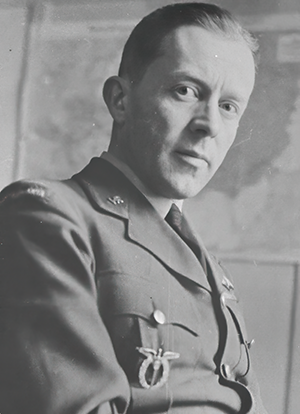
* 09.08.1905, Prague.
† 07.12.1977, Prostějov.
Early Years
Josef Duda was born on 9 August 1905, in the Pohořelec District of Prague 1. He was the youngest son of Jan and Maria née Selixová, a staunch patriotic family who believed in the ethos of the Sokol movement whose principle was ‘a sound mind in a sound body’ which was achieved by gymnastics, moral education, patriotism, and community involvement. At that time, Jan was a sergeant in the Army. Between 1911 and 1916 Josef attended his primary schooling in the neighbouring Hradčany District and his secondary education at nearby Malá Strana District, from which he graduated in 1923.
Czechoslovak Army
On graduation Josef followed in his father’s footsteps and joined the Czechoslovak Army and was assigned to the 9th Infantry of the Karel Havlíček Borovský Regiment who were stationed at Most, some 50 miles north-west from Prague. Late in 1923, he attended the Military Academy at Hranice from where he graduated on 15 August 1925. Josef then attended the Artillery School at Olomouc from where he graduated as an artillery officer and was posted to the 111th Artillery Regiment stationed at Košice, Slovakia.
Czechoslovak Air Force
In April 1928 he applied for transfer to the fledgling Czechoslovak Air Force and was assigned to the Military Aviation Academy at Cheb for a training course as an aerial observer. He completed the course that August and was posted to the 7th Observation Squadron of the 3rd ‘M R Štefánik’ Air Regiment who were deployed at Košice.
On 1 October 1929, he was transferred to the 2nd Aviation School Section of the 16th Observation School at the Military Aviation Academy at Prostějov for further training as an aerial observer. He completed the course in 1930 and was posted to the newly formed 63rd Reconnaissance Sqn of the 2nd ‘Dr. Edvard Beneš’ Aviation Regiment who were deployed at Olomouc airbase. Josef completed an aerial photography course in 1932 at the Military Studies Institute in Prague. The following year he completed an Officers’ Mechanical course at Olomouc airbase. Between 1933 and 1935, at the rank of nadporučík [F/O], he was appointed an instructor at the Military Aviation Academy at Prostějov, where amongst the many cadets he trained there were future Battle of Britain pilots Jindřich Bartoš, František Fajtl, Stanislav Fejfar, Josef Jaške, Miroslav Kredba and Karel Mrázek.
Josef’s next posting, in 1935, was to the 38th Fighter Sqn of the 3rd ‘M R Štefánik’ Air Regiment who were deployed at Vajnory, Slovakia. In 1936, now aged 31, he was appointed interim commander of the Regiment’s 64th Long-Range Reconnaissance Sqn who were deployed at Piešťany, Slovakia. In 1937 he was appointed Commander of the Regiment’s 37th Fighter Squadron.
Tisíc pilotů republice – 1000 pilots for the Republic

Following Germany’s Anschluss of Austria in March 1938, rising tensions over the Sudeten regions of Czechoslovakia and the rapidly expanding military in neighbouring Nazi Germany had resulted in the Czechoslovak Government instigating the ‘Tisíc pilotů republice’ – 1000 pilots for the Republic – an initiative to covertly train 1000 young Czechoslovak men to become pilots who could be incorporated into the Czechoslovak Air Force if the situation demanded. The campaign was supported by commercial enterprises in Czechoslovakia as well as the Masaryk Aviation League, the Sokol movement, aero clubs and the Air Force. It encouraged young men, and sometimes women, to join flying clubs or training courses to train to fly light aircraft. Instructors on these courses would often be serving members of the Air Force.
In late 1938, Josef joined that training campaign, becoming one of the instructors at the Pilot School in Nitra, Slovakia, then as Commander of the Pilot and Training School in Piešťany and the Training Centre in Spišská Nová Ves, Slovakia.
Munich Dictat
The threatening overtures by neighbouring Nazi Germany regarding the Sudeten regions – the German speaking areas – of Czechoslovakia caused the Czechoslovak Government to declare a mobilisation on 23 September 1938.
Following this threat, Chamberlain, the British Prime Minister, Daladier, the French President, Hitler, the German Chancellor and Mussolini, the Italian Dictator, met in Munich. The outcome of this was the Munich Agreement of 30 September 1938 wherein the Sudeten regions were ceded to Germany. Eduard Beneš, the Czechoslovak President, was not invited to participate in the discussion concerning the future of his country; instead, he was merely told by Chamberlain and Daladier to either accept the agreement or Czechoslovakia would have to defend itself without any support from Britain and France, despite there being a tri-lateral defence agreement between the three countries. As a result of that Agreement, in addition to Germany being ceded the Sudeten regions, Poland and Hungary took this opportunity to take some Czechoslovak territory on ethnicity grounds. Thus, about 30% of Czechoslovakian territory had been lost, which included its border defences, and the new revised German border was now only some 30 km from Prague.

During the mobilisation, Josef assumed command of the 45th Fighter Sqn of the 3rd ‘M R Štefánik’ Air Regiment at Piešťany and Spišská Nová Ves airbases.
German Occupation

Despite assurances given by Hitler at the Munich Agreement, that he had no further interest in territorial gains for Germany, just a few months later he extended his demands that the remaining regions of Czechoslovakia become part of Germany.
On the evening before the occupation, on March 14, 1939, Czechoslovak intelligence officers called a meeting where they announced that the threat of invasion was imminent and recommended measures which would prevent most important assets from falling into German hands. However, no orders were handed down until too late. The Chief of the Czechoslovak Air Force General Fajfr and his deputy General Vicherek ordered that no aircraft were allowed to take off. The Ministry of National Defence started organising the transfer of the aircraft to several airfields in Moravia with the intention to get the airfleet to Romania and Yugoslavia. None of these plans were carried out.

The Germans occupied Czechoslovakia on 15 March 1939. Under pressure, Emil Hácha, the Czechoslovak President, had acceded to their demands and, in the early hours of that day, he had ordered all Czechoslovak military units to stand down, remain in their barracks and not resist the occupation. Germanisation of Bohemia and Moravia began immediately: they were now the Reich Protectorate of Bohemia and Moravia (Protektorat Böhmen und Mähren), while Slovakia, in return for its allegiance to Nazi Germany, had become the puppet ’independent’ state of Czechoslovakia.
After the German occupation of Czechoslovakia, they disbanded the Czechoslovak military, and all personnel were dismissed. As a Czech, Josef was returned to the German Protectorate. During his service in the Czechoslovak Air Force, he had made 4700 flights which included 1240 flying hours as a pilot.
Resistance
But just four days later internal resistance organisations were being established. On 19 March 1939, former Senior officers of the now-disbanded Czechoslovak military had started to form an underground army, known as Obrana Národa [Defence of the Nation]. Obrana Národa also worked in co-operation with Svaz Letců, the Airman Association of the Czechoslovak Republic. One of their objectives was to assist as many airmen and soldiers as possible to get to neighbouring Poland where they could be formed into military units to fight for the liberation of their homeland. These two organisations provided money, courier and other assistance to enable airmen to escape to Poland. Usually, this was by crossing the border from the Ostrava region into Poland. Josef was one of the many Czechoslovak airmen and soldiers who clearly saw it was their duty to go to Poland from where they could participate in efforts to achieve the liberation of their homeland.
To Poland
With additional help from the Sokol organisation, another patriotic organisation, Josef travelled on 4 June, 1939, with fellow airmen Stanislav Fejfar, Otakar Hrubý and Josef Hudec by train to the mining town of Ostrava, on the eastern side of Czechoslovakia, near the Polish border. Then by local train to Frýdek-Místek, south from Ostrava. There a pre-arranged guide led them some 20km through the forests to cross over the border into Poland. From there they then travelled to Kraków and reported for duty at the Czechoslovak Consulate.

Polish Disappointment
However, there they were informed that the formation of Czechoslovak military units in Poland was just a rumour because the Polish authorities would not allow Czechoslovak military units to be formed on its territory for fear of provoking Nazi Germany.
Instead, they learnt that Vladimír Znojemský, the Czechoslovak Consul, had, via Štefan Osuský, the Czechoslovak Ambassador in Paris, negotiated with the French Government that the escaped Czechoslovak military would be permitted to travel to France. But there was a condition: as French Law did not permit foreign military personnel on its territory during peacetime, the Czechoslovaks would be required to enlist in the French Foreign Legion for a period of five years – but with the assurance that in the event of war being declared, the Czechoslovaks would be released from the Legion and transferred into French military units. The alternative was that they would be sent back to the German Protectorate of Czechoslovakia, where their execution or deportation to a concentration camp would be the most likely outcome. Josef and his colleagues decided that their best choice was to go to France.
Initially they were accommodated at the ‘Dom Turystczny’, a cheap tourist hostel near the Czechoslovak Consulate, whilst preparations were made for their onwards journey to France. Then, on 8 June, they relocated to Bronowice Małe, a former Polish Army barracks on the outskirts of Kraków, which was now utilised as a temporary transit camp where the escaped Czechoslovak military were billeted. Josef was the 253rd Czechoslovak escapee to arrive there. In the meantime, there was very little for the escapees to do there apart from being patient, keeping fit, exercising, and occasionally playing football against local Polish teams. To France.

After a short stay in Poland, Josef, in command of 138 other Czechoslovak military escapees, 42 of whom were airmen, travelled by train to the Polish Baltic port of Gdynia, where on 17 June they boarded the ‘Sobieski’, a Polish passenger ship, the second ship to take Czechoslovak escapees. They sailed, via Dover, England, where the Czechoslovak military were not permitted to disembark, to Boulogne, France, arriving on the night of 19/20 June 1939.

France
The Czechoslovak escapees were met at Boulogne by the Air Attaché from the Czechoslovak Consulate, Paris. Each escapee was given 20 francs to cover their immediate needs and after two days there, they travelled by train to Paris. There the Czechoslovak military command appointed Josef Commander of the Czechoslovak airmen arriving in France.
l’Armée de l’Air
Germany invaded Poland on 1 September 1939, and two days later, France and Britain declared war on Germany as their ultimatum to Germany to withdraw from Poland had been ignored.
Josef, at the rank of Capitaine [F/Lt], was assigned to the l’Armée de l’Air’s Centre d’Instruction de Chasse fighter training school at Chartres airbase, some 75km south-west of Paris, to organise the reception there of arriving Czechoslovak pilots.

The relative calm of the Phoney War ended at 05:35 on 10 May 1940 when Germany attacked Holland, Belgium, Luxembourg and France. In France they came through the dense Ardennes Forest to skirt around the main defence of the Maginot line and swept Northwards towards the English Channel. The Battle of France had begun.
At Chartres, Josef also undertook re-training on French fighter aircraft and took French language lessons. On 18 May 1940 after 40.25 hrs of retraining, Josef with fellow Czechoslovak Josef Burger was posted to GC II/5 ‘La Fayette’, who were deployed at Croix-de-Metz airbase at Toul, some 160 miles east of Paris, and equipped with Curtis H-75c fighter aircraft. There they joined fellow Czechoslovaks Josef Jaške, Jan Klan, Otto Hanzlíček, Ladislav Světlík, František Chábera and Josef Janeba who had been posted to GC II/5 on 2 December 1939.
In the Battle of France this unit was to become one of the most successful French units: its pilots destroyed 76 Luftwaffe aircraft, 17 of which were downed by its Czechoslovak pilots.
With GC II/5, Josef flew 10 operational hours during the Battle of France and achieved combat success:
| Date | Time | Action |
07.06.40 | 15:30 | a Do 17, probable. |
15.06.40 | a He 111, destroyed, near Bois de Champlitte. |
Evacuation from France
The rapid advance of the German Blitzkreig caused GC II/5 to keep retreating westward to avoid capture. By 16 June they were now at La Salanque airbase at Perpignan in south-west France, their 11th redeployment westwards since Germany had invaded on 10 May. The French authorities had by now realised that the war on mainland France was lost and sought to evacuate as much of their military to Algeria as they could.
By the time GC II/5 arrived at La Salanque airbase, there were some 250 aircraft from other units that had already congregated there en-route to Algeria. There everything was very chaotic, and with few ground-crew available, the pilots of GC II/5 had to refuel their aircraft themselves. On 20 June they flew from France, over the Mediterranean to Maison Blanche airbase, Algeria.
There they learned that that France had capitulated on 22 June and that Winston Churchill, the British Prime Minister, was appealing to all the evacuated Czechoslovak airmen to come to Britain and continue the fight from there. In l’Armée de l’Air service, Josef had flown 10 aircraft types in 142 flights totalling 70 hours and 15 min.
With France capitulated, the Czechoslovak airmen were released from l’Armée de l’Air service. On 4 July, Josef and other Czechoslovak airmen travelled by train for four days to Casablanca, Morocco. Here they boarded the MV Royal Scotsman, a passenger and cargo ferry, which sailed on 9 July for Gibraltar arriving the next day. On 21 July 1940, they embarked on the MV David Livingstone which was part of a convoy of 69 vessels. They sailed for the UK, arriving in Cardiff on 5 August 1940.

RAF
On arrival in England, after security vetting and medical checks, like most of the Czechoslovaks, Josef’s path first led to the Czechoslovak resettlement camp at Cholmondeley Park, near Chester. The Battle of Britain was now in progress and there was an urgent need for fighter pilots and on 10 August, despite his age of 35, Josef was transferred to the Czechoslovak Depot, at RAF Cosford.

On 2 August, as a trained fighter pilot he was quickly admitted to the voluntary reserves of the RAF, swore his oath of allegiance to King George VI and was commissioned at the rank of P/O. As when joining l’Armée de L’air the previous year in France, the Czechoslovak airmen were given theoretical aviation training and language lessons, this time for British aircraft and the language was English.
On 5 September, after some basic English lessons, Josef with fellow P/Os Alois Hlobil, Alois Vašátko, Josef Jaške, Jindřich Bartoš, Vlastimil Veselý, Adolf Vrána, Tomáš Výbíral and Sgts František Chabera, Josef Keprt, Josef Stehlík, Václav Šlouf, and Jan Truhlář were posted to RAF Duxford. Along with these and 78 other ranks he was posted to the newly formed 312 (Czechoslovak) Sqn which was deployed at RAF Duxford and was equipped with Hawker Hurricane Mk I fighter aircraft, becoming one of its founding members. There, Josef and his fellow Czechoslovak pilots were immediately re-trained to fly Hurricanes by British RAF officers who were the flying instructors. F/O Ladislav Češek, a Briton of Czech origin, was engaged as an interpreter to assist in overcoming the language barrier and English lessons with Mr G H Booty to enable at least elementary radio communication to the required RAF standard.

Battle of Britain
On 26 September, 312 Sqn, now an operational unit, were re-deployed to Speke airfield, now John Lennon airport, at Liverpool where their role was the defence of the city and its ports from Luftwaffe air raids. Initially, however, poor weather hampered further training of the pilots on their Hurricanes. Josef was appointed ‘B’ Flight Commander. He made his first operational flight on 6 October, flying on a patrol near Northwich as an enemy aircraft had been reported. Take-off was at 10:00 returning at 10:30, but no Luftwaffe aircraft were sighted.
During the Battle of Britain Josef made a total of four operational flights – all uneventful scrambles with no enemy sighted – totalling 2 hrs 35 min.
After the Battle
With the Battle regarded as finishing on 31 October 1940, 312 Sqn continued in its role of aerial defence of Liverpool and its docks, but the demand for operational fighter pilots had reduced. Josef was stood down from operational flying and on 17 November was posted to No 4 Ferry Pilot Pool [4 FPP] at RAF Kemble whose role was delivering new or repaired aircraft to operational squadrons. On 27 December he was promoted to the rank of F/O. His next posting was on 1 January 1941 to No 8 Maintenance Unit at RAF Little Rissington where he was flight testing aircraft after they had been repaired. His next posting, on 8 February 1941, was to 55 OTU [Operational Training Unit] as a flying instructor, and ten days later he was posted to No 2 Signal School [2 SS] at RAF Yatesbury for radio communication training. On 1 March 1941 he was promoted to the rank of F/Lt.
Czechoslovak Inspectorate General
On 15 December 1941, at the rank of Acting S/Ldr Josef’s next posting was to the Czechoslovak Inspectorate General (CIG) in London where he was training officer and later head of the Study Department, being promoted to the rank of S/Ldr on 4 April. On 22 June 1942, Josef was then was posted, as Commanding Officer to the Czechoslovak Depot at St Athans, South Wales, where he oversaw the training of Czechoslovak airmen at the trade school there.

Josef’s next promotion to Acting W/Cmdr was on 15 January 1943. On 15 June 1943, he returned to CIG and on 22 June 1943 he was appointed Commander of the Czechoslovak Fighter Air Force, promoted to the rank of Acting G/Cpt, and assigned as Czechoslovak Liaison Officer between CIG and ADGB-HQFC (Air Defence of Great Britain-Headquarters Fighter Command) at Bentley Priory at Stanmore, north-west London. During that posting he was on the main staff for Operation Overlord – D-Day – and other operations of the Anglo-American air and ground forces commanded by General Dwight D. Eisenhower and Air Chief Marshal Sir Traford Leigh-Mallory, KCB, GCMG, DSO, the commander of the Allied Air Forces.
With the war in Europe rapidly coming to an end, Josef was appointed Commanding Officer of the Czechoslovak Fighter Wing on 9 March 1945. The Wing was now deployed at RAF Manston, Kent, in preparation for their return to Czechoslovakia. The Germans surrendered on 8 May 1945 and with the war in Europe now finished, Josef returned to CIG in London the following day.
On 16 May 1945, Josef resigned his RAF commission and held the rank of podplukovník [W/Cmdr] in the Czechoslovak Air Force. He returned to Czechoslovakia on 17 May 1945, on Dakota KG780 from 147 Sqn. Take-off from Croydon was 08:45 and the plane was piloted by F/Lt Václav Foglar. On board was a delegation representing the Czechoslovak government in Exile in London and a military delegation,which included Josef. En-route, their first stop-over was at Brussels Evere airfield, landing at 10:25, refuelling and taking-off at 11:10, landing at Plzen Bory airfield at 14:05, again for refuelling. For the final leg of the trip, take-off from Plzen was at 15:15 and landing at Ruzyně, Prague at 16:00. It was the first aircraft to arrive at Prague from England following the end of the war in Europe.
Post WW2

On return to Czechoslovakia, he remained in the Czechoslovak Air Force and in June 1945 was appointed Commander of the Stichovice and later Olomouc airbase. On 2 March 1946 was promoted to the rank of plukovník [G/Cpt] and that December appointed Commanding Officer of the Military Aviation School at Prostějov where he was responsible for the quality and teaching of new trainee pilots.
For his liaison duties between CIG and the RAF, on 15 January 1947 he was awarded the British Chivalry award of Commander of the Most Excellent Order of the British Empire [CBE].
The citation for this award, reads:
‘Group Captain Duda was the senior Czechoslovak Liaison Officer at headquarters Fighter Command [HQFC] from 22 June 1943. He provided cooperation and excellent assistance in matters relating to Czechoslovak air personnel. The high combat performance of the Czechoslovak squadrons was in no small measure due to the exceptional commitment and initiative of Colonel Duda and his staff’.
Communist putsch
Following the Communist take-over on 15 February 1948, Josef was amongst the first of the senior Air Force officers to be relieved of their Command. On 3 March he was recalled, removed from active service, and placed on ‘dovolenou s čekaným’ from the Czechoslovak Air Force, a position more commonly known today as ‘gardening leave’ but with the former airmen receiving only a small fraction of their pay. This move was designed to prevent the person from having contact with his workplace colleagues and gave the employer time to decide or be instructed, on how to deal with this undesirable employee. This was followed by the StB – Státní bezpečnost, the state secret service – searching his apartment and interrogating him. Like most of his fellow former Czechoslovak RAF colleagues, he was now classed as a Western agent of imperialism and a class enemy of the Czechoslovak working people. This resulted in further persecution for Josef and his family, including eviction from their military apartment, then their civilian apartment and difficulty being able to find employment as he was blacklisted. On 19 August 1949 he was dismissed from the Czechoslovak Air Force and degraded by having his rank reduced to vojín [Private].
In 1963, whilst there was a large-scale amnesty towards former political prisoners and those who had a negative attitude to the Communist regime, it only had limited effect in minimising the hardships being endured by Josef.
G/Cpt Josef Duda died 7 December 1977, aged 72, at Prostějov, Czechoslovakia.
Medals Awarded
Commander of the Most Excellent Order of the British Empire
1939 – 45 Star with Battle of Britain clasp
Defence Medal
1939 – 45 War Medal
Válečný kříž 1939
Za chrabrost
Za zásluhy I.stupně
Pamětní medaile se štítky F–VB
Croix de Guerre
Remembered
Great Britain:
Capel-le_Ferne:
He is commemorated, along with the other 2940 Battle of Britain aircrew, on the Christopher Foxley-Norris Memorial Wall at the National Battle of Britain Memorial at Capel-le-Ferne, Kent:

Hawkinge:
Josef is remembered on the Czechoslovak Battle of Britain pilots memorial at the Kent Battle of Britain Museum at Hawkinge, Kent. It was unveiled on 28 October 2025, to commemorate the 88 Czechoslovaks who flew in that battle.

London – Battle of Britain Memorial:
He is also commemorated on the London Battle of Britain Memorial:
Czech Republic:
Prague 1 – Klárov:
In November 2017, his name, along with the names of 2524 other Czechoslovak men and women who had served in the RAF during WW2, was unveiled at the Winged Lion Monument at Klárov, Prague 1.

Prague 2:
At the Churchill Building near the Main Railway Station, a memorial plaque was unveiled for him in 2022.

Prague 2 – Vinohrady:
A street named after him in the Vinohrady District of Prague 2.

Prague 6 – Břevnov:
In 2020 a memorial plaque was unveiled at his former school, now the Gymnázium Jana Keplera, Břevnov, near near Pohořelec and Prague Castle at Hradčany.

Prostějov:
At Prostějov, a memorial plaque for him was unveiled on his former home.

Article last updated: 30.10.2025.
Discover more from Free Czechoslovak Air Force Associates ltd
Subscribe to get the latest posts sent to your email.
Widgets
