
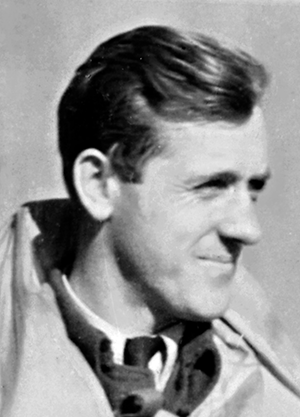
| Rank and unit | F/Lt, 313 Sqn |
| Role | Pilot |
| Died | † 17 May 1942, aged 29 |
| Buried / commemorated | Pihen-les-Guines Communal cemetery, France |
* 25.11.1912, Štikov.
† 17.05.1942, France.
The Early Years
Stanislav Fejfar was born on 25 November 1912 in the village of Štikov near Nová Paka, some 90 km northeast of Prague. As a child, he was raised by his stepfather Alois Junek, a widower, whom his mother Mária Fejfarová married whenher husband Josef Fejfar was killed in the First World War. The parents were financially secure, as they owned an inn, so they could provide young Stanislav with a better high school education.
Stanislav attended five years of primary school in his village, then four years of secondary school in Nová Paka, and then four years at the Higher Technical School at Pardubice, from where he matriculated with a diploma in engineering on 20 June 1932. At school, he was remembered as intelligent, independent-minded, and very determined. Having graduated, Stanislav, like many other young men of that time, was enchanted by aviation and aspired to join that elite group of men, and so in 1932, he volunteered to enlist in the Czechoslovak Air Force and train to become a pilot.
Czechoslovak Air Force
On 20 April 1932, he joined the cadet school at the Military Aviation Academy at Prostějov for his basic military training. On 1 October 1932, at the rank of vojín [AC1] Stanislav was assigned to the 1st ‘T. G. Masaryk’s’ Air Regiment, who were stationed at Kbely airbase, Prague. There, he was selected for pilot training and eight days later returned to the Military Aviation Academy at Prostějov to commence that training.


He graduated on 15 June 1933 and was posted to the 4th Air Regiment stationed at Hradec Králové airbase. On 1 September 1933, at the rank of četař [Sgt] he was assigned to the Military Aviation Academy at Hranice, where he strived to be the best trainee. He graduated on 1 July 1935 with a grade of very good, and finished ninth from the 27 graduates on that course. Amongst his fellow cadets there were future Battle of Britain pilots Jindřich Bartoš, František Fajtl, Josef Jaške, Miroslav Kredba and Karel Mrázek. Their instructor was Josef Duda who would also join with them in that Battle. Stanislav was promoted to the officer rank of poručík [P/O] and posted to the 6th Reconnaissance squadron, and later to the 61st Reconnaissance Squadron, of the 1st ‘T. G. Masaryk’ Air Regiment at Kbely airbase, Prague.

On 2 September 1935, he was sent for a training course back to Prostějov, from which he graduated on 21 December 21, 1935, with the grade of ‘very good’ finishing 5th from the 12 graduates of that course, and was now an operational fighter pilot. Between 1 July to 14 November 1937 Stanislav completed a night flying course at Piešťany airbase, Slovakia. He was then first posted to its 38th Fighter Squadron and then to its 37th Fighter Squadron. In 1938, he was appointed Commander of the Regiment’s 45th Fighter Squadron, who were deployed at Spišská Nová Ves airbase, Slovakia, and equipped with Avia B-534 biplane fighter aircraft, the most advanced fighter used at that time by the Czechoslovak Air Force.
Mobilisation

The threatening overtures by neighbouring Nazi Germany regarding the Sudeten regions – the German speaking areas – of Czechoslovakia caused the Czechoslovak Government to declare a mobilisation on 23 September 1938.
During this worrying period, Stanislav’s squadron was put on combat alert and integrated first with the 4th Army in southern Moravia and later with the 3rd Army in Slovakia.
Munich Dictat
Following the Munich Agreement, when the Sudetenland was ceded to Germany, Poland and Hungary also took some Czechoslovak territory. About 30% of Czechoslovakian territory had been lost, which included its border defences, and the new revised German border was now only some 30 km from Prague.
At the time of the signing of the Munich Agreement, Stanislav was with the 45th squadron at the Spišská Nová Ves airbase, Slovakia, where they remained until March 1939.
German Occupation

Despite assurances given by Hitler at the Munich Agreement, also known in Czechoslovakia as the ‘Munich Dictat’ or ‘Munich Betrayal’, of 30 September 1938, that he had no further interest in territorial gains for Germany, just a few months later Hitler extended his demands that the remaining regions of Czechoslovakia become part of Germany.
The Germans occupied Czechoslovakia on 15 March 1939. Under pressure, Emil Hácha, the Czechoslovak President, had acceded to their demands. In the early hours of 15 March 1939, he had ordered all Czechoslovak military units to stand down, remain in their barracks and not resist the occupation. By dawn that day, the Germans began their occupation of Czechoslovakia. Germanisation of Bohemia and Moravia began immediately: they were now the Reich Protectorate of Bohemia and Moravia (Protektorat Böhmen und Mähren), while Slovakia, in return for its allegiance to Nazi Germany, had become the puppet ‘independent’ state of Slovakia. As a Czech, Stanislav was returned to the German Protectorate.
Within a few days of their occupation, the Germans disbanded the Czechoslovak military and all personnel were dismissed. By the time of the Occupation Stanislav had achieved 580 flying hours and held the rank of poručík [P/O].

Resistance
Just four days later, on 19 March 1939, former Senior officers of the now-disbanded Czechoslovak military started to form an underground army, known as Obrana Národa [Defence of the Nation]., which worked in co-operation with Svaz Letců, the Airman Association of Czechoslovakia. One of their objectives was to assist as many airmen and soldiers as possible to get to neighbouring Poland, where Ludvík Svoboda, a former distinguished Czechoslovak Legionnaire from WW1, was planning the formation of Czechoslovak military units to fight for the liberation of their homeland. These two organisations provided money, a courier and other assistance to enable former military personnel to escape to Poland. For the former military personnel and many patriotic Czech citizens, this was a degrading period. Many sought to redress this shame and humiliation and wanted to fight for the liberation of their homeland. Within Czechoslovakia, former military personnel and civilian patriots covertly started to arrange for former Air Force and Army personnel to be smuggled over the border into Poland to join these newly-formed Czechoslovak units. Usually, this was by crossing the border from Czechoslovakia’s Ostrava region.
Like many of his fellow Czechoslovak airmen, Stanislav was bitterly disappointed, feeling that Czechoslovakia had been betrayed by its allies. He could not reconcile himself to the Munich surrender and subsequent occupation. Amongst the now demobilised former members of the Czechoslovak military, rumours were being heard that Czechoslovak military units were being formed in Poland for the purpose of fighting for the freedom of their homeland. He responded to this news and investigated further. He was put in contact with the Obrana Národa. Stanislav was one of the many Czechoslovak airmen and soldiers who saw it was their patriotic duty to voluntarily go to Poland, from where they could participate in efforts to achieve the liberation of Czechoslovakia.
At the time of the occupation, the Czechoslovak Air Force had around 2,500 to3,000 officers, NCOs and airmen (combat and ground). Between 1,200 and 1,500 Air Force personnel succeeded in escaping abroad in 1939–1940.
Stanislav sought out Ota Hrubý, his Air Force friend also from Nová Paka, asking if he was interested in escaping from the Protectorate of Bohemia and Moravia and going join the resistance In Poland. Otakar was and they made their preparations.
To Poland
With the help of those two organisations, on 1 June, 1939, Stanislav and Ota Hrubý, departed from Stará Paka railway station to Prague, where they met Josef Duda and Josef Hudec. That evening, they caught the overnight express train from Wilson railway station, Prague, to the mining town of Ostrava, on the eastern side of Czechoslovakia, near the Polish border. There they went to the Hotel Blanik, a pre-arranged venue to meet the local contact of the escape organisation. There they were joined by Josef Stransky, another Air Force pilot, where they nervously waited to hear about the next stage in their escape. Finally, at 5pm on 7 June, a member of the local escape committee arrived and declared that they are leaving the next morning. They were to buy a change of clothing and rucksacks so that they would look like tourists walking the countryside rather than four men, in suits, which would draw attention to themselves, with German border patrol, in the proximity of the border.
They changed their clothes, left their luggage at the hotel, and openly talked about the hike they would be doing that day so as to mislead any possible Gestapo informers. On leaving the hotel, they travelled to another part of Ostrava and stayed the night at the Hotel Atlantic.
The following morning, 8 June, they woke at 4 a.m., had breakfast, and went to the railway station at Ostrava Vítkovice where they waited to meet their contact with whom they would catch the train to Frýdek-Místek, a small town about 24 km south of Ostrava and near the new Polish border. Whilst waiting for their contact they had another breakfast in the station’s waiting room. The contact identified himself by displaying a blue handkerchief, the pre-arranged signal. The escape group reciprocated the signal by using their own distinct handkerchief. The contact, accompanied by a woman and another man boarded a carriage on the Frýdek train, while Stanislav’s group boarded another carriage.
At Frýdek-Místek, their contact with his two companions walked away from the railway station, with Stanislav and his companions following about 300 mtrs behind. They walked to the village of Dobra, about 6 km away; this route ran parallel to the border. At Dobra, a Gestapo informer was known to live, and it was important that they were not seen walking towards the Polish border. Once clear of the village, they changed direction and headed north to the village of Pazderna, about 5 km away, where in the Public House four German border guards were seen drinking beer.
Now having passed through the village they were back into forests and shortly after they came to a brook. This was now on the new border with Poland, since they had occupied the Český Těšín region following the Munich Agreement the previous year. They crossed the brook and were now in Poland. It was now 09:55. With brief goodbyes, the contact and the woman, who was his wife, returned back into Czechoslovakia having successfully guided another group of escaping Czechoslovak military to Poland.
Stanislav and his group carried on walking through the forest until they reached a bus stop, where they waited for a bus to take them to Český Těšín, 23 km away. There they boarded a bus that took them to Těšín, where they had lunch at the railway station whilst waiting for the train to Kraków. On arrival in Krakow, they reported for Duty at the Czechoslovak Consulate.

Polish Disappointment
However, there they were informed that the formation of Czechoslovak military units in Poland was just a rumour because the Polish authorities would not allow Czechoslovak military units to be formed on its territory for fear of provoking Nazi Germany.
Instead, they learnt that Vladimír Znojemský, the Czechoslovak Consul, had, via Štefan Osuský, the Czechoslovak Ambassador in Paris, negotiated with the French Government that the escaped Czechoslovak military would be permitted to travel to France. But there was a condition: as French Law did not permit foreign military personnel on its territory during peacetime, the Czechoslovaks would be required to enlist in the French Foreign Legion for a period of five years – but with the assurance that in the event of war being declared, the Czechoslovaks would be released from the Legion and transferred into French military units. The alternative was that they would be sent back to the German Protectorate of Czechoslovakia, where their execution or deportation to a concentration camp would be the most likely outcome. Ota and his colleagues decided that their best choice was to go to France.
Initially they were accommodated at the ‘Dom Turystczny’, a cheap tourist hostel near the Czechoslovak Consulate, whilst preparations were made for their onwards journey to France. Then, on 8 June, they relocated to Bronowice Małe, a former Polish Army barracks on the outskirts of Kraków, which was now utilised as a temporary transit camp where the escaped Czechoslovak military were billeted. Stanislav was the 255th Czechoslovak escapee to arrive there. In the meantime, there was very little for the escapees to do there apart from being patient, keeping fit, exercising, and occasionally playing football against local Polish teams.

To France
With other Czechoslovak military colleagues, early morning on 17 June 1939, Stanislav and 138 other escapees left Małe Bronowice by train for the Polish Baltic port of Gdynia, arriving there at 09:15 where they boarded the ‘SS Sobieski’, a Polish passenger ship which departed at 15:15 and sailed to Boulogne in France via Dover, England. At Dover, the Czechoslovak military were not permitted to disembark. They arrived at Boulogne on the afternoon of 20 June. The sea had been rough with many of the airmen suffering from seasickness on the voyage.
France
The Czechoslovak escapees were met at Boulogne by kapitán Jan Pernikář, the Air Attaché from the Czechoslovak Consulate, Paris. Each escapee was given 20 francs to cover their immediate needs, and after two days there, they travelled by train to Gare du Nord railway station in Paris, where they were met by Štefan Osuský, the Czechoslovak Ambassador. From there they went by military truck to Place Balard, the Legion’s recruitment centre. Here, medical examinations were undertaken and documentation prepared for their enlistment. While there, they were required to attend French classes, and so any free time was usually spent in Paris exploring the sights and practising their newly-learnt French with the girls they met.
French Foreign Legion
On 7 August, Stanislav, departed with fellow Czechoslovaks from their billet in Paris and were taken to the Gare de Lyon railway station where they boarded a train to Marseilles on the French Mediterranean coast and from where they marched some 2.5km to Fort St Jean, the Legion’s transit depot.
On 28 August, they boarded the ‘General Tirman’, a transport ship which sailed to Oran on the Mediterranean coast of Algeria. From there, they travelled on to the Legion’s training base at Sidi-bel-Abbès, some 35 miles south of Oran. Here, Stanislav was assigned to the 1st Battalion of the Legion’s 1st Regiment with the rank of sergent [Sgt].

The climate in Algeria and the Legion’s harsh training conditions were both physically and mentally demanding on them and the Czechoslovaks all looked forward for news of war being declared so that they would be released from the their Legion contract.
l’Armée de l’Air

When Germany invaded Poland on 1 September 1939, Stanislav was with the Legion, still at Sidi Bel Abbés. Two days later Britain and France declared war on Germany resulting in the Czechoslovaks serving in the Legion, being released from their Legion contract and transferred to French military units.
Stanislav was transferred to the l’Armée de l’Air and posted to their North African airbase of Centre d’Instruction de Chasse at La Senia airbase at Oran, Algeria, for training on MS-406 aircraft. On completion of his re-training, he was awarded his l’Armée de l’Air pilots wings and posted to GC I/6 as an operational pilot on 13 December 1939. They were stationed at La Senia airbase and equipped with MS-406C aircraft. Fellow Czechoslovaks also posted with him to GC I/6 that day were František Bíeberle, Svatopluk Janouch, Václav Jícha, Jiří Kučera and Stanislav Popelka.
Two days later GC I/6 redeployed to mainland France and were stationed at Mérignac airbase at Marseille until 8 March 1940 when they redeployed east to Chissey airbase near Dijon.
Battle of France
The relative calm of the Phoney War ended at 05:35 on 10 May 1940 when ‘Fall Gelb’ – the German attack on Holland, Belgium, Luxembourg and France – took place. In France they came through the dense Ardennes Forest to skirt around the main defence of the Maginot line and swept Northwards towards the English Channel. The Battle of France had begun.
Not surprisingly, the lightning speed and ferocity of the German Blitzkrieg attack caused the l’Armée de l’Air units to rapidly retreat westwards. By 19 June GC I/6 were now at Bergerac in south-west France, their 7th deployment westward since the beginning of May!
During the Battle of France Stanislav achieved combat success:| Date | Time | Action |
20.05.40 | 07:30 | a Me 109 shot down near Amiens. |
25.05.40 | 18:20 | a He 111 probable near Arleux |
05.06.40 | 11:00 | a Hs 123 shot down near Chaulnes. |
Stanislav had flown 96.30 operational hours during this Battle.
Evacuation from France
With the French capitulation imminent, Winston Churchill, the British Prime Minister, appealed to all the Czechoslovak airmen in the l’Armée de l’Air to come to Britain and continue the fight from there. The Allies were making every effort to evacuate Allied military personnel from the west coast of France and, for those in North Africa, from Casablanca on the Atlantic coast of Morocco.
The Czechoslovaks with GC I/6 were released from l’Armée de l’Air service and they travelled to Port Vendrés, about 30km away on the Mediterranean coast. France capitulated to Germany on 22 June 1940, when an armistice was signed in the Compiègne Forest, in the same railway carriage that Germany had surrendered to France in November 1918. The armistice to come into effect on 25 June. At Port Vendrés, the Czechoslovaks and other evacuating military personnel, boarded ‘Général Chanzy’ which sailed to Oran, Algeria, on 24 June.
Evacuation to England
From Oran, Stanislav, along with other Czechoslovak airmen, departed on a four-day train journey around the Sahara Desert, to Casablanca, Morocco, and there, after a five-day wait, they were able to board the ship ‘Gib-el-Dersa’ which sailed, at 15:12 on 29 June 1940, to Gibraltar, arriving at 11:00 on 30 June.

Here they changed ships to the ’Neuralia’, a former hospital ship converted into a troop transport, and sailed, on 2 July, in a convoy of about another 30 ships, deep into the Atlantic, to avoid any attacks by Luftwaffe aircraft based on the west coast of France. They arrived at Liverpool on 12 July 1940.
RAF
On arrival in Liverpool, Stanislav’s first path, as for most of the Czechoslovak escapees, led to the Czechoslovak resettlement camp atCholmondeley Park, near Chester. At Liverpool, they boarded a train to Nantwich, Cheshire, some 30 miles away, and from there marched to Cholmondeley Castle, 8 miles away. There they were accommodated in the grounds in a tented camp where they were security vetted.
The Battle of Britain was now in progress, and the RAF urgently needed trained pilots, and the Czechoslovaks – many of whom had already seen combat in France – were particularly valued. As a trained pilot Stanislav was quickly transferred to the Czechoslovak RAF Depot, Cosford, where, on 1 August 1940, he was admitted to the Volunteer Reserve of the RAF, swore his oath of allegiance to King George VI, and was awarded the rank of P/O. There, as when joining l’Armée de l’Air the previous year in France, the Czechoslovak airmen were given theoretical aviation training and language lessons, this time for British aircraft, and the language was English.
To 310 Sqn
On 6 August 1940 Stanislav was posted to the newly-formed 310 (Czechoslovak) Sqn who were deployed at RAF Duxford near Cambridge. They were equipped with Hawker Hurricane Mk I aircraft and commanded jointly by S/Ldr Alexander Hess, the first Czechoslovak to command an RAF squadron, and S/Ldr George D.M Blackwood.
The priority was to undertake a crash course in rudimentary English, learning RAF radio codes in the Officers’ Mess and immediately, hasty re-training on Hawker Hurricane Mk I fighter aircraft.
There, F/O Ladislav Češek, a Briton of Czechoslovak origin, was engaged as an interpreter to assist in overcoming the language barrier and Mr Louis de Glehn was brought in to give English lessons, three times a week, to the Czechoslovak pilots. For these pilots it was reminiscent of only a few months earlier when they were in France and had joined l’Armée de l’Air, converted to French aircraft and had learnt French before they could become operational pilots in that Air Force. For Stanislav, this was now the 2nd Air Force he had served in since leaving Czechoslovakia just 14 months before!
By 17 August, 16 of the pilots had completed their re-training, enabling ‘A’ and ‘B’ Flights to be assembled and the squadron was declared operational and made its first patrol in the Battle of Britain at 14:10 on 18 August.
6 OTU
However, by this date, Stanislav and 18 other pilots had not yet reached the required standard, and with all of the squadron’s Hurricanes needed to participate in the Battle of Britain, there were no spare aircraft for further retraining to continue. Instead, these reserve pilots were posted to 6 OTU [Operational Training Unit] at RAF Sutton Bridge for their retraining to continue to RAF standard. Firstly, on the slow and forgiving Tiger Moth, a dual-seater biplane, then graduating to the dual-seater Miles Magister monoplane, and then the more powerful dual-seater Harvard monoplane. When, in his instructor’s opinion, the required standard had been achieved, Stanislav progressed to flying solo on Hawker Hurricane fighter aircraft, but not without incident: on 3 September 1940, shortly after taking off on a training flight in Hurricane L1924 from RAF Sutton Bridge, the aircraft suffered a propellor failure. Stanislav had to make an emergency landing in a field a short distance from the airfield but was unhurt in the incident. A few days later, he completed he completed the conversion course and was awarded his RAF pilot’s wings.
Battle of Britain
Stanislav returned to 310 Sqn on 7 September 1940 and participated in the Battle of Britain. He made his first operational flight in the Battle of Britian two days later with an uneventful patrol, taking-off at 17:05 in Hurricane P3143 and returning at 19:10, thus qualifying him for the coveted Battle of Britain clasp.
| Date | Time | Action |
09.09.40 | 17:40 | Me 110 shot down near Croydon, in Hurricane V6608 ‘B’. |
15.09.40 | 14:40 | a Do 17 near London, in Hurricane V6608 ‘B’. |
18.09.40 | 17:15 | a Do 17 (shared) near London in Hurricane V6579 ‘J’. |
By 31 October 1940 when the Battle had finished, he had made a total of 18 operational flights, totalling 18 hours 44 min, during which he achieved combat success:

Hospitalised
On 1 November 1940, Stanislav was suffering from acute inflammation of his frontal sinuses, causing severe headaches. His health condition was so serious that he was initially taken to Ely Hospital for treatment. At the beginning of December he was transferred to a Hospital at Littleport, Suffolk, run by the Canadian Red Cross where his condition was operated on. On 22 December he was then transferred to a convalescent Home at Torquay, Devon, where he stayed until 24 February 1941. Stanislav then returned back to 310 Sqn at RAF Duxford, but for non-flying duties.
Czechoslovak Inspectorate General

On 1 April 1941, Stanislav was posted to the Inspectorate of the Czechoslovak Air Force in London. There he had a deskbound liaison and administrative role until the RAF Doctor passed him medically fit to return to operational flying. It was a fraught time to be stationed in London as the capital was experiencing nightly bombing by the Luftwaffe during this period, known as The Blitz. In May he was promoted to the rank of F/O and two months later to the rank of F/Lt. Finally, in July, he was medically cleared to return to operational flying duties!
313 Sqn
On 21 July, he was posted to the newly formed 313 (Czechoslovak) Sqn based at RAF Leconfield, 13 Group RAF Fighter Command, and equipped with Supermarine Spitfire Vb aircraft. There, he was appointed ‘B’ Flight Commander. On 26 August 1941, the squadron moved south to 10 Group RAF Fighter Command and were deployed at RAF Portreath, Cornwall, then on 23 November to RAF Warmwell, Devon. Then to 11 RAF Fighter Command on 15 December 1941 being deployed at RAF Hornchurch, Essex. The squadron’s role was offensive sorties and bomber escort duties over northern France and the Channel coast, while still maintaining local defensive duties.
During this period, Stanislav achieved further combat success:
| Date | Time | Action |
27.02.42 | >a Fw 190 damaged in Spitfire Vb. |
|
12.03.42 | a Me 109 damaged in Spitfire BL973 ‘S’. |
|
25.04.42 | 16:40 | a Fw 109 damaged near Berck, France in Spitfire BL973. |
05.05.40 | 15:35 | a Fw 190 shot down near Lille, France in Spitfire BL9736. |
05.05.40 | 15:35 | a Fw 190 probable near Lille, France in Spitfire BL973. |

On 5 May 1942, 12 Spitfires from 313 Sqn took off from RAF Fairlop at 14:40. Stanislav was flying Spitfire Vb BL973. That day, the Hornchurch Wing – 64, 122 & 313 sqns were tasked to provide fighter escort for Circus 157, a raid on the Sequedin power station, at Lille, Northern France, by 6 Douglas Boston twin-engined light bombers from 242 Sqn. Since Spring 1941, ‘Circus’ was a code name used by the RAF for an operational tactic, in which each day a small group of RAF bombers was sent out on vital bombing missions in France. The bombers were accompanied by large numbers of fighter planes for protection as well as potential engagement with the fighter planes of the German Luftwaffe. Over Clacton, Essex they rendezvoused, at 10,000 feet, with the Bostons, from North Weald and Debden Wings and crossed the French coast 5 miles East of Dunkirk and proceeded to target, at 25,000 feet. On their return, over the Belgian Heuvelland region near Kemmelberg, the Spitfires of 122 and 313 Squadrons were ambushed, at 15:35, by 21 Luftwaffe Fw 190 fighters, from I/ JG 26 prompting fierce aerial combat.
Stanislav’s combat report for his successes of 5 May 1942 reads:
I was Red 1. After crossing Lille, I saw 9 Fw 109s pass the squadron on my right at 24,000 feet. The e/a then turned and came from behind. I immediately warned the Wing Commander and gave the order to break formation. In this manner, I turned to the sun and saw 6 Fw 190s on my left, followed by two lots of 4 Fw 190s. I went into attack two of the 6 e/s and opened fire, 4/5 secs burst from port quarter at an opening range of 200 yards and a closing range of 100 yards. Immediately after this burst, the pilot from one of the Fw 190s bailed out. I saw him jump, but did not actually see his parachute open. I then went into a spin losing 4,000 feet in height, and after coming out of the spin climbed again and saw a pair of 2 Fw 190’s on my left about to attack 3 Spitfires. I went into attack and opened fire at one of the e/s from port quarter at an opening range of 300 yards and a closing range of 200 yards, expending all my ammunition. Before I could observe the result of this attack, I saw in my mirror a Fw190 very closely behind me, and in taking evasive action, went into a further spin. As I pulled out of the spin, a Fw 190 passed me on its back and with half of its wing missing. As I did not see a Spitfire at this time, and as the e/a passed me, it spun immediately after my attack. I claim this as probably destroyed apart from the e/a, probably destroyed in similar circumstances by P/O Kucera. I crossed the French coast west of Dunkirk and asked for homing, being short of petrol. I landed at the forward base at 16:25 hours. I claim 1 Fw 190 destroyed and 1 Fw 190 probably destroyed.
313 Sqn landed back at RAF Fairlop at 16:05. Whilst the squadron had had a successful day, they had lost Sgt Karel Pavík and Sgt Jiří Kučera was slightly injured.

Unfortunately, Stanislav began to again suffer from headaches as a result of the sinus inflammation the previous year, and to his disappointment, was taken off flying duties from 20 March 1942 and placed on sick leave. He returned to flying duties on 13 April 1942.
Fateful Flight

At an altitude of 24,000 feet, they crossed the French coast heading south towards St Omer, from where they turned north heading for Boulogne. North Weald Wing was already in combat with the Luftwaffe’s Fw190 fighters. The bombing raid was completed successfully, and the Allied formation was heading back to England when, uncharacteristically, Stanislav, a strictly disciplined Commander who would not tolerate individual actions from the pilots under his command, broke away, followed by his wingman, Sgt Miroslav Borokovec, flying Spitfire BM306 diving down to attack some 15 Fw 190’s from III/ JG 26, one of the Luftwaffe’s premier fighter wings.
S/Ldr Karel Mrázek, a close friend of Stanislav, believed that he was seeking revenge for the loss of S/Ldr Frantisek Fajtl, his close friend of many years, who had been shot down over France a few days earlier. Neither Stanislav nor Sgt Borokovec returned. Stanislav’s Spitfire was shot down at 11:33 by Fw 190s from JG-III 26 flown by German ace Hauptmann Josef Priller, as his 72nd victim and crashed between Guines and Audembert, France. Priller’s combat report for this action reads:
At 11:17, on 17 May 1942, I took off with my Gruppe against the approaching English Air Force. At about 11:33 I climbed to 5,000 metres and found myself behind a pair of Spitfires. I fired at the rear of the leading one from a distance of 50 – 20 metres, after which a large piece flew off the Spitfire. The Spitfire burst into flames, rolled over on its back and plummeted straight down. I dived after it through the clouds and saw it break up on the ground. The crash site is somewhere between Guiness and Audembert.
Sgt Borokovec was shot down at 11:43, into the English Channel, some 10 miles north-west of Calais.

F/Lt Stansilav Fejfar was buried at row C, grave 8 at the Pihen-les-Guiness Communal cemetery near Calais, France. He was 29 years old.
The remains of Sgt Miroslav Borokovec were not found and he is commemorated on panel 78 at the Air Forces Memorial at Runnymede. He was 25 years old.
Medals Awarded
1939 – 45 Star with Battle of Britain clasp
Air Crew Europe Star
Defence Medal
1939-1945 War Medal
Válečný kříž 1939 and bar
Za chrabrost and bar
Za zásluhy I.stupně
Pamětní medaile se štítky F–VB
Croix de Guerre avec 3 palmes et etoile vermeil
Remembered
Great Britain:
Capel-le-Ferne:
He is commemorated, along with the other 2940 Battle of Britain aircrew, on the Christopher Foxley-Norris Memorial Wall at the National Battle of Britain Memorial at Capel-le-Ferne, Kent:

Hawkinge:
Stanislav is remembered on the Czechoslovak Battle of Britain pilots memorial at the Kent Battle of Britain Museum at Hawkinge, Kent. It was unveiled on 28 October 2025, to commemorate the 88 Czechoslovaks who flew in that battle.

Fairlop:
Stanislav is commemorated on a memeorial panel, along with other Allied airmen, who were killed whilst stationed at RAF Fairlop, Ilford, Essex.
London – Battle of Britain Memorial:
He is also commemorated on the London Battle of Britain Memorial:
London – St Clement Danes:
He is remembered in the Remembrance books at St Clements Danes Church, London.
London – West Hampstead:
He is remembered on the Memorial Plaque at Bohemia House, formerly the Czech Club, London.

Czech Republic:
Nová Paka:
He his symbolically remembered on the family grave at the Kumburská cemetery, Nová Paka.

Nová Paka:
In September 2020, a memorial plaque for him and fellow RAF Czechoslovaks Stanislav Fejfar and Adolf Vrána from Nová Paka at Jirový park.

Nová Paka:
Stanislav is commemorated on the Victims of WW2 mmeorial at at Jirový park.

Prague 1 – St Vitus Cathedral:
He is remembered in the Remembrance book at St Vitus Cathedral, Hradčany, Prague.
Prague 1 – Klárov:
In November 2017, his name, along with the names of 2533 other Czechoslovak men and women who had served in the RAF during WW2, was unveiled at the Winged Lion Monument at Klárov, Prague 1.

Prague 3 – The Army Museum:
He is remembered on the Memorial Plaque at the Vojenský Ústřední Archiv, Prague 3.

Prague 6 – Dejvice:
He is named on the Memorial for the fallen Czechoslovak airmen of 1939-1945, at Dejvice, Prague 6.

Prague 9 – Černý Most:
A a street in the Černý Most suburb of Prague 9, which has streets named after numerous WW2 Czechoslovak airmen who served in the l’Armée d’Air or the RAF, a street was named “Fejarova” in his honour.

Prostějov”
Stanislav is commemorated on the RAF Airmen’s Memorial at Prostějov cememtery.

Article last updated: 30.10.2025.
Discover more from Free Czechoslovak Air Force Associates ltd
Subscribe to get the latest posts sent to your email.
Widgets
