
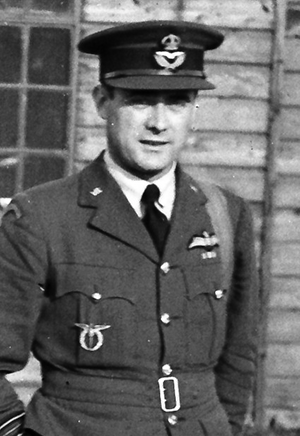
* 03.08.1905, Beroun.
† 18.09.1979, Hendon, UK.
Pre WW2
František Kordula was born on 3 August 1905 at Beroun, a small town in the Central Bohemian Region of Czechoslovakia, some 20 miles south-west of Prague. He graduated from High School on 24 June 1924.
For his mandatory military service, that August he was called up and joined the 18th Infantry Regiment. He was then transferred to the Military Academy at Hranice from where he graduated, on 15 August 1926. František was then posted to the 33rd Infantry Regiment at Falknov. That November he was posted to the 8th Battery of the 11 Artillery Regiment who were stationed at Košice, Slovakia. On 15 August 1928 he was posted to the 101st Artillery Regiment stationed in Prague.
František then transferred to the fledgling Czechoslovak Air Force and between 1928 to 1930 attended the Military Aviation Academy at Prostějov for training as an aerial observer. On graduating from the course, he was posted, as an operational observer to the 3rd Squadron of the 1st ‘T.G. Masaryk’ Air Regiment, who were deployed at Prague-Kbely airbase.
In the Autumn of 1932 he attended a meteorological course and on graduation, was posted on 1 March 1933 to the Technical Squadron at Prague where he held the position as its Commanding Officer. On 1 April 1934 he returned to Prostejov for pilot training. On graduation he joined the 43rd Squadron of the 4th Air Regiment deployed at Prague-Kbely airbase, and was appointed Commanding Officer of its meteorological section. In January 1935 was appointed Adjutant to the 3rd Squadron of the 1st ‘T.G. Masaryk’ Air Regiment. That October he was promoted to the rank of kapitan and the following year posted for Staff Officer training. On completion of that training, František returned back to 1st ‘T.G. Masaryk’ Air Regiment and was appointed its Adjutant. In December 1937, he was appointed Commanding Officer of the 4th Air Regiment who were also deployed at Prague-Kbely airbase.
Munich Dictat
Following the Munich Agreement, when the Sudetenland was ceded to Germany, Poland and Hungary also took some Czechoslovak territory. About 30% of Czechoslovakian territory had been lost, which included its border defences, and the new revised German border was now only some 30 km from Prague.
Despite assurances given by Hitler at the Munich Agreement, also known in Czechoslovakia as the ‘Munich Dictat’ or ‘Munich Betrayal’, of 30 September 1938, that he had no further interest in territorial gains for Germany, just a few months later Hitler extended his demands that the remaining regions of Czechoslovakia become part of Germany.
German Occupation

The Germans occupied Czechoslovakia on 15 March 1939. Under pressure, Emil Hácha, the Czechoslovak President, had acceded to their demands. In the early hours of 15 March 1939, he had ordered all Czechoslovak military units to stand down, remain in their barracks and not resist the occupation. By dawn that day, the Germans began their occupation of Czechoslovakia. Germanisation of Bohemia and Moravia began immediately; they were now the Reich Protectorate of Bohemia and Moravia (Protektorat Böhmen und Mähren), while Slovakia, in return for its allegiance to Nazi Germany, had become the ‘puppet’ independent state of Slovakia. Within a few days of their occupation, the Germans disbanded the Czechoslovak military and all personnel were dismissed.
Resistance
In addition to his native Czech, František was conversant in German, French and, English which enabled him to find employment in civvie street as a clerk at Zemského finančního ředitelství in Prague.
But like many of his Air Force colleagues he was bitter that they had been ordered by the Czechoslovak President Emil Hácha not to oppose the German occupation. Many of his Air Force colleagues, with the assistance of Obrana Národa (Defence of the Nation), a Czechoslovak military anti-Nazi resistance organisation and Svaz Letců, the Airman Association of the Czechoslovak Republic, escaped to Poland where they had been told Czechoslovak military units were being formed to fight for the liberation of their homeland. However, after Poland was invaded by Germany on 1 September 1939, escaping Czechoslovaks had to use the ‘Balkan Route’ instead.
The Balkan Route
On 5 January 1940, František escaped from Czechoslovakia, over the border into Slovakia, then onto Hungary and reached the French Consulate in Budapest. From there, with their assistance and with other Czechoslovak escapees, František crossed into Yugoslavia and reached Belgrade, where, at the Czechoslovak Consulate, they met more escapees. Next, they went by ship to Greece and then to Turkey and Beirut. There, on 24 February 1940, they boarded the French ship SS ‘Providence’ and sailed around the southern Mediterranean Sea to avoid air attacks from the Regia Aeronautica (the Italian Airforce). They went via Alexandria, Egypt, and Algiers, Algeria, arriving at Marseille, France, on 3 March.
France

František, with fellow Czechoslovak’s including airmen Miloslav Cígler, Jiří Macháček and František Weber, was taken to the Czechoslovak military transit camp at Agde, about 220 km West of Marseille, where they reported for duty on 6 March 1940.
There he was assigned to the Airman’s Group and accepted into l’Armée de l’Air. On 1 April he was assigned to the Czechoslovak Reserve Corps and posted as Liaison Officer with the Czechoslovak Military Administration at the Czechoslovak government-in-exile in Paris.

The relative calm of the Phoney War ended at 05:35 on 10 May 1940 when Germany attacked Holland, Belgium, Luxembourg and France. In France they came through the dense Ardennes Forest to skirt around the main defence of the Maginot line and swept Northwards towards the English Channel. The Battle of France had begun. However, the lightning speed and ferocity of the German Blitzkrieg attack caused the l’Armée de l’Air units to rapidly retreat westwards. In between 28 May and 4 June, some 338,000 personnel from the British Expeditionary Force as well as French and Belgium military had been evacuated from Dunkirk – Operation Dynamo. The Allies realised that the war on mainland France was lost and the priority now was evacuation.
Operation Aerial
Since 15 June, Operation Aerial, the evacuation of Allied military forces and civilians from ports in Western France had been in operation. With the French capitulation imminent, the Czechoslovak military in France were in danger of being interned by the Vichy regime or captured by the Germans. Winston Churchill, the newly appointed British Prime Minister (since May 1940), recognised the importance of experienced Czechoslovak airmen for the upcoming defence of Britain. He appealed to all the evacuated Czechoslovak airmen to come to Britain and continue the fight from there. The l’Armée de l’Air released the Czechoslovak airmen from their service so that they could make their journey to Britain via one of the evacuation ports, on mainland France or North Africa. For those in western France, they were instructed to get to the port at Bordeaux, on the Atlantic coast, before the Germans reached there, so that they could be evacuated to England from where they could carry on the fight against Nazi Germany. František was one of the airmen who made his way to Bordeaux.
At Bordeaux, the Czechoslovak airmen, were under the command of Staff Capitan Josef Schejbal, and with Poles and other nationalities boarded the ship ‘Karanan’, a small 395 tonne Dutch cargo ship, for evacuation by ship to Britain before the advancing German army reached the port. The ‘Karanan’ sailed on 19 June down the Gironde estuary to the Atlantic. The Luftwaffe attacked Bordeaux that night emphasising the importance of leaving swiftly. The route took them far out into the Atlantic, to avoid U-Boats and Luftwaffe attacks from German occupied Northern France. They then changed course East to Falmouth, Great Britain. They arrived on 21 June, the day before France capitulated.

RAF
On arriving at Falmouth, the Czechoslovak airmen were given a clean-up, a meal, a change of clothing, 5 shillings back pay and taken to Falmouth railway station for onward travel to RAF Innsworth, Gloucestershire, for security vetting and medical checks. Once that was completed, their next move was to the Czechoslovak resettlement camp at Cholmondeley Park, near Chester. Here they were billeted in the tented camp in the castle grounds.

The Battle of Britain was now in progress and the RAF urgently needed trained pilots, and the Czechoslovaks—many of whom had already seen combat in France—were particularly valued. Despite his mature age of nearly 35 for a fighter pilot, as a trained pilot, on 12 July, František swore his oath of allegiance to King George VI and was accepted into the RAF Volunteer Reserve, at the rank of P/O. He was quickly transferred to the Czechoslovak RAF Depot, Cosford, for elementary RAF training and also, importantly, English language classes. With some basic English , he was posted on 27 July 1940 to the newly formed 310 (Czechoslovak) Sqn deployed at RAF Duxford and equipped with Hurricane Mk I aircraft. Thus, he became one of the squadron’s founding members and was assigned to the squadron’s reserve of pilots for re-training onto Hurricanes.

6 OTU
With 310 Sqn becoming operational on 17 August 1940, it was no longer possible for re-training to be undertaken within the squadron due to shortages of aircraft and instructors. The reserve-pool pilots of 19 Czechoslovak pilots, including František, were posted to 6 OTU at RAF Sutton Bridge, on 17 August to continue their re-training. There, František progressed to flying solo on a Hawker Hurricane fighter aircraft and, having completed the re-training course, was awarded his RAF pilot’s wings.
Battle of Britain
František completed his training on 11 September and with fellow Czechoslovak P/O František Fajtl, was posted to 1 Sqn at RAF Wittering, near Peterborough, Cambridgeshire. There he made his first operational flight in the Battle of Britian with an uneventful patrol, taking-off at 15:30 in Hurricane V7256 and returning at 16:30, thus qualifying him for the coveted Battle of Britain clasp.
František remained with 1 Sqn, making two further operational flights until 25 September when he and P/O František Fajtl were posted to 17 Sqn at RAF Debden, near Saffron Walden, Essex which was in RAF 11 Group.
After the Battle
With 17 Sqn he achieved combat success:
| Date | Time | Hurricane | Action |
05.11.40 | V7570 | a Do 17z confirmed kill north of Bury St Edmunds. |
|
17.11.40 | 09:15 | P3023 | a Me 110c confirmed shared kill near Ipswich |
17.11.40 | 09:15 | P3023 | a Me 110c shared damaged near Ipswich |

On 17 November, five Hurricanes of 17 Sqn’s B Flight, took off at 09:15 from Martlesham Heath with 257 Sqn for a convoy patrol and were vectored to intercept an enemy raid. František was flying Hurricane P3023. As they were approaching Ipswich, they sighted about 40 enemy aircraft consisting of two formations of bombers with Me 109’s above and behind flying at between 7,000 and 10,000 feet. The enemy aircraft were believed to have been about to attack Wattisham airfield when intercepted. The Squadron attacked the second formation which were Me 110’s of which they destroyed three and damaged two.
František’s combat report of that combat reads:
I was weaving behind the Squadron with Green 3 when we turned and attacked the Me 109’s. I dived to attack the leading section, and attacked No 2 from abeam with a 3 second burst at 200 yds range. Three sector broke outwards, and I attacked No 1 from abeam at 150 yds. I broke away and found myself in cloud. On coming out, I saw another Me 110 200 yds ahead of me flying north and chasing him in and out of cloud for 7 or 8 minutes and fired 4 short bursts at him. I saw black smoke from his starboard engine, and left him less than 2000 ft crossing the coast near Southwold. Having finished my ammunition, I returned to base.
The five 17 Sqn Hurricanes landed back at Martlesham Heath at 09:40.
František remained with 17 Sqn until 22 April 1941 when he was posted to the pilot training section at HQ SFS Ferry [Service Ferry Squadron] at RAF Kemble, some 80 miles west of London, for his rest period from operational flying. The squadron was in RAF Ferry Command and their role was ferrying of new aircraft from the factory to operational squadrons in the UK.
František returned to 17 Sqn on 25 May 1941, who were now deployed at RAF Castletown in northern Scotland, where the sqn had moved for a rest from frontline operational duties. On 5th June, now at the rank of F/Lt, his operational flying service ended and he was posted to the Czechoslovak Depot at St Athan, South Wales, for ground duties.
Czechoslovak Inspectorate General
On 22 June, he was assigned to the Czechoslovak Inspectorate General [CIG] in London. There he had a non-operational role as a Liaison Officer. On 23 December 1941 he was promoted to the rank of Acting S/Ldr and on 23 March 1942 to the rank of Acting Wing Commander. Later was appointed Head of its 2nd Department, where he worked as Chairman of the Commission for Intelligence. There they undertook the debriefing of airmen who returned from German captivity to England in 1945. He remained with the Inspectorate until the end of the war.

Return to Czechoslovakia
Whilst in the RAF he was also concurrently serving in the Czechoslovak Air Force and by the end of the war held their senior rank of podplukovník [W/Cmdr]. He resigned his RAF commission and returned back to Czechoslovakia where he was a Staff Officer at the Defence Ministry at Prague.
In April 1946 he was promoted to the rank of plukovník [G/Cpt] and that August was appointed Commander of the 4th Department of the Air Force Command at the Defence Ministry. The following June he was appointed head of the Air Study Group at the Air Force Command, Prague.
Communist putsch
In the aftermath of the Communist putsch of Feb ’48, the Czechoslovak airmen and soldiers who had fought in the West were now regarded by the Communist authorities as being politically unreliable and undesirable citizens. Many were arrested, imprisoned and subjected to other persecution.
The Communists commenced purging them from the military services and also Czechoslovak Airlines [ČSA]. Usually, this would entail being placed on ‘waiting leave’ followed by arrest, interrogation, and detention by the Státní bezpečnost [StB], the Czechoslovak Secret Police. This invariably led to a ‘trial’ – a formality as the outcome had already been decided – and imprisonment for several years at a hard labour camp with further persecution to their families. Thus, many former RAF airmen made the choice of escaping again to the West rather than be persecuted by their Communist countrymen.
In František’s case this began on 15 March 1948 when he was transferred from his Staff Officer position in Prague to Commanding Officer of JNP at Vysoke Myto airbase, about 70 miles East of Prague. On 12 April he was placed on dovolenou s čekaným – ‘waiting leave’ – from the Air Force but with the former airmen receiving only a small fraction of their pay. This move was designed to prevent the airman from having contact with his workplace colleagues and gave the Air Force time to decide or be instructed on how to deal with this undesirable airman who was not compatible with Communist ideology.
2nd Exile
In May, Rose, his wife whom he had married in England in 1942 and their two British born children, were repatriated with the aid of the British Embassy, Prague, along with other British wives who had married Czechoslovak RAF airmen, back to the UK.
On 2 August 1948, along with former RAF airman F/Lt Václav Zima, František escaped on foot over the border into the American Zone of Germany. After security vetting by the American authorities, he was transferred to a Displaced Persons Camp in Germany whilst he considered his future life in the West. For František, this was returning to England, to be with his wife and children and where he hoped to re-join the RAF,
Since Spring 1948, the RAF had become aware of the plight of former Czechoslovak RAF airmen, and their families, who were now destitute and living in appalling conditions in those Displaced Persons Camps, and were hoping to re-join the RAF. However, regardless of the airmen’s previous RAF rank, they now were only offered the rank of AC2 whilst the RAF established what roles these escapees could undertake in the post WW2 RAF Service. They were transferred to No 2 RAF Cardington, Recruitment Unit near Bedford. Whilst there, usually for between two to four months, while the RAF were ascertaining their future roles in the RAF, the men, many of whom had been awarded DSOs or DFCs for their wartime service, were kept fully employed. They were required to undertake general service training, including taking instruction on service subjects, physical education, English lessons, but also to undertake menial tasks like sweeping floors, scrubbing tables, dishing up food and cleaning toilets at weekends for new recruits when civilian staff where not available.
František was accepted back into the RAF on 3 September 1949, at the rank of AC2 and posted to No 2 RAF Cardington Recruitment Unit. Currently little is known about his subsequent life.
On 18 September 1979, František Kordula died aged 74, at Hendon, Middlesex, UK.
Medals Awarded
1939 – 45 Star with Battle of Britain clasp
Defence Medal 1939 – 1945
War Medal 1939 – 1945
Válečný kříž 1939
Za chrabrost
Za zásluhy I.stupně
Pamětní medaile se štítky F–VB
Remembered
Great Britain:
Capel-le-Ferne:
He is commemorated, along with the other 2940 Battle of Britain aircrew, on the Christopher Foxley-Norris Memorial Wall at the National Battle of Britain Memorial at Capel-le-Ferne, Kent:

Hawkinge:
František is remembered on the Czechoslovak Battle of Britain pilots memorial at the Kent Battle of Britain Museum at Hawkinge, Kent. It was unveiled on 28 October 2025, to commemorate the 88 Czechoslovaks who flew in that battle.

London – Battle of Britain Memorial:
He is also commemorated on the London Battle of Britain Memorial:
Czech Republic:
Prague 1 – Klárov:
In November 2017, his name, along with the names of 2533 other Czechoslovak men and women who had served in the RAF during WW2, was unveiled at the Winged Lion Monument at Klárov, Prague 1.

Article last updated: 31.10.2025.
1 thought on “František Kordula – One of the Few”
Leave a reply
Widgets

Their Courage and Sacrifice Will Never be Forgotten,