
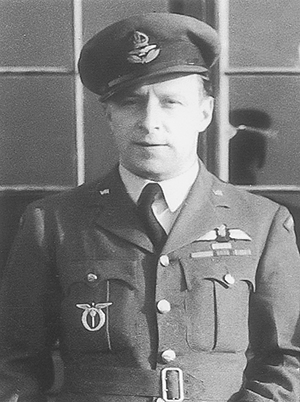
* 26.03.1915, Pikarec.
† 31.05.1991, Slavičín.
Pre WW2:
Josef Stehlík was born on 26 March 1915 at Pikarec, a village in eastern Bohemia, 140km south-east of Prague. He was the youngest son of František and his wife Berta née Šušterová’s five children. František was a WW1 veteran who was now employed as a gamekeeper on the estate of Baron Nádherný. They lived in the game-keeper’s cottage on that estate. That domestic environment was the catalyst for Josef to begin a lifelong interest in hunting for wildlife.
For his schooling. Josef attended the municipal school in nearby Dolní Libochová, some 5km away, for five years and then secondary school in Strážek, 5km east Pikarec, for three years. After leaving school he was accepted for an apprenticeship in Tišnov where he trained as a lathe operator and later as electrical mechanic. Having completed his apprenticeship, he changed employment to an electrical motor manufacturer. However, the Great Depression of the 1930’s was affecting central Europe causing an economic crisis and mass unemployment. Even Czechoslovakia, the most industrialised country in that region was affected, resulting in Josef being one those being made redundant.
A New Interest:
One of the early commercial routes for ČŠA, – Československé Státní Aerolinie – the fledging state airline of Czechoslovakia was between Prague and Brno, the capital town of Moravia. This meant that their aircraft were regularly seen flying over the Baron Nádherný estate en-route between those two cities. Josef was enthralled watching the freedom offered by flying and aspired to become an aviator. However, his father was firmly against the idea and wanted his son to follow in his footsteps and become a gamekeeper.
Czechoslovak Air Force:
This impasse caused Josef to apply to join the Czechoslovak Air Force without his father’s knowledge. He successfully passed the entrance exams and on 1 October 1935 began a training course to become an aircraft mechanic at the 83rd Squadron of the 5th Bomber Regiment who were deployed at Brno airbase.
On completion of that course, he was selected for pilot and NCO training and posted to the 1st ‘T.G. Masaryk’ Air Regiment deployed at Prague-Kbely airbase. On February 1, 1937, he was promoted to the rank of svobodník [LAC] and posted to Hradec Králové airbase for fighter pilot training.

On 1 May, he graduated from that course and, on 15 July, was posted to the 39th Fighter Squadron of the 3rd ‘M. R. Štefánik’ Air Regiment. They were deployed at Piešťany airbase Slovakia and equipped with Avia B-534 biplane fighter aircraft, the most advanced fighter used by the Czechoslovak Air Force. On 1 May 1938 he was promoted to the rank of četař [Sgt].
In Czechoslovakia between 1935 and 1938, there was a plan called the ‘Akce 1000 pilotů republice’ – the training of ‘One thousand pilots for the Republic’. It was an initiative by the Czechoslovak Authorities who were alarmed by the rise to power of the Nazi Party in neighbouring Germany and sought to increase the size of its Air Force. The plan called for 1,000 young Czechoslovaks to receive flying training in their spare time at local civilian flying clubs, but with active military support. The plan was described as a development of sports flying so that Germany would not be provoked into claiming it was war preparation by the Czechoslovaks.
In October 1938, due to his flying skills, Josef was appointed as a flying instructor at the new pilot training school, which had been established at Spišská Nová Ves Slovakia, as part of that programme. In the latter part of November, he was posted to Piešťany airbase, Slovakia, where a new flying school was established as part of that programme.
1938 Mobilisation:

In the aftermath of the Munich Agreement and the accession of the Sudeten regions of Czechoslovakia by Nazi Germany, Josef was working as a flying instructor at a pilot school in Spišská Nová Ves, Slovakia. In March 1939, Slovakia became an ‘independent’ puppet State to Germany and the Bohemia and Moravia regions were annexed by Germany becoming the Reich Protectorate of Bohemia-Moravia -Protektorat Böhmen und Mähren. Czech military personnel in Slovakia were repatriated back to the Protectorate, from where they were demobbed. For Josef, this was on 19 March 1939.
German Occupation:

On the evening before the invasion, on March 14, 1939, Czechoslovak intelligence officers called a meeting where they announced that the threat of invasion was imminent and recommended measures which would prevent most important assets fall in German hands. However, no orders were handed down until too late. The Chief of the Czechoslovak Air Force General Fajfr and his deputy General Vicherek ordered that no aircraft were allowed to take-off. III Department of the Ministry of National Defence started organising the transfer of the aircraft to several airfields in Moravia with the intention to get the airfleet to Romania and Yugoslavia. None of these planned intentions came to be instigated.
At the time of the German occupation of Czechoslovakia on 15 March 1939, he was stationed at Piešťany airbase and had achieved 470 flying hours. As a Czech, he was returned to Czechoslovakia, now the German Reich Protectorate of Bohemia and Moravia. After the German occupation, the Czechoslovak military was quickly disbanded by the Germans, and all personnel were dismissed. For the military personnel and many patriotic Czech citizens, this was a degrading period. Many wanted to redress this shame and humiliation and sought the liberation of their homeland. Germanisation of Bohemia and Moravia began immediately. But by 19 March 1939, former senior officers of the now-disbanded Czechoslovak military had started to form an underground army known as Obrana Národa [Defence of the Nation]. One of their objectives was to assist as many airmen and soldiers as possible to get to neighbouring Poland, where Ludvík Svoboda, a former distinguished Czechoslovak Legionnaire from WW1, was planning the formation of Czechoslovak military units to fight for the liberation of their homeland. Within Czechoslovakia, former military personnel and civilian patriots covertly started to arrange for former Air Force and Army personnel to be smuggled over the border into Poland to join these newly formed Czechoslovak units.
To Poland:
Obrana Národa also worked in co-operation with Svaz Letců, the Airman Association of the Czechoslovak Republic. These two organisations provided money, courier and other assistance to enable airmen to escape to Poland. Usually, this was by crossing the border from the Ostrava region into neighbouring Poland. News soon began to be covertly spread amongst the former Czechoslovak airmen and soldiers and many voluntarily made their personal decision to go to Poland. Josef was one of those who decided to escape and enlist in one of those units.
With the help of Svaz letcu [the Airmens Association of Czechoslovakia] Josef attempted to escape to Poland. His first attempt in May had to be aborted. With other former Czechoslovak personnel, he had travelled by train from Prague to Ostrava near the Polish border and then made his way to the village of Beskydy where it had been pre-arranged that their guide, a local game-keeper would meet them in a pub and lead them through the forests to the Polish border, some 9 miles away. The escapees arrived at the pub and waited for their guide. However instead of their guide, someone else arrived saying that the Germans had been tipped-off about this escape and for them to immediately get away. The escapees quickly gathered their things and ran off into the forest. It was a lucky escape as a German patrol was already approaching the pub, saw the airmen fleeing away and fired at them. Fortunately, none of them were hit. Safe, but disappointed, they returned to Ostrava and then by train to Prague.
Undeterred by that failure, Josef tried to escape again in June, and this time, he was successful. This time, the group travelled to Ostrava and, with the pre-arranged assistance of railway workers, on 5 June 1939, were smuggled aboard a freight train carrying coal to Poland. On arrival in Poland, they made their way to Krákow, where they reported for duty at the Czechoslovak Consulate.

Polish Disappointment:
However, there he was informed that the formation of Czechoslovak military units in Poland were just rumours because the Polish authorities would not allow Czechoslovak military units to be formed on its territory for fear of provoking Nazi Germany.
Instead, he learnt that the Czechoslovak Consul had, via his counterpart in Paris, negotiated with the French Government that the escaped Czechoslovak military would be permitted to travel to France. But there was a condition: as French Law did not permit foreign military personnel on its territory during peacetime, the Czechoslovaks would be required to enlist in the French Foreign Legion for a period of five years – but with the assurance that in the event of war being declared, the Czechoslovaks would be released from the Legion and transferred into French military units. The alternative was that they would be sent back to Czechoslovakia, now a German Protectorate, where execution or deportation to a concentration camp would be the most likely outcome. Josef decided that his best choice was to go to France.

Initially, Josef and his fellow escapees were accommodated at the ‘Dom Turystczny’, a cheap tourist hostel near the Czechoslovak Consulate whilst preparations were made for their onward journey to France. The hostel was now overfull with Czechoslovaks, so they were then transferred to Bronowice Małe, a derelict former Polish Army barracks from the Austro-Hungarian era, on the outskirts of Krakow This was then being utilised as a temporary transit camp for the escaped Czechoslovak military prior to their transfer to France. Josef arrived there on 25 July 1939, the 1167st Czechoslovak escapee to arrive. The barracks, which were in poor condition, were already well inhabited by Czechoslovak escapees who stayed whilst arrangements were made for their transportation, by sea, to France.
When those arrangements were completed, Josef with 189 other escaped Czechoslovak military personnel travelled by train to Gdynia, a port on the Baltic coast of Poland, where, on 26 July, they boarded the Swedish steamship the SS ‘Kastelholm’, a 921 ton Swedish coastal-cruising ship, and sailed to France. Part of the voyage down the Baltic Sea was very rough, even to airmen who were used to flying in turbulent conditions, and so the ‘Kastelholm’ stop at the Danish port of Frederikshaven to re-supply was a welcome relief for the Czechoslovaks onboard.
France:

The ‘Kastleholm’ arriving at Calais on 31 July. On arrival, the Czechoslovaks boarded a train which took them to Paris and then to Place Balard, the Foreign Legion’s recruitment depot in Paris, to undergo medical checks whilst the necessary documentation was prepared for their enlistment into the Legion pending their transfer to the Legion’s training base at Sidi Bel Abbès, Algeria. During this period, they were required to attend French classes and classroom tuition about the Foreign Legion. Any free time was usually spent in Paris exploring the sights and practising their newly learnt French with the girls they met.
Before that processing could be completed, war was declared and instead Josef and the other Czechoslovak airmen were released from their Foreign Legion contract, and were transferred to the l’Armée de l’Air at their recruitment centre at Dugny, near Paris. On 11 October, at the rank of Caporal-chef, Josef was transferred to Chartres, the l’Armée de l’Air training airbase, 80km West of Paris, for training on the Morane-Saulnier MS-406c, the most widely used fighter aircraft that l’Armée de l’Air had at that time.

On 2 December, having completed some 14 hours of re-training, Josef was posted to GC III /3 along with fellow Czechoslovaks Jindřich Beran, Evžen Čížek, Josef Hubáček, Josef Keprt and Václav Šlouf. Josef, Beran and Keprt was assigned to the unit’s 5th squadron, while Čížek and Šlouf went to the 6th. At the time, GC III/3 were deployed at Toul airbase near Ochey, some 260 km south-west of Paris and equipped with MS-406C fighter aircraft. This was the period of the ‘phoney war’ with very little activity on the western-front in France. During this time GC III /3 were mainly flying patrols along their section of the western front but with little sighting of Luftwaffe aircraft.
The relative calm of the Phoney War ended at 05:35 on 10 May 1940 when Germany attacked Holland, Belgium, Luxembourg and France. In France they came through the dense Ardennes Forest to skirt around the main defence of the Maginot line and swept Northwards towards the English Channel. The lightning speed and ferocity of their Blitzkrieg attack caused the l’Armée de l’Air units to rapidly retreat Westwards.
By 17 May, GC III /3’s 5 squadron were now deployed at Maubeuge airbase at Elesmes in north-west France, near the Belgium border. The three Czechoslovaks were joined by six more of their countrymen: František Běhal, Jan Čermák, Bedřich Krátkoruký, Tomáš Kruml, Karel Kuttelwascher and Josef Novák who had completed their re-training at Chartres.
On 21 May, GC III/3, they redeployed to Cormeilles-en-Vexin airbase, 40km North of Paris. They were withdrawn from the front line as its pilots were now exhausted from combat, and the unit was in need of re-equipping with the more powerful French Dewoitine Dw-520c fighter aircraft, which was comparable in performance to the Luftwaffe Me 109. Josef was one of the pilots sent directly to the Dewoitine factory at Toulouse in south-west France to collect these replacements. After a brief familiarisation with the new aircraft, they took off for the return journey. However, in Josef’s case, just after take-off, there was an explosion, and the aircraft’s engine caught fire. In such circumstances, the pilots had been instructed to bail out and abandon the aircraft. Josef was aware that there was a shortage of new aircraft and decided to try and save it. Using all his skills, he managed to glide back to the factory airfield and side-slip it for landing. This he did successfully, and the firefighters there were able to extinguish the flames before the aircraft was destroyed.
During the Battle of France he achieved combat success:
| Date: | Time: | Aircraft: | Action: |
12.05.40 | 08:00 | MS-406 | a Me 110 shared probable near Moerbeke, Belgium |
12.05.40 | 21:00 | MS-406 | 2 He III shared victories near Woesdrecht, Holland |
19.05.40 | 05:35 | MS-406 | a Hs 126 shared vistory near Le Quesnoy |
19.05.40 | 18:31 | MS-406 | a Do 17 victory north-east of Foret de Mormal, France |
05.06.40 | 07:45 | Dw-520c | a Do 17 shared victory near Brevent St Pol, France |
06.06.40 | 16:30 | Dw-520c | a Me 109 shared victory at 16:30 near Beauvraigne, France |
The rapid German Blitzkreig forced the Allied frontline back causing l’Armée de l’Air to frequently move its airfields westwards. In the case of GC III/3, by the early part of June, this was now happening on a daily basis.
The French authorities had by now realised that the war on mainland France was lost and sought to evacuate as much of their military to Algeria as they could. With the French capitulation imminent, GC III/3 were now at Perpignan, La Salanque airfield, in south-west France. Some 250 aircraft from other units had already congregated there en-route to Algeria. There everything was very chaotic, and with few ground-crew available, the pilots of GCIII/3, had to refuel their aircraft themselves. The Dw-520Cs were fitted with long-range fuel tanks and hand-operated starters. The following day, at the hour of their en-mass departure, each pilot had to start their engine manually.
Even with the extra range given by the long-range fuel tanks and without the aircraft carrying any ammunition, the flight over the Mediterranean Sea was only just achievable. Further weight saving was achieved with the pilots themselves limited to only a small bag containing real essentials – all their other possessions had to be left behind. In the event of being forced to engage with any Luftwaffe aircraft en-route to Algeria, the Dw-520Cs would not have enough fuel to reach the Algerian coast. On 19 June the aircraft of GC III/3 took-off and after a 700km uneventful flight, they reached the Algerian coast and landed at the l’Armée de l’Air airbase at Maison Blanche, Algeria.
Evacuation to England:
It was there that they learned that France had capitulated on 22 June. Winston Churchill, the British Prime Minister, appealed to all the evacuated Czechoslovak airmen to come to Britain and continue the fight from there. The l’Armée de l’Air released the Czechoslovak airmen from their service so that they could make their journey to Britain. On 4 July 1940, they left Maison Blanche by train and travelled for four days to Casablanca, on the Atlantic coast of Morocco. From here, on 4 July, under the command of štábní kapitán Josef Duda, they boarded the SS ‘Royal Scotsman’, which sailed on 9 July and took them to Gibraltar.
There they boarded the ‘David Livingstone’ which sailed on 21 July 1940 to Cardiff, arriving on 5 August 1940.
During the Battle of France, Josef had flown 65.55 hours and had achieved six victories making him the 6th most successful Czechoslovak pilot who served in l’Armée de l’Air. For these achievements he was awarded the Médaille Militaire and Croix de Guerre 2 Palmes et Etoile de Vermeil from France.

RAF:
On arrival to England, after security vetting, Josef was initially placed at the Czechoslovak transit camp at Cholmondeley, near Chester. The Battle of Britain was in progress and there was an urgent need for fighter pilots. As a trained pilot. on 10 August, Josef was transferred to the Czechoslovak Airmens Depot at Cosford. He was accepted into the RAF Volunteer Reserve, at the rank of AC2, on 14 August 1940.
As when joining l’Armee de L’air the previous year in France, the Czechoslovak airmen were given theoretical aviation training and language lessons, this time for British aircraft and the language was English.
On 5 September, at the rank of Sgt, he was posted to the newly formed 312 (Czechoslovak) Sqn along with 310 (Czechoslovak) Sqn, which were being formed at RAF Duxford and equipped with Hurricane Mk Is. With British instructors, re-training for Hawker Hurricane fighter aircraft commenced immediately and on the following day Josef made his first flight in a Hurricane. 310 Sqn became operational on 17 August which, due to the now low number of aircraft available to 312 Sqn, slowed down the re-training of 312 Sqn pilots. On 26 September, 312 Sqn redeployed to RAF Speke airfield at Liverpool, where on completion of their retraining, their role was the defence of Liverpool and its docks.

Battle of Britain:
The squadron was declared operational on 2 October and 6 days later it achieved its first combat success in what is considered to be the quickest ‘kill’ of the Battle of Britain – 11 min.
The Fastest ‘Kill’:
That day 312 Sqn achieved its first combat success in what is considered to be the quickest ‘kill’ of the Battle of Britain – 11 minutes! How many minutes?? On 8 October 1940, at 16:30, the squadron’s Yellow Section were ordered to take-off for a routine defensive patrol over Hoylake, to the West of Liverpool. Alois who, as Yellow 2, was flying Hurricane L1926, withJosef (Yellow 3) and F/Lt Dennys Gillam (Yellow 1) were taking-off in their Hurricanes. Gillam and Alois were already airborne, but the Merlin engine of Josef’s Hurricane was reluctant to start causing a slight delay in his take-off.
During this time a lone Ju 88, M7+DK from 2/KGr806 based at Caen, in Northern France, was approaching Speke airfield, flying at 1,200 feet on course to attack the Rootes Factory by Speke airport, which was producing aircraft. The weather forecast given to its pilot, Oberleutnant Helmut Brückmann indicated that there would be cloud covering their route, ideal for avoiding contact with RAF fighter aircraft. This was his 36th operational missions and his fifth to the Lancashire area around Liverpool.
Josef’s reluctant Hurricane engine finally started allowing him to make a belated take-off. Whilst still only at an altitude of 1,000 feet anti-aircaft fire, about 4km away at Birkenhead, caught the attention of the three Hurricane pilots. They immediately went to attack the enemy aircraft and Josef, with his Hurricane still retracting its undercarriage, got in the first burst from his guns.
Despite heavy and accurate machine gun gun-fire from the Ju 88 rear gunner, the three Hurricanes pressed on with their attack. Their accurate machine gun fire resulted in both engines of the Ju 88 catching fire causing it to make a forced-landing on the left bank of the River Mersey.
All three Hurricanes were slightly damaged with Alois’s engine exhaust manifolds shot up, Josef’s fuel tank pipe line damaged and F/Lt Gillam’s windscreen smashed. The Ju 88 pilot, Oberleutnant Helmut Brückmann, was uninjured, while wireless Operator, Unteroffizier Helmuth Weth, was slightly injured on landing. The Ju 88’s navigator, Leutnant Herbert Schlegel, was killed by a machine gun bullet in the head while still in the air. Sonderfuhrer Horst Lehmann, who was in the central underside gondola under the cockpit acting as rear-gunner, had detached the underside gondola from the aircraft at a height of about three feet just before the aircraft crash-landed.

After crashing, both Brückmann and Weth left the aircraft to see if they could help the badly injured Lehmann – he had broken many bones in his body and legs in addition to major stomach injuries. All three Luftwaffe airmen were captured, without resistance to become PoWs. Lehmann was taken to hospital for treatment and was unable to leave for many months, the severity of his injuries causing him to be re-patriated later in the war back to Germany.

After the Battle:
With 312 Sqn Josef achieved further aerial-combat success:
| Date: | Time: | Aircraft: | Action: |
14.03.41 | ?? | Hurricane | a Ju 88 shared victory 25 miles south-west of Bradsey Island, UK. |
18.06.41 | 18:30 | Hurricane | a Me 109E probable near Gravelines, France. |
08.07.41 | 06:32 | Hurricane | a Me109E damaged near Lens, France. |
10.07.41 | 13:06 | Hurricane | a Me109 probable north-west of Gravelines, France. |
Josef was commissioned, at the rank of P/O, on 7 August 1941.
On completion of his first operational tour, he was posted, on 20 October 1941, to the Central Flying School at RAF Upavon for a flying instructor’s course. On graduation from the course, he was then posted, on 13 December 1941, as a flying instructor to 9 SFTS [Service Flying Training School] at RAF Hullavington.
Canada:
The British Commonwealth Air Training Plan had been instigated in April 1940 as an initiative to train new Allied aircrew in various Commonwealth countries . One of the main countries used in that plan was Canada. On 10 February 1942, Josef was posted to Canada to join as a flying instructor. His first posting there was to 31 EFTS [Elementary Flying School] at De Winton airbase, in Alberta, some 30km south of Calgary. On 6 August 1942, he was promoted to the rank of F/O.
Josef’s next posting, on 28 October 1942 was to 34 [SFTS] at Medicine Hat, some 250km south-east from De Winton. There he was primarily teaching new Czechoslovak airmen to fly , firstly in two-seater Tiger Moth bi-planes and then graduating onto the more powerful North American Harvard, a dual seat monoplane training aircraft. One of his outstanding pupils there was Otto Smik who was to be the most successful Slovak fighter pilot of WW2, who was killed on 28 November 1944, aged 22, during an attack on the railway marshalling yard at Zwolle, Holland.
Whilst in Canada, Josef was able to follow one of his early interests – hunting, including moose and bears.
Back to 312 Sqn:
Josef returned to England on 10 April 1943, and was posted back to 312 Sqn, who were now deployed at RAF Churchstanton, Somerset, for operational flying duties and the start of his 2nd Operational Tour. The squadron were now equipped with Spitfire Mk Vc’s fighter aircraft.
Whilst at RAF Churchstanton, 312 Sqn were primarily involved, with other fighter squadrons, in providing cover for Allied bombers on raids over northern occupied France. These raids, known as ‘Ramrods’ were primarily intended to destroy a ground target and also inflict losses by the escorts on German fighters trying to intervene.
Josef’s next promotion was on 7 August to the rank of F/Lt.
On 24 December, 10 of the Squadron’s Spitfires participated in Ramrod 393, the escort of 24 Mitchell bombers on a raid on Cherbourg. Josef was flying Spitfire Mk Vb BM322, DU-S. On the return flight, whilst over the Isle of Wight, the engine suddenly cut out at 14:40. Gliding from 4,000 ft he managed to make a forced landing at Tapwell Farm, near Yarmouth on the Isle of Wight. The landing causing slight injuries to his leg.

On 1 February 1944 S/Ldr Tomáš Vybíral was promoted to the rank of Acting Wing Commander and was appointed Commanding Officer of the newly formed 134 Czechoslovak Wing, comprising of 310, 312 and 313 Czechoslovak fighter squadrons. The Wing was, in turn, part of the 2nd Tactical Air Force of the Allied forces and deployed at RAF Exeter.
Call for Volunteers for Russia:

In November 1943, W/Cmdr František Doležal, the current commanding officer of the Czechoslovak Wing, asked the pilots of that Wing for volunteers to go to the Eastern Front and fly for Russia. A total of 21 volunteers comprising pilots from 310, 312 and 313 Sqns were selected. Josef was one of them, his reason for that was he would be fighting the Luftwaffe nearer his homeland and so would get home sooner. This was a common sentiment shared by the other 20 as well.
Josef resigned his RAF commission on 1 February 1944 and was released from his RAF service in preparation for going to Russia.
Whilst in RAF service he had flown a total of 1,175 hours including 650 in Canada.
To Russia:
On 21 February 1944, with 20 other volunteer Czechoslovak former RAF pilots, Josef sailed from Glasgow aboard the ‘Reina del Pacifico’ to Gibraltar and then onto Port Said, Egypt. From there to Cairo where they went by train to Damascus, Syria. From there by coach to RAF Habbányia near Bagdad, then by train to Tehran, Persia. From Tehran they were then flown to Ivanovo airbase, 325 km east of Moscow. On this journey, many of them took the opportunity to learn some Russian, the 3rd language they were having to learn since they left their homeland in 1939. It would also be the 4th Air Force they had served in during that period.
Eastern Front:
On arrival at Ivanovo airbase they were re-trained for Soviet Lavochkin La 5 FN fighter aircraft. On completion of their training the unit was declared operational on 3 May 1944 and renamed 1st Czechoslovak Independent Fighter Aviation Regiment. On 1st August Josef was promoted to the rank of Lieutenant.
The Slovak National Uprising had broken out on 15 September and after news of the uprising, the regiment redeployed to Stubno, Poland, to be closer to the front line. The Command in Moscow then ordered the regiment to fly to Slovakia to support the insurgents.

On 15 September, the first four of the regiment’s La 5FN’s were flown to the Tri Duby airfield near Banská Bystrica, Slovakia. They were flown by František Fajtl, the regiment’s C/O, Jan Klán, deputy C/O, František Chábera squadron C/O and Josef to arrange the logistics of the arrival of the whole regiment. Unfortunately, having landed Josef jumped from the wing of his aircraft and sprained his ankle, which immobilised him for a few days. By 18 September, the remainder of the regiment’s La 5FN were flown in. The next day they attacked Pieštany airbase, some 100km west of them and now used by the Luftwaffe. Josef led the attack as he had served at Pieštany pre-war and was very familiar with the terrain. The attack caught the airbase by surprise and before its ground defences could respond, the Ln- 5FNs were able to inflict damage to ground targets. Under difficult conditions, the unit achieved a number of successes in both aerial combat and against ground targets.
Josef combat success during this period:
| Date: | Aircraft: | Action: |
19.09.44 | Ln-5FN | a Ju88 victory near Piešťany, Slovakia. |
19.09.44 | Ln-5FN | a Ju87 shared victory near Piešťany, Slovakia. |
Whilst attacking ground targets he had also destroyed 3 aircraft, 12 military trucks, 2 military cars and a railway locomotive.
Unfortunately, the Slovak National Uprising was ill-fated and by October had been suppressed, forcing the unit to evacuate from Slovakia back East to Soviet-held territory. During the Slovak National Uprising, Josef had flown 26.20 operational hours. Here the unit was reorganised and on 19 December 1944 Josef was appointed commander of the 2nd Czechoslovak Fighter Regiment, who were now deployed at Balice, near Kraków, Poland. WW2 in the east finished on 9 May and five days later the regiment’s La 5FN’s flew to Czechoslovakia, landing at Letňany airbase, Prague.
Josef was to learn that his parents and his two brothers had been arrested and imprisoned by the Gestapo in September 1942, because of Josef being with the Allies in the west.
Return to Czechoslovakia:
Josef was discharged from his Soviet military service and returned to Czechoslovakia on 1 July 1945 where he remained in the Czechoslovak Air Force. That August, at the rank of kapitán [F/Lt] he was posted to the Military Aviation Academy at Prostějov as a flying instructor. On 1 January 1946, he was promoted to the rank of štábního kapitán [S/Ldr]. A year later he was posted to České Budějovice airbase where he led the training of flying instructors.
Communist putsch:
Following the Communist take-over in February 1948, the Czechoslovaks who fought for the Allies in WW2 were regarded by the new regime as being tainted by capitalism. This resulted with many being arrested, imprisoned and subjected to other persecution.
In Josef’s case, on 1 June 1948 he was initially placed on waiting leave and on 1 September, dismissed from Czechoslovak Air Force.
Arrested:
During that Summer he had been at home in Dolní Libochová, and two people, who he did not know, visited him and asked if he had a contact for anyone who could help them escape over the border to the American Zone of Germany. Josef told them that he didn’t know anyone who could help them. However, he was suspicious as to what their actually motive was and spoke to his brother Eduard about this. Eduard was of the opinion that the two were undercover StB [Státní Bezpečnost, the state secret police] agents looking to entrap Josef as a former RAF airman, and that Josef should take the ‘good loyal citizen stance’ and safeguard himself by reporting this to the Police, which he duly did. A few hours later Josef was arrested by the StB and taken to their detention centre at Loreta at Hradčany, Prague. He was held there in pre-trial detention for seven months. In April 1949 he was charged with “helping others to escape illegally and damaging the good name of the army“ and taken to Court for trial and sentencing. In Court, the case was dismissed due to lack of evidence. Despite being acquitted of that charge, his Czechoslovak military rank was stripped from him: he was demoted to the lowest rank and he had to vacate his military service apartment.
Josef’s Twilight years:
As a former RAF airmen in now Communist Czechoslovakia, finding employment was very difficult as few employers had any desire to antagonise the Communist authorities. By 1950 he managed to find work as a labourer in the construction industry in Brno and lived in a hostel. Usually, such employment would last just a short period before the authorities became aware of his new job and put pressure on the employer to dismiss him. After a string of manual jobs, by 1963 he was working as a driver and luggage porter at the Lipová-lázně spa near Hrubý Jeseník, some 100km north-east of Brno.
In the general amnesty in 1964, by the Czechoslovak authorities, Josef was finally rehabilitated and re-employed by the Czechoslovak Air Force. In the Summer of 1990, the 50th anniversary of the Battle of Britain, Josef and other Czechoslovak veterans of that battle were invited to England to attend commemoration events for that battle. On 13 July, they visited the Imperial War Museum at Duxford, where they were re-united with 310 Sqn Spitfire AR501, NN-A.

That year he was promoted to the rank of plukovník [retired] – Group Captain. On 8 May 1991, he was awarded the high Czechoslovak State award of Order of Milan Rastislav Štefánik, 3rd Class, but due to poor health he was unable to attend the award ceremony at Prague Castle. Instead, it was scheduled to be presented to him at his home at Slavicin on 30 May 1991. Sadly, fate cruelly intervened and the night before the presentation, he died.
Josef Stehlík died on 30 May 1991, aged 76 at Slavičín, Czechoslovakia.
Medals Awarded for his WW2 service:
1939 – 45 Star with Battle of Britain clasp
Air Crew Europe Star
Defence Medal
1939-1945 War Medal
Válečný kříž 1939 and 4 bars
Za chrabrost and 2 bar
Za zásluhy I.stupně
Pamětní medaile se štítky F–VB-SSSR
Croix de Guerre 2 Palmes et etoile de vermeil.
Médaille Militaire
Médaille commémorative des Services Volontaires de la France Libre
Victory over Germany in the Great Patriotic War 1941–1945.
Order of the Patriotic War, Grade II.
Rad Slovenskeho narodnihopovstabi [Order of the Slovak National Uprising Medal].
Remembered:
Great Britain:
Capel-le-Ferne:
He is commemorated, along with the other 2940 Battle of Britain aircrew, on the Christopher Foxley-Norris Memorial Wall at the National Battle of Britain Memorial at Capel-le-Ferne, Kent:

Hawkinge:
Josef is remembered on the Czechoslovak Battle of Britain pilots memorial at the Kent Battle of Britain Museum at Hawkinge, Kent. It was unveiled on 28 October 2025, to commemorate the 88 Czechoslovaks who flew in that battle.

London – Battle of Britain Memorial:
He is also commemorated on the London Battle of Britain Memorial:
Czech Republic:
Prague 1 – Klárov:
In November 2017, his name, along with the names of 2533 other Czechoslovak men and women who had served in the RAF during WW2, was unveiled at the Winged Lion Monument at Klárov, Prague 1.

Pikarec:
On 21 March 2015, to commemorating the 100th anniversary of his birth, a memorial plaque was unveiled at Josef Stehlík’s birth village of Pikarec.

Slavicin:
He is commemorated on a memorial plaque at his former family home at Slavicin.

Strazek:
At the elementary school building in the village of Strážek is a memorial plaque commemorating Josef Stehlík.

Article last updated: 31.10.2025.
Widgets
