
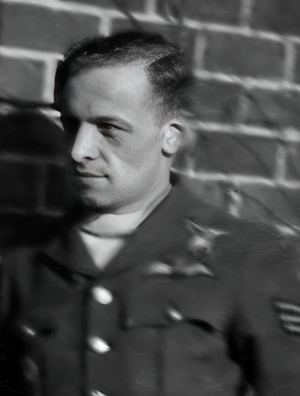
* 26.09.1914, Krupina.
† 21.07.1994, West Africa.
The Early Years
Jozef Kaňa was born on 26 September, 1914 at Krupina, about 90 miles east of Bratislava. At that time the region was part of the Austro-Hungarian Empire [now Slovakia]. He was the first child of Ľudovít, a master shoemaker, and his wife Katarina. His sister Emilia was born the following year and Mária in 1917.
For his schooling, Jozef attended the local schools at Krupina. On completion of that, instead of joining his father’s shoemaking business, in 1930 he started at the Teachers Training College at Banská Bystrica with the intention of becoming a teacher. He soon realised that was not his vocation and instead, on 22 January 1931, he enrolled in the Trade School at Banská Bystrica where he trained as a machine locksmith. He was subsequently employed as a mechanic and driver.
One thousand pilots for the Republic

Tomáš G Masaryk, the first Czechoslovak President, recognised the strategic importance of air power and between 1935 and 1938 he instigated in Czechoslovakia, an initiative called the ‘Akce 1000 pilotů republice’ – the training of ‘One thousand pilots for the Republic’. The Czechoslovak Authorities were alarmed by the rise to power of the Nazi Party in neighbouring Germany and sought to increase the size of its Air Force. The plan called for 1,000 young Czechoslovaks to receive flying training in their spare time at local civilian flying clubs, but with active military support. The plan was proclaimed to be a development of sports flying so that Germany would not be provoked into claiming it was war preparation by the Czechoslovaks.
The campaign was supported by commercial enterprises in Czechoslovakia as well as the Masarykova letecká liga – the Masaryk Aviation League, MML – the Sokol movement, aero clubs and the Air Force. The MML encouraged the formation of local flying clubs, and published books and magazines aimed at drawing ambitious young men into a career in aviation.
Only a limited number of candidates were accepted for this training programme, and then only those who were conscripted to join the army the same year and who had applied for admission to the school for Air Force officers in reserve. Admission was decided by the committee of the relevant aeroclub. Applicants who met the requirements were sent for medical examinations and those selected were called to attend a theoretical course at the relevant aeroclub. Those who passed the exams were called in in April to attend a three-month practical pilot training course, which took place during the morning and evening hours. After finishing their sports pilot training and exams, they undertook maintenance flights [from July until September], until their military service started.
For Jozef, who already possessed technical and mechanical skills, the opportunities offered by a career which promised the romance and excitement of flying must have looked irresistible. He became one of these thousand young men, by joining the Stredoslovenský aeroklub [Central Slovak Aeroclub] at Zvolen, one of the regional branches of the MLL, which used aeroclubs as a feeder for military pilot recruitment with promising students then selected for military pilot courses in the Czechoslovak Air Force.
Czechoslovak Air Force
On completion of that training, for his mandatory military service, Jozef presented himself at Vajnory airbase, near Bratislava, on 1 October 1937, for his basic training in the Czechoslovak Air Force with the 38th Sqn of the 3rd ‘M. R. Štefánik’ Air Regiment. On 14 October 1937, at the rank of vojín [AC2], he was assigned to the training squadron of the 3rd ‘M. R. Štefánik’ Air Regiment. On completion of that training, on 19 November 1937, he was assigned to the Regiment’s NCO [Non-Commissioned Officers] school, at Piešťany airbase, for pilot training, where one of his flying instructors was Otto Hanzliček, who would also later be a pilot in the Battle of Britain. Jozef completed his pilot training on 15 August 1938 and was then posted to the Regiment’s 15th Reconnaissance Squadron, who were deployed at Žilina airbase, Slovakia, some 100 miles north-east of Bratislava and near the border with Poland. They were equipped with the Letov Š-28 aircraft, dual-seater biplane reconnaissance aircraft where he attained the rank of desátník [Cpl].

Mobilisation

The threatening overtures by neighbouring Nazi Germany regarding the Sudeten regions – the German speaking areas – of Czechoslovakia caused the Czechoslovak Government to declare a mobilisation on 23 September 1938. During this period Jozef’s squadron role was reconnaissance patrols in the north-east border regions of Slovakia.
Munich Dictat
Following the Munich Agreement, when the Sudetenland was ceded to Germany, Poland and Hungary also took some Czechoslovak territory. About 30% of Czechoslovakian territory had been lost, which included its border defences, and the new revised German border was now only some 30 km from Prague.
German Occupation

Despite assurances given by Hitler at the Munich Agreement, also known in Czechoslovakia as the ‘Munich Dictat’ or ‘Munich Betrayal’, of 30 September 1938, that he had no further interest in territorial gains for Germany, just a few months later Hitler extended his demands that the remaining regions of Czechoslovakia become part of Germany.
The Germans occupied Czechoslovakia on 15 March 1939. Under pressure, Emil Hácha, the Czechoslovak President, had acceded to their demands. In the early hours of 15 March 1939, he had ordered all Czechoslovak military units to stand down, remain in their barracks and not resist the occupation. By dawn that day, the Germans began their occupation of Czechoslovakia. Germanisation of Bohemia and Moravia began immediately; they were now the Reich Protectorate of Bohemia and Moravia (Protektorat Böhmen und Mähren), while Slovakia, in return for its allegiance to Nazi Germany, had become the puppet ‘independent’ state of Slovakia. Within a few days of their occupation, the Germans disbanded the Czechoslovak military and all personnel were dismissed.
The Regiment’s Slovak personnel were absorbed into the newly formed Slovak Air Force [Slovenské vzdušné zbrane].
Slovak Air Force

As Jozef was a Slovak, he remained in the new Slovak Air Force and on 15 April 1939 was posted to the 64th Squadron of the 3rd ‘M. R. Štefánik’s Air Regiment, who were equipped with Aero A-101, a biplane light bomber and reconnaissance aircraft and deployed at Piešťany airbase, Slovakia.
However, in the months that followed, Jozef soon realised that Slovakia was no more than a ‘German puppet’ State which was totally controlled by Berlin and thus without any actual independence. He became disillusioned with this so-called independence and found that some of his fellow Slovak airmen were of the same opinion, causing unrest and a refusal to continue to serve under such German domination. Poland was the only nearby country that could offer refuge and a pathway to continue the struggle against Nazi Germany. Jozef and seven other colleagues at Piešťany began to plan their escape.
Escape to Poland
On 7 June 1939, three AS-328’s and an Aero 101 military biplane aircraft were flown from Piešťany airbase in Slovakia to Poland. The airmen were all serving members of the new Slovak Air Force. The AS-328’s were crewed by Jan Lazar and Karel Valach, Jozef Kaňa and František Knotek, Imrich Gablech and Josef Řehák, while the Aero 101 was crewed by Jozef Hrala and Ľudevit Ivanič.
At the time of the German occupation, Jozef was serving in the 3rd Air Regiment and stationed at Zilina, Slovakia. He was intent on escape but before he could do so the airbase was occupied by the Germans. The Slovak airmen were restricted to two hours of flying and, because of the close proximity of the Polish border, aircraft were permitted to carry only enough fuel for them to make a circuit of the airbase.
The unit was disbanded in April 1939, and Gablech and two others were posted to the 34th Flight at Piešťany airbase, Slovakia. Lazar and Hrala were already here, and shortly after, Valach, Ivanič, and Řehák arrived, having previously been stationed in the now-called Protectorate of Bohemia and Moravia. Here, the airmen found that they, and other airmen, had similar intentions of wanting to escape German occupation and began to make their plans.
The escape was planned for 7 June 1939, because due to the God Body`s Celebration, held on the following day, the Piešťany airbase activities would finish at 10 am and all personnel would leave the airbase and go to the nearby Eva open-air swimming pool. Ivanič was a Chief Mechanic at the airbase and had the keys for the fuel bowser. He filled up all four aircraft with fuel. On the airfield were three hangars, one of which was used by an airline company. The escapees planned to take off within a few seconds of each other. First was Lazar followed by Jozef, then Hrala and finally Gablech.
Lazar took off and a guard fired a warning shot, causing panic on the airfield. A few seconds later Jozef had taken off, and Gablech taxied his aircraft to near the Air Lines Comp hanger while Hrala took his turn to take off.
Hrala was sitting at the controls of an Aero 101 bomber for the first time and had problems taking off. He aborted his first attempt mid-way down the runway, turned the aircraft around, returned to the start of the runway, gave the engines full power and tried a second attempt to take off. After two bumps he succeeded in getting airborne but only just missing the top of a hangar and narrowly avoided crashing into the Jewish cemetery behind the hangar before he was able to gain altitude.
When Gablech tried to taxi to the runway, several of the cadets from the airbase grabbed hold of his aircraft’s wings to prevent it from moving. Gablech applied full throttle to the engine to overcome this resistance and took off. The four aircraft flew north-east and, over the town of Žilina, the Germans fired at two of the aircraft. They then headed towards the town of Kraľovany and flew, in cloud, over the High Tatra mountains to Poland. Having crossed into Poland, Jozef landed his aircraft near Krákow, whilst the three S-328’s, because of their longer range, were able to land at Dęblin military airbase.
When they had landed their aircraft they insisted on joining the French Air Force. The following day local newspapers had stories about the Slovaks who came to strengthen the Polish Air Force. This media publicity was not welcomed by the Polish authorities who were keen not to provoke the Germans. The eight were initially taken to Warsaw, where they were interrogated for three weeks, before they were returned to Dęblin. Here, they were persuaded to sign contracts to join the Polish Air Force. Jozef signed on 1 July 1939.
For this action the Slovak state sentenced, in absentia, the eight airmen to life imprisonment.
Polskie siły powietrzne
After security vetting by Polish intelligence officers, on 1 July 1939, these eight airmen were assigned to the Centrum Wyszkolenia Lotnictwa [CWL], the Polish Air Force Training Academy at Dęblin, Jozef and the other pilots were employed as civilian flying instructors. On 26 July 1939, they were joined by 13 more Czechoslovak pilots: Josef Balejka, Jaroslav Dobrovolný, Josef Flekal, Josef Frantšek, Oldřich Kestler, Jan Mokrejš, Tomáš Motyčka, Vilém Murcek, Matěj Pavolovič, Zdeněk Škarvada and Jaroslav Vyhnis. These were from a group of 190 Czechoslovak escapees, from Bronowice Małe, the temporary camp for the Czechoslovak escapees outside Kraków, who were due to board the ‘Kastelholm’ to take them to France. As the group were preparing to board the ship, they were addressed by a group of Polish officials who were trying to convince the Czech pilots to join the Polish Air Force. As there had been apathy from the Polish Authorities when the escapees had first arrived in Poland, the escapees now showed little interest in remaining in Poland. As they had no response, the officials threatened to prevent the ship from departing until they had some volunteers and eventually these 13 decided to remain behind. At Dęblin, these 13 were also employed as civilian flying instructors.
The fabricated German attack on the Polish radio station at Gliwice, provided the Germans with the pretext for their invasion of Poland on 1 September 1939. Just before midnight on that first day, Dęblin airbase received evacuation orders, but at 5 am on the morning on 2 September Luftwaffe bombers, escorted by Me 109 fighters raided the airfield. The Czechoslovak pilots Balejka, Dobrovolný, František, Gablech, Kestler, Lazar, Muček and Škarvada were amongst the airmen who evacuated their aircraft by flying them to Góra Puławska, a nearby satellite airfield, 20km away. The next day they returned by truck to Dęblin for more aircraft. The airbase had been heavily damaged by the German bombing. During the Polish Campaign, the Czechoslovaks were flying primarily reconnaissance flights.
Evacuation from Poland
The German Blitzkrieg was causing the Polish forces to retreat eastwards, and then on 17 September 1939, the Soviets invaded Poland from the east. With no fuel for their aircraft, the Czechoslovak and Polish Forces began to make their way to Romania. For Jozef, this involved travelling on foot, horse-drawn carts or trucks for days, accompanied by Oldřich Kestler and Tomáš Motyčka. After barely three days on foot they fell into Soviet captivity on 20 September. They were transported to Tarnopol, in the Ukraine, now occupied by the Soviets, where they were detained for the next 23 days. On 13 October 1939 they were released.
They immediately proceeded towards the Romanian border, first by train through Stanislawow and Kolomiji, then by bus through Kosów to the city of Kut. On 16 October 1939 they finally crossed the border into Romania but shortly after they were again arrested at Chernivtsi for illegally crossing into Romania and detained. On 30 October transferred to the internment camp at Buzău. There was poor security at this camp and they escaped on the night of 3 November and made their way to Bucharest. There they went to the Polish Consulate who provided them with Polish passports, visas and money. On 9 November 1939 they departed from Bucharest, by train to the Black Sea port of Constanța.
To France

That evening they boarded the MS ‘Transilvania’, a Romanian passenger ship, which sailed via Istanbul, Turkey, to Piraeus, Greece, for the three- day journey to Beirut, Syria. There, on 14 November 1939, they boarded the SS ‘Champollion’, a 1,000 capacity French passenger liner which primarily carried passengers and mail between Marseilles, Egypt, Lebanon, and Syria. They arrived at Marseilles, France, on 21 November 1939.
France
In France, Jozef joined the Polish Air Force on 15 December 1939, at the rank of Sierżant [Sgt], and was assigned to Dépôt d’Instruction de l’Aviation Polonaise (DIAP) their training airbase at Lyon–Bron, [Base aérienne 102] for refresher courses and type-conversion to French aircraft. These were completed on 5 May 1940 and he was awarded his l’Armée de l’Air pilot’s badge.
I Dywizjonu Obserwacyjnego
On completion of the conversion course, he was assigned to II Eskadra Obserwacyjna I Dywizjonu Obserwacyjnego [1st Observer Sqn] of the Polish Air Force, but the unit never became operational. He was transferred to EAA 301 (Entrépot de l’Armée de l’Air 301) at Châteaudun airbase [Base aérienne 279], some 100 km south-west of Paris. This was the main l’Armée de l’Air aircraft depot, whose role was to receive, store, maintain, and dispatch aircraft from French factories to operational units. By early 1940, it had become the largest aircraft storage facility in France, with some 600+ aircraft onsite, potentially making it a high-value target for the Luftwaffe. This was the period of the ‘phoney war’ with very little activity on the Western Front in France
During this period, Jozef had met Božena Kocmanová, a Czechoslovak expat from Moravia, now living in France and on 27 April 1940, they were married.
The relative calm of the Phoney War ended at 05:35 on 10 May 1940 when Germany attacked the Netherlands, Belgium, Luxembourg and France. In France, they came through the dense Ardennes Forest to skirt around the main defence of the Maginot line and swept Northwards towards the English Channel. The Battle of France had begun.
Patrouille DAT Châteaudun
The speed and aerial superiority of the German blitzkrieg soon overwhelmed the fighter protection by the l’Armée de l’Air and RAF of their now rapidly withdrawing front line. This alarmed the French as they realised that they had no aerial protection for strategic French cities and factories, and so quickly formed Patrouille Défense Aérienne du Territoire (DAT) – Air Defence Patrols to protect them. Pilots and aircraft from various training units were used to equip these DAT units. One of those units was Patrouille DAT Châteaudun, and Jozef was one of a group of 20 pilots under the command of Lt Mieczysław Wolański that joined that unit on 12 May. One of the other pilots was fellow Czechoslovak Oldřich Kestler.
On 17 May, Jozef took off at 18:20 for a familiarisation flight in a Morane-Saulnier MS-406 fighter aircraft, No 49. On landing at 18:35 he forgot to lower the undercarriage, and suffered a belly landing, causing the plane to catch fire and be burnt out.
On 1 June Jozef was promoted to the Polish Air Force rank of Starszy sierżant [F/Sgt].

Escape from France
It was now clear that the war in mainland France was lost and it was just a matter of days before France would have to capitulate. The French high command ordered what remained of the Armée de l’Air to evacuate their aircraft and personnel to the French colonies in North Africa to continue the fight. However, with the French capitulation imminent, the Allies were making every effort to evacuate Allied military from the port of Casablanca on the Atlantic coast of Morocco.
The Polish pilots of EAA 301, now at Marignane airbase at Marseille, took a twin-engined Lioré-et-Olivier LeO-451 medium bomber aircraft and flew to Algiers.

However, left behind in Lyon, France, was Jozef’s wife, Božena, then pregnant, who in 1941 gave birth to their son Jean-Claude.
Operation Aerial

Since 15 June, Operation Aerial, the evacuation of Allied military forces and civilians from ports in Western France had been in operation. With the French capitulation imminent, the Czechoslovak military in France were in danger of being interned by the Vichy regime or captured by the Germans. Winston Churchill, the newly appointed British Prime Minister (since May 1940), recognised the importance of experienced airmen for the upcoming defence of Britain. He appealed to all the evacuated Czechoslovak and Polish airmen to come to Britain and continue the fight from there.
It was there in Algeria that they learned that Winston Churchill, the British Prime Minister, appealed to all the evacuated Allied airmen to come to Britain and continue the fight from there. They travelled for four days by train across the Sahara Desert to Casablanca, Morocco where they boarded a ship which took them to Gibraltar. Here they transferred ships and were brought to England, arriving on 22 June 1940.
Polskie Siły Powietrzne
After the French capitulation in June, some 8,000 Polish airmen were amongst the Allied personnel evacuated from France or North Africa. For many their first UK location was the Polish Air Force temporary reception and transit depot at Glasgow. There they underwent, security vetting, medical checks, registration, rest, uniformed and temporary accommodated before onward travel by train to RAF Eastchurch, Kent, or RAF Blackpool, Lancashire for training and reorganisation prior to posting to frontline squadrons.
On his arrival in the UK, Jozef was sent there and he met up with Josef Balejka, Josef František, Matěj Pavlovič and Ladislav Uher, all of whom were fellow Czechoslovaks who had fought with the Polish Air Force in Poland. On 1 July, Jozef was posted, at the rank of F/Sgt, to the Polish Air Force Depot at Blackpool. There he undertook an English language course, focusing on aviation terminology, military drill and RAF procedures. This was the administrative and reception centre hub where they were absorbed into the RAF system, uniformed, and dispatched to training or frontline squadrons.
On 1 July, Jozef was posted to the Polish Air Force Depot at Blackpool. There he undertook an English language course, focusing on aviation terminology, military drill and RAF procedures.
303 [Polish] Sqn
The Battle of Britain was now in progress, and there was an urgent need for fighter pilots. On completion of those procedures to the required standard, as a trained fighter pilot, Jozef was posted, on 22 August, to 303 (Kościuszko) Polish Sqn who were deployed at RAF Northolt, in north-west London, and equipped with Hawker Hurricane Mk I aircraft. There, he initially had training flights in the dual-seater Miles Magister and then on Hurricanes to learn the nuances of British aircraft, especially a retractable undercarriage, a feature not found on Polish fighter aircraft.
Battle of Britain
On completion of that retraining, he was assigned to the squadron’s ‘B‘ Flight and made his first operational flight – a scramble to intercept a large formation of Luftwaffe aircraft in the Horsham area – on 11 September in Hurricane V6673, RF-U, taking off at 16:10 and landing at 16:40. However, his limited flying in Hurricanes – just 3 hrs – showed, and on 16 September, he was posted to 6 OTU [Operational Training Unit] at RAF Sutton Bridge, Lincolnshire, for additional training, as with 303 Sqn now operational, this was no longer possible at RAF Northolt.
At 6 OTU, one of the others being retrained was Oldřich Kestler, one of his pre-war trainers, who arrived there on 21 September. Jozef returned to 303 Sqn on 6 October. He made a further four operational flights in the Battle, totalling 3 hrs and 5 minutes, thus qualifying him for the coveted Battle of Britain clasp.

After the Battle
No. 315 ((Dębliński) Polish Fighter Squadron was formed at RAF Acklington, near Morpeth, some 20 miles north of Newcastle upon Tyne, on 21 January 1941 and was equipped with Hawker Hurricane II. For its flying personnel, the Polish Authorities had newly trained pilots transferred from its Depot at Blackpool as well as eleven experienced pilots, including Jozef from 303 Sqn, who was assigned to its ‘B’ Flight. After training flights, the squadron redeployed to RAF Speke, in March 1941, where their role was the aerial defence of Liverpool and its docks.

Due to health reasons, Jozef was stood down from operational flying and on 22 April 1941 was posted to No 4 Ferry Pilot Pool [4 FPP] at RAF Kemble whose role was delivering new or repaired aircraft to operational squadrons. On 1 September 1941 he was promoted to the rank of W/O.
His next posting was to 16 (Polish) SFTS (Service Flying Training School) as flying instructor. They were stationed at RAF Hucknall, some 45 miles north-east of Birmingham. Under RAF supervision, the Polish instructors provided advanced training, formation flying, navigation, gunnery, and operational handling for Polish pilots
On 5 January 1942, Jozef was posted to 1 AACU [Anti-Aircraft Co-operation Unit], stationed at Westonzoyland, near Bridgewater, Somerset. Their role was target towing for anti-aircraft gunnery practice, for SAAD, the School of Anti-Aircraft Defence at Watchet, near Minehead, Devon. Here he was usually flying Hawker Henleys, a twin seater aircraft derived from the Hawker Hurricane and originally intended for usage as a light bomber. Apart from several weeks in Bridgewater hospital following an accident on his motorcycle on 27 June 1942, Jozef remained in this role when serving with 1601 Target Training Flight, then from 1 December 1943, in a similar role at 587 Sqn at RAF Culmhead, Somerset. From 21 January 1944 Jozef was posted to 631 Sqn stationed at RAF Towyn, near Aberystwyth, Wales. He returned to 587 Sqn on 5 June 1944 and on 1 November 1944 was appointed the squadron’s Senior Polish Officer.
On 1 March 1945, Jozef returned to operational flying, being posted to 309 ‘Ziemia Czerwieńska’ Sqn, a Polish fighter squadron based at Andrews Field, near Great Dunmow, Essex, who were equipped with North American P-51 Mustang Mk I aircraft. The squadron was part of the Allies 2nd Tactical Air Force, and whose role was escorting bombers to targets in Germany and the Low Countries following D-Day and also included some ground attack sorties. Jozef remained with 309 Sqn until the end of the war.
Post WW2
With the war in Europe now over on 8 May 1945, Jozef remained with 309 Sqn until 1946 when he was transferred to the Polish Air Force Depot at Blackpool and demobilised. He decided to remain in England and joined the Polish Resettlement Corps [PDC] on 16 January 1947. The PDC was an organisation set up by the British Government, to assist the some 160,000 Polish military personnel in Britain who declined to return to their now Soviet controlled homeland. The PDC, which was run on military lines and administered by British authorities, was housed in around 160 resettlement camps – usually former military bases in the UK. It provided the Poles with a demobilisation scheme and an immigration pathway with vocational and technical training courses, so that the personnel could ease their transition from military into civilian life in their new British homeland.
On his demobilisation, Jozef joined the PDC on 13 January 1947. However, he shortly after found employment as a factory worker with C & J Clark International Ltd, a well-established shoe manufacturer, known today as Clark’s Shoes, whose factory was at Street in Somerset. Jozef left the PDC on 16 February 1947.
His personal life was also going through change. His marriage to Božena had ended in divorce after the war and in 1949 he married Madge Nyria Payne in Wells, Somerset, a WAAF who he had met during the war when he was stationed in Somerset. Jozef became a British subject on 21 November 1950. They moved to Chichester where he had a smallholding and grew vegetables commercially, and later ran a local public house.
However, life in post-WW2 Britain was austere with the economy crippled by the cost of the War, rationing, housing shortages and with the Cold War just commencing with the threat of another war causing emigrants from Eastern Europe to be regarded with suspicion. Because of these factors, Jozef and his new wife aspired to lead a better life, but realised it would not be in post WW2 UK. In the 1950s, they moved to Kenya where by the late 1950’s they had a small farm near Lake Naivasha about 200 miles west of Nairobi. Following their divorce, Jozef later worked with the Food and Agriculture Organisation [FAO] of the United Nations in Somalia. Subsequently he went into obscurity, believed to be in West Africa.
Jozef Kaňa died on 21 July 1994, aged 79.
Medals Awarded
1939 – 45 Star with Battle of Britain clasp
Air Crew Europe Star
Defence Medal
Krzyż Walecznych
Remembered
Great Britain:
Capel-le-Ferne:
He is commemorated, along with the other 2940 Battle of Britain aircrew, on the Christopher Foxley-Norris Memorial Wall at the National Battle of Britain Memorial at Capel-le-Ferne, Kent:

Hawkinge:
Alexander is remembered on the Czechoslovak Battle of Britain pilots memorial at the Kent Battle of Britain Museum at Hawkinge, Kent. It was unveiled on 28 October 2025, to commemorate the 88 Czechoslovaks who flew in that battle.

London – Battle of Britain Memorial:
He is also commemorated on the London Battle of Britain Memorial:
Czech Republic:
Prague 1 – Klárov:
In November 2017, his name, along with the names of 2533 other Czechoslovak men and women who had served in the RAF during WW2, was unveiled at the Winged Lion Monument at Klárov, Prague.

Slovak Republic:
Piešťany:
In September 2022 a memorial plaque to commemorate the daring escape on 7 June 1939 of Imrich Gablech, Jozef Hrala, Ľudevit Ivanič, Jozef Kaňa, František Knotek, Jan Lazar, Josef Řehák and Karel Valach was unveiled at Piešťany airbase, Slovakia.

Article last updated: 30.10.2025.
Discover more from Free Czechoslovak Air Force Associates ltd
Subscribe to get the latest posts sent to your email.
