
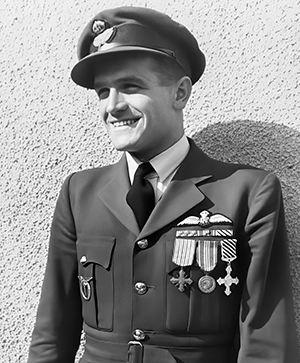
Pre WW2
Leo Anderle was born on 24 May 1913 in the small village of Nosálovice, part of Vyškov, in the southern region of Moravia, about 120 miles south east of Prague. He was the youngest son of Leonhard and Josefa Anderle and had two older brothers – Jan and Stanislav. Whilst actually named Leonhard after his father, he was usually known just as Leo. On completion of four years of secondary school, he continued his education for a further three years, where he trained to be a car mechanic. He was then employed at a branch of the Škoda factory in Brno, but like many young Czechoslovak men at that time, his ambitions had become focused on aircraft. Fuelling that aspiration was both Jan and Stanislav had joined the Czechoslovak Air Force, had undertaken flight training and were now military pilots.

To move into the aviation industry, Leo got a job as an aircraft mechanic in Otrokovice, in the Moravian region of the country, some 150 miles south east of Prague. There he worked for A.S. Walter, továrna na automobily a letecké motory, one of Europe’s leading aircraft engine manufacturers, who had a branch there, and he also worked for the Zlínská letecká společnost [Zlín Aircraft company] who were part of the Baťa Shoe Group who itself had their own air cargo fleet there.
Military Service

In October 1933, Leo was required to start his compulsory military service. He enlisted at Brno and was assigned to the 14th Brno autopraporu [Automobile Battalion]. However, due to his civilian aircraft mechanic training, after completing a shortened mechanics course, he was posted to the 2nd “Dr. Edvard Beneš Air Regiment, which were deployed at Olomouc airbase, to work on aircraft.at the rank of desátnik [Cpl].In 1934 he was posted to Prague and whilst there, undertook training for a civilian private pilot’s licence.
That August, he was posted to the Military Aviation Academy at Prostějov for training as a military pilot, from which he graduated, with a rating of ‘very good’, in October 1936. mongst his fellow pilot graduates that year were Josef Horáček, Karel Kopal, František Naxera and Otakar Žanta, all of whom he was to later meet in the RAF at 311 Sqn.

Leo was then posted to the 2nd Observation Sqn of the 1st Air ‘T.G. Masaryk’ Regiment who were deployed at Kbely airbase, Prague. During that period, he completed a night flying course and that December, he was promoted to the rank četař [of Sgt]. In 1938 he attended a fighter pilots training course, but unlike most of his fellow trainees who aspired to become fighter pilots, Leo preferred flying multi-engined aircraft and was selected for that training.
Mobilisation

The build-up of military forces by Nazi Germany along the Czechoslovak borders caused the Czechoslovak government to declare a partial mobilisation, on 20 May 1938, to counter that threat. Later that year, the agressive overtures by neighbouring Nazi Germany regarding the Sudeten regions – the German speaking areas – of Czechoslovakia caused the Czechoslovak Government to again declare a mobilisation on 23 September 1938.
During this tense time, when Czechoslovakia was preparing to defend itself against a possible German attack, Leo was posted to the 6th Air Regiment, a light bomber and reconnaissance unit, who were deployed at Německý Brod [since 1945 Havlíčkův Brod] airbase and equipped with twin-engined Marcel Bloch MB-200 bombers. Their role, in the event of such attack, was to carry out strategic retaliatory strikes on Nazi troop concentrations.
Munich Dictat
Following the Munich Agreement, when the Sudetenland was ceded to Germany, Poland and Hungary also took some Czechoslovak territory. About 30% of Czechoslovakian territory had been lost, which included its border defences, and the new revised German border was now only some 30 km from Prague. The 71st squadron redeployed back to its peacetime base of Kbely.
Despite assurances given by Hitler at the Munich Agreement, also known in Czechoslovakia as the ‘Munich Dictat’ or ‘Munich Betrayal’, of 30 September 1938, that he had no further interest in territorial gains for Germany, just a few months later Hitler extended his demands that the remaining regions of Czechoslovakia become part of Germany.
German Occupation

After the German occupation of Czechoslovakia, on 15 March 1939, many of the Czechoslovak Air Force personnel were offered the opportunity to join the Luftwaffe. Only a handful accepted the offer, resulting in the Air Force being quickly disbanded by the Germans and all personnel dismissed. Leo was one of those who refused that offer, and on his release, returned home. The same fate befell most of those serving in the Czechoslovak Army. For the military personnel and many patriotic Czech citizens, this was a degrading period. Many, including Leo, wanted to redress this shame and humiliation and sought the liberation of their homeland. By this time, he had made 2,595 flight totalling 705 hours.

Resistance
Germanisation of Bohemia and Moravia had begun immediately, but, just four days later, internal resistance organisations were being established. On 19 March 1939, former Senior officers of the now-disbanded Czechoslovak military had started to form an underground army, known as Obrana Národa [Defence of the Nation]. Obrana Národa also worked in co-operation with Svaz Letců, the Airman Association of the Czechoslovak Republic. One of their objectives was to assist as many airmen and soldiers as possible to get to neighbouring Poland, where they could be formed into military units to fight for the liberation of their homeland. These two organisations provided money, a courier and other assistance to enable airmen to escape to Poland. Usually, this was by crossing the border near Ostrava, via the Těšín area, the Czechoslovak border region that had been occupied by the Poles following the 1938 Munich Agreement, into Poland.
To Poland
Leo was one of the many Czechoslovak airmen and soldiers who saw that it was their patriotic duty to go to Poland, from where they could participate in efforts to achieve the liberation of their country. On 3 June 1939, with the assistance of the two underground organisations, Josef travelled with fellow airmen Josef Kubák, Miroslav Mansfeld, Miroslav Kopecký, Josef Šnajdr and Josef Vopálecký. They travelled by train to Ostrava in north-east Czechoslovakia which was adjacent to the Český Těšín region. There they were met by a former presidential guard who guided them to the Polish border from where they crossed into Poland. Shortly after crossing the border on 9 June, they were detained by Polish police and taken to the local Police Station. Here their details were taken and as the Police station was small and unable to accommodate the six, they were permitted, under parole not to try and return to Czechoslovakia, to leave the Police station and stay in a nearby hotel that night. The following day they, returned to the Police station and were taken to Těšín Police station for further questioning. They were there for a week before they were released and travelled to Kraków, in southern Poland, where they reported for duty at the Czechoslovak Consulate.

Polish Disappointment
Unfortunately, once there, Leo and his colleagues, like all the previous escapees from Czechoslovakia, found that there was no enthusiasm from the Polish authorities to have Czechoslovak military units assembled on their territory as the Poles had no wish to provoke neighbouring Nazi Germany. This Polish attitude caused some of the Czechoslovak escapees to become discontented and disillusioned, with some considering returning to their homeland. Fortunately, patriotic speeches by General Ludvík Svoboda, a Legionnaire veteran from WW1 and Senator Vojtěch Beneš, brother of former Czechoslovak President Eduard Beneš, now exiled in in Britain, averted this return. Meanwhile the Czechoslovak Consulate at Kraków had been in negotiations with France, a country with which Czechoslovakia had an Alliance Treaty. Under French law, foreign military units could not be formed on its soil during peacetime. The Czechoslovak escapees, however, could be accepted into the French Foreign Legion, for a five-year period, but with the agreement that should war be declared, they would be transferred to French military units. The Czechoslovaks would, however, have to enlist with the French Foreign Legion for a five-year term. The alternative was to be returned to occupied Czechoslovakia and face German retribution for escaping – usually imprisonment or execution, with further retribution to their families in Czechoslovakia.

Leo and his companions,, like most of the Czechoslovak escapees, decided that their best choice was to go to France. Initially they were transferred to Bronowice Małe, a derelict former Polish Army barracks from the Austro-Hungarian era, on the outskirts of Kraków that was then being utilised as a temporary transit camp for the escaped Czechoslovak military prior to their transfer to France. The barracks were in poor condition, and already well inhabited by Czechoslovak escapees whilst arrangements were made for their transportation, by sea, to France. Leo was the 302nd escapee to be registered there, arriving on 11 June 1939.
After a short stay at Bronowice Małe, Leo, and 138 other escapees left Małe Bronowice by train for the Polish Baltic port of Gdynia where, on 17 June 1939, they boarded the ‘SS Sobieski’, a Polish passenger ship which sailed via Dover, where the Czechoslovak military were not permitted to disembark, to Boulogne in France, arriving on the night of 19/20 June 1939.

France
The Czechoslovak escapees were met at Boulogne by the Air Attaché from the Czechoslovak Consulate, Paris. Each escapee was given 20 francs to cover their immediate needs and after two days there, they travelled by train to Place Balard, Paris, the French Foreign Legion’s transit barracks in South West Paris, for enlistment. Here, medical examinations were undertaken and documentation prepared for their enlistment. While there, they were required to attend French classes, and so any free time was usually spent in Paris exploring the sights and practising their newly-learnt French with the girls they met.
French Foreign Legion
Leo was accepted into the French Foreign Legion, at the lowest rank of soldat, on 28 June 1939, and transferred to their transit centre at Fort St Jean at Marseille, on the French Mediterranean coast. On 28 August, they boarded the ‘General Tirman’, a transport ship which sailed to Oran on the Mediterranean coast of Algeria. From there, they travelled on to the Legion’s training base at Sidi-bel-Abbès, some 35 miles south of Oran. Here, he was assigned to the 1st Battalion of the Legion’s 1st Regiment.

Fall Weiß
Fall Weiß, the German invasion of Poland, commenced on 1 September 1939, and two days later Britain and France declared war on Germany. With war now declared, the Czechoslovaks were released from their Legion service contract and transferred to French military units.
l’Armée de l’Air
On 3 September, Leo was released to the l’Armée de l’Air and transferred to their Colonial Air Force at their Centre d’Instruction de Chasse (CIC) at Base Aérienne 140 Blida airbase, Algeria. There, he first flew the outdated Potez XXV, the French light multi-purpose fighter-bomber, a dual-seat, single-engined biplane designed during the 1920s. Then he flew the Marcel Bloch MB-200 bomber which he had flown in the Czechoslovak Air Force. This was the period of the ‘phoney war’ with very little activity on the Western Front in France.
On 20 November 1939, Leo was posted to Base Aérienne 103 de Châteauroux-Déols, the Armée de l’Air training airbase, some 140 miles south west of Paris, for additional bomber training. On 1 December 1939 he was promoted to the rank of caporal-chef [Cpl]. He had requested to be transferred for fighter pilot training five times, but each time he had been rejected. Hisnext posting was on 1 February 1940 to Base Aérienne 125 Istres-Le Tubé airbase, some 400 miles south of Paris, near the Mediterranean coast, some 25 miles north west of Marseille, where he trained on the twin-engined Caudron C-445 Goéland and then on the modern Marcel Bloch MB-210, a twin-engined bomber. On 1 May 1940, he was promoted to the rank of sergent-chef [F/Sgt].
The relative calm of the Phoney War ended with Fall Gelb , when at 05:35 on 10 May 1940, Nazi Germany attacked Holland, Belgium, Luxembourg and France. In France they came through the dense Ardennes Forest to skirt around the main defence of the Maginot line and swept Northwards towards the English Channel. The Battle of France had begun.
On 18 May 1940, Leo was posted to Base Aérienne 141 at Tafaraoui,, near Oran, Algeria, to where he flew, via Corsica, in one of the Marcel Bloch MB-210. Thus, Leo never flew operationally during the Battle of France.
In France, the lightning speed and ferocity of the German Blitzkrieg attack caused the l’Armée de l’Air units to rapidly retreat westwards.
It was now clear that the war in France was lost and it was just a matter of days before they would have to capitulate. The French high command ordered what remained of the Armée de l’Air to evacuate their aircraft and personnel to the French colonies in North Africa from where it could continue the fight. It was there that Leo and his fellow Czechoslovak airmen learned that France had capitulated and that Winston Churchill, the British Prime Minister, was appealing to all the evacuated Czechoslovak airmen to come to Britain and continue the fight from there. L’Armée de l’Air released the Czechoslovak airmen from their service so that they could make their journey to Britain.
On 17 June 1940, Leo wrote in his diary “France is burning and changes in ruins,” massive sabotage, I really was not wrong France is riddled with traitors and spies throughout …,” sounded his bitter condemnation. And three days later no less bitterly continues: “I have ten months at school and not at all surprised that the French lose. ignite in France aircraft, because there are not pilots and we are staring because we have airplanes. All flees in confusion and tell the horrors of the queue, but when I come to the dining room, there’s a lot of fun and roar as if the French defeated the Germans. Definitely not occur elsewhere than to perish. So beautiful and rich country so corrupt nation. And our leaders did not see it, or did not want to see…”
Operation Aerial
With the imminent capitulation of France, the Czechoslovak airmen stationed at Toulouse airbase on mainland France had travelled in a group, commanded by Captain Emil Bušina, to Port Vendres, on the Mediterranean coast, some 90 miles away. There, on 19 June, they embarked on the SS ‘Meonia’ to Oran, Algeria. At Oran, they had been joined by Czechoslovak airmen stationed there, including Leo. From Oran, they travelled for four days by train across the Sahara Desert to Casablanca, Morocco, from where they boarded the ‘Gib-el-Dersa’, which sailed at 15:12 on 29 June 1940 to Gibraltar, arriving at 11:00 on 30 June. Here they changed ships to the ’Neutralia’ and sailed on 2 July, in a convoy of about 30 other ships, for Liverpool, England, arriving on 12 July 1940.

RAF
On arrival in England, Leo and his fellow evacuees went first to the Czechoslovak resettlement camp at Cholmondeley Park, near Chester, for security vetting. From there, on 26 July 1940, as a trained pilot, Leo was accepted into the RAF Volunteer Reserve, at the rank of AC2 and transferred to the Czechoslovak RAF Depot at RAF Cosford, near Wolverhampton, for basic training, some elementary English lessons and on the Links Trainer flight simulator.

Whilst at this time Britain was under threat of invasion by Nazi Germany and the RAF’s emphasis was on finding fighter pilots for the Battle of Britain. Thus, Czechoslovak fighter pilots were quickly accepted into the RAF Volunteer Reserve and sent for fighter aircraft retraining. However, at RAF Cosford, there was now also a pool of experienced Czechoslovak airmen assembling that were not fighter pilots. They thus became the embryo for a bomber squadron which would not need extensive retraining, but only to undertake some brief retraining to familiarise them with RAF equipment and procedures. The officers amongst them were formally commissioned and they began to attend English language classes.
To provide a training cadre, serving RAF personnel were drafted in and a number of RAF ground staff were also posted to the new unit to provide technical and administrative support. Such training was initially undertaken at RAF Honington using nearby RAF East Wretham as a satellite airfield.
On 29 July 1940, Leo was posted to the 311 [Czechoslovak] squadron, becoming one of its founding members. The squadron was a newly formed bomber unit deployed at RAF Honington, some 7 miles north of Bury St Edmunds, Suffolk.
To 311 Sqn
The squadron was in No.3 Group of RAF Bomber Command, and equipped with Vickers Wellington twin-engined medium-range bombers. Initially the squadron was jointly commanded, with Wing Commander Karel Mareš (who chose to change his surname to Toman to protect family and relatives who remained in the former Czechoslovakia), together with Wing Commander John Griffiths DFC, a Canadian serving in the RAF. Its role at that time was bombing raids on the Channel ports to thwart the build-up of landing barges that the Germans were assembling there in anticipation of invading England. They also attacked the railway marshalling yards in northern occupied Belgium and France to frustrate the movement of the German Wehrmacht to those Channel ports.
In WW2, the standard operational tour for a RAF Bomber Command crew was 30 completed operational sorties. But by 1941, the odds of surviving a full tour were slim, and statistically, only 1 in 6 were expected to complete their first tour without being shot down and killed or captured.

Leo was promoted to the rank of Sgt on 10 October 1940. His first operational flight with 311 Sqn was on 14 October 1940, when three of the squadron’s Wellingtons were tasked with bombing the harbour at Le Havre, France. Leo was co-pilot to Sgt Jaroslav Bala in Wellington N2773, K, which took off from RAF Honington at 19:42. Despite heavy anti-aircraft fire, all three aircraft reached the target and dropped their bombs from between 12,000 and 16,000 feet and bomb-bursts were seen in the target area. All three aircraft returned back to base, with N2773 landing at 00:12 after a flight of 4hours 30 min.

However, just a few days later, the night of 16/17 October was the darkest ever for 311 Squadron. Captain of Wellington N2773 K was Josef Šnajdr and Leo was co-pilot. It was one of four 311 Sqn Wellingtons dispatched for a raid on Keil and the naval base at Bremen, Germany. They had taken off at 18:30. They reached their target, but due to low cloud, they were unable to observe the results of their bombing. On the return flight to base from the raid it became iced up. The radio failed, and due to the ground being totally obscured by cloud, the crew were unable to get a positional fix. Hoping for a break in the cloud, Šnajdr decided to stay airborne to the limit of his fuel. He took the aircraft down to below five hundred feet, and the crew had a brief glimpse of a strange piece of coastline, but were still uncertain as to where they were.
Sometime later, with the fuel rapidly running out and no break in the overcast, Šnajdr reluctantly ordered Leo and his crew to prepare to jump. After a quick round of handshakes and good luck wishes, the crew, one by one, leapt out into the blackness. It was raining heavily, so the crew got a soaking to add to their misfortune. One crew member, after a safe landing, knocked at a cottage door and requested help. He was promptly held up at gunpoint by the irate cottager. For him, this was the last straw, and he fainted! He came to sometime later, comfortably ensconced in an armchair and had his spirits revived with a mixture of tea and whisky. He was then collected by the village policeman and spent the remainder of the night at his home. A second crew member arrived at the village doctor’s home, having spent an hour trying to get down from a tree in which his parachute had become entangled. Unfortunately, things did not go well for P/O Miloslav Vejražka, the wireless operator Officially it was reported that his parachute had failed to open properly and that he fell to his death (although other accounts suggest that he was shot and killed by members of the local Home Guard, who mistook him for a German paratrooper!). The aircraft came down near Blidworth in Nottinghamshire.
Of the four aircraft sent out, three did not return to base, and of their eighteen crew members, ten men were killed, two were captured and one was seriously injured. S/Ldr Jan Veselý’s Wellington had crashed in the grounds of Bentley Priory, with only František Truhlář surviving, but very badly burned. The Wellington flown by P/O Bohumil Landa was shot down over the Zuider Zee, Holland, and the entire crew were killed.
The translated script of a radio broadcast made on the BBC by Leo to his homeland in early 1941 here
On 13 January 1941 Leo was promoted to the rank of F/Sgt and on 23 July that year he was commissioned at the rank of P/O. During this period, he had flown bombing raids on the Channel ports of occupied France and Belgium as well targets in Germany. This included repeat raids to Bremen, Cologne, Keil and other targets in Germany as well as the German battle-cruisers Scharnhorst and Gneisenau at Brest harbour, France. Flight times ranged from about 2.5 hrs for Channel port raids to between 4 to 7 hrs to Germany, the longest being 8 hrs 50 min for a raid on Bremen.
At the end of October 1941, after having completed 26 operational flights, totalling 126.5 hours in RAF Bomber Command, Leo volunteered to join 138 Sqn for special duties. As a pilot Leo was rated as quite exceptional, an above average pilot with nerves of steel.
To 138 [Special Duties] Sqn
138 Sqn was a RAF special duties squadron and the first unit dedicated to supporting resistance movements and intelligence services in occupied Europe. Initially deployed at RAF Newmarket, some 60 miles north east of London. 138 Sqn were equipped with a mix of single-engined Lysanders, twin-engined Armstrong Whitworth Whitleys, four-engined HandleyPage Halifaxes and Short Stirlings. These multi-engined former bomber aircraft often had defensive gun turrets removed or modified to decrease drag and improve performance and range for long-haul night flights. They made clandestine flights dropping Special Operations Executive [SOE] agents and supply containers on designated landing zones on moonless nights.
The first Czechoslovaks to be posted to 138 Sqn were Jaroslav Bala, Vladimír Slánský and Miroslav Cígler, who had been posted there on 7 October 1941 from 311 Sqn. Two days later Leo, Karel Kvapil, Oldřich Šiška and Jan Timko, also from 311 Sqn, joined them.
First, Leo was sent to RAF Abingdon, south west of Oxford, which was one of the principal Bomber Command OTU [Operational Training Unit] airfields for training aircrews for the Whitley aircraft. On 5 September 1941, during one of these training flights, his Whitley crashed while attempting a night landing, but no injuries were incurred by the crew. Despite this mishap, Leo was passed for operational flying on the Whitely. The role of 138 Sqn required some specialist training and next, on 12 October 1941, Leo was sent to No. 1 Parachute Training School, at RAF Ringway for training in the dropping of parachutists from aircraft. He returned to 138 Sqn on 24 October 1941.
His first operational flight with 138 Sqn was on the night of 7 November 1941 in Whitley Z9125 in an attempt to drop three-man teams of SOE agents for Operation Silver A into Czechoslovakia. This was part of the military operation against the Nazi occupation there and was organised by the Intelligence Section of the Czechoslovak government-in-exile, in London, with the assistance of the British SOE and the RAF. Unfortunately, this early Czechoslovak SOE insertion attempt was unsuccessful, due to weather and navigational difficulties over a blacked-out occupied Europe as the crews relied on dead reckoning and visual cues, and they were operating at the limit of the Whitley’s flying range. They returned to base with the agents after a flight of some 1,600 miles. On 30 November, for Leo’s next operational flight, he made a 2nd attempt but again encountered similar difficulties and was unsuccessful.

Between 12 December 1941 and 3 March 1942, Leo made five clandestine flights over occupied France; to drop SOE agents, usually in a group of three, to the French resistance. On 12 December 1941, a blind drop of the PERSIL group near the Brière Marshes, just north of Saint-Nazaire on the Atlantic coast. The squadron redeployed to RAF Stradishall, near Bury St Edmunds, Suffolk, on 16 December 1941. Then, on 25 January 1942 to Château de La Vallière, in the Loire region, where he dropped the DACE team 2km south of Mulsanne and the CYPRUS and HORNBEAM teams near Vermeil. No reception committee was spotted, but the agents were dropped regardless. Then on 3 March 1942, to Étang de Thau, south-west of Montpellier to drop the RUM team from an altitude of 600 feet, all which were successful. But the drop at Le Mans in north west France on 7 January 1942 with the MOUSE, VERMILLION teams nor with the LUCKYSHOT, WEAZEL teams at Saint Quentin on 28 January 1942 were unsuccessful due to appalling weather. Whilst these missions highlighted 138 Sqn’s growing experience in long-range SOE insertions, they clearly demonstrated the limitations of the Whitley’s suitability after the earlier difficult flights in northern France and Czechoslovakia. By early 1942, the Halifax Mk II enabled safer operations with an improve range, payload, and reliability for night operations over occupied Europe than the Whitley. By this time, Leo had made a total of seven operational flights in them. On 11 March 1942, 138 Sqn redeployed to RAF Tempsford, Bedfordshire, some 50 miles north of London.

For conversion to Halifaxes, Leo was posted on 15 March 1942, to No 1652 HCU [Heavy Conversion Unit] which was stationed at RAF Marston Moor, some 10 miles west of York. This was a major RAF heavy bomber training airbase in Yorkshire. He completed the course ten days later.
Leo’s first operational flight in a Halifax was on the night of 28/29 March 1942 when he flew the Outdistance team to Czechoslovakia. At the controls of Halifaxes, he made five operational flights to Czechoslovakia: on 25 April 1942 with the BIOSCOP, BIVOUAC and STEEL teams, which was unsuccessful, then again on 27 April 1942 which was successful. Each of these Czechoslovak flights were of 13 to 16 hour duration and of 1,300 to 1,500 miles distance. Leo made 15 flights to various locations in France from Marseille in the south to six at Lyon in the north, with flights times between 5 to 7 hour duration and 1000 mile distance, one to Norway of 12 hour duration and 1500 miles distance and one to Austria.
The Austrian flight was to drop the Whiskey team at Passau on 8 April 1942. Leo took off at 20:25 from RAF Tempsford, in Halifax L9613 and set course for his destination, but soon encountered thick fog and icing. He arrived north of Manheim, Germany at 23:15, but with occupied Europe blacked out and it being a moonless night, he was unable to identify any features on the landscape below as a navigational point. Thus, south of Manheim he decided to abort the mission and return. On the return route he was flying over Paris, but only realised that when he recognises the castle of La Roche Guyon, on the Seine below Paris. They cross the French coast at Ally, just west of Dieppe at 03:30 and encounter bad weather over the English Channel, landing back at RAF Tangmere at 04:40. On 23 July 1942, Leo was promoted to the rank of F/O.
On 5 September 1942, Leo was awarded the DFC gallantry medal, the citation for this award reads:
“This officer is the captain of a Czech crew. He has completed successfully many long-distance sorties and has displayed keenness and determination which have greatly inspired his crew. In April 1942, within five days, he participated in three sorties over Czechoslovakia which were of the greatest importance. Pilot Officer Anderle has always shown eagerness to undertake operations of a difficult nature.”
Fateful Flight
On 8 November 1942, Operation Torch – the Allied invasion of French North Africa -commenced. Whilst the role of 138 Sqn was primarily intended for SOE work over occupied Europe, after Operation Torch had began, it was necessary to reinforce Allied transport activities to support it. From 311 Sqn, seven Halifaxes and two from 161 Sqn were assigned to 511 Sqn, an RAF Transport Command squadron, as temporary reinforcements for the transportation of supplies to North Africa and the Middle East.

On the night of 10 December 1942, Halifax Mk II, W1002, NF-Y, with Leo at the controls, took off from LG-224, a temporary airfield at Jabal al Manşūrīyah, 20 miles west of Cairo bound for Malta, en-route for England. On board were Leo’s crew of W/O Václav Pánek, co-pilot, F/O Viktor Krcha, navigator, František Vaníček, wireless-operator, P/Os Miroslav Rozprým and Josef Tesař, air-gunners and F/Sgt Bohumil Hájek, flight engineer and ten British, Canadian and New Zealand passengers [8 pilots from RAF squadrons and 2 mechanics.
On board were eight passengers. They were scheduled to land at Malta, but the aircraft disappeared without trace over the Mediterranean Sea, and no further radio contact or crash location was definitively established. At the time it was believed that the Halifax had been shot down near Benghazi by Luftwaffe night fighters, but post-WW2 research into Luftwaffe records have shown no claims for that night.
All on board are commemorated on the El-Alamein memorial, Egypt. This loss essentially ended the activities of Czechoslovak airmen in 138 Sqn, dating back to 7 October 1941. During January 1943 the squadron’s remaining three Czechoslovak airmen were posted back to 311 Sqn.
F/O Leo Anderle DFC was 29 years old. During his RAF service he had made a total of 56 operational flights.
Medals Awarded
Distinguished Flying Cross
War Medal
Válečný kříž 1939 & 3 bars
Za chrabrost & bar
Za zásluhy I.stupně
Pamětní medaile se štítky F–VB
Légion d‘Honneur au grade de Chevalier
Croix de Guerre with two palmes and a silver star
Remembered
Czech Republic:
Ledce:
There is a memorial commemorating hime at the cemetery at Ledce.

Prague 1 – St Vitus Cathedral:
He is remembered in the Remembrance book at St Vitus Cathedral, Hradčany, Prague.
Prague 1 – Klárov:
In November 2017, his name, along with the names of 2533 other Czechoslovak men and women who had served in the RAF during WW2, was unveiled at the Winged Lion Monument at Klárov, Prague.

Prague 3 – The Army Museum:
He is remembered on the Memorial Plaque at the Military History Institute, at Žižkov Prague.

Prague 6 – Dejvice:
He is named on the Memorial for the fallen Czechoslovak airmen of 1939-1945, at Dejvice, Prague 6.

Prague 9 – Černý Most:
In 1991, a street in the Černý Most suburb of Prague 9, which has streets named after numerous WW2 Czechoslovak airmen who served in the l’Armée d’Air or the RAF, a street was named ‘Anderleho’ in his honour.

Vyškov:
There is a symbolic grave for him at the family tomb at Vyškov.

Egypt:

He is commemorated on the Allied Memorial at el-Alamein.
Great Britain:
London – West Hampstead :
He is remembered on the Memorial Plaque at the Bohemia House, the former Czechoslovak National House, at West Hampstead, London.

Discover more from Free Czechoslovak Air Force Associates ltd
Subscribe to get the latest posts sent to your email.
