
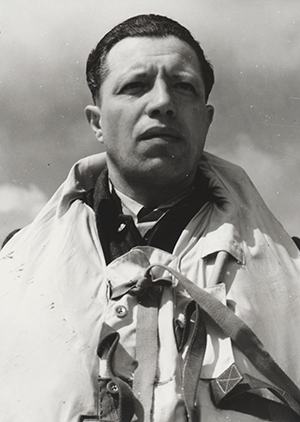
* 28.06.1910, Brno.
† 29.07.1976, Brno.
Pre WW2
Josef Keprt was born on 28 June 1910, in Brno, a city in the Moravian region of Czechoslovakia, some 180 km south-east of Prague. For his education he completed 5 years of general education, 4 years at secondary school and 3 years at technical school, and then trained as a mechanic.
Czechoslovak Air Force
In 1928, now aged 18, for his mandatory military service. Josef volunteered for the Air Force and was assigned as a cadet to the Military Aviation Academy at Cheb and then to the Military Aviation Academy at Prostějov for pilot training. In 1930, having been awarded his pilot’s wings, he was then posted as an operational pilot to the 2nd ‘Dr. Edvard Beneš’ Air Regiment who were deployed at Olomouc airbase. In 1934 he was selected for fighter pilot training and was posted, at the rank of rotmistr (Sgt), to the 34th Fighter Squadron of the 2nd Air Regiment at Olomouc. They were equipped with Avia B-534 biplane fighter aircraft, the most advanced fighter used by the Czechoslovak Air Force.
Mobilisation

By the Autumn of 1938, the political situation in central Europe was changing rapidly. Hitler and the Nazis in Germany were making territorial demands on the Czechoslovak Government in respect of the Sudetenland border regions. This resulted in Czechoslovakia calling a general mobilisation and thus all men of military age were drafted into the military to help defend the country in the event of invasion.
During the mobilisation, Josef held the position of squadron commander of the 36th fighter squadron of the 2nd Air Regiment, who were also equipped with Avia B-534 aircraft. By the time of the German occupation of Czechoslovakia, in March 1939, Josef held the rank of rotmistr (Sgt) and had achieved 1220 flying hours of experience.
German Occupation

Despite assurances given by Hitler at the Munich Agreement, that he had no further interest in territorial gains for Germany, just a few months later he extended his demands that the remaining regions of Czechoslovakia become part of Germany.
On the evening before the invasion, on March 14, 1939, Czechoslovak intelligence officers called a meeting where they announced that the threat of invasion was imminent and recommended measures which would prevent the most important assets from falling into German hands. However, no orders were handed down until too late. The Chief of the Czechoslovak Air Force General Fajfr and his deputy General Vicherek ordered that no aircraft were allowed to take-off. The Department of the Ministry of National Defence started organising the transfer of the aircraft to several airfields in Moravia with the intention to get the airfleet to Romania and Yugoslavia. None of these plans were carried out.
The Germans occupied Czechoslovakia on 15 March 1939. Under pressure, Emil Hácha, the Czechoslovak President, had acceded to their demands and, in the early hours of that day, he had ordered all Czechoslovak military units to stand down, remain in their barracks and not resist the occupation. Germanisation of Bohemia and Moravia began immediately: they were now the Reich Protectorate of Bohemia and Moravia (Protektorat Böhmen und Mähren), while Slovakia, in return for its allegiance to Nazi Germany, had become the puppet ’independent’ state of Slovakia.
Resistance
But just four days later, on 19 March 1939, former senior officers of the now-disbanded Czechoslovak military had started to form an underground army, known as Obrana Národa [Defence of the Nation]. Obrana Národa also worked in co-operation with Svaz Letců, the Airman Association of the Czechoslovak Republic. One of their objectives was to assist as many airmen and soldiers as possible to get to neighbouring Poland where they could be formed into military units to fight for the liberation of their homeland. These two organisations provided money, courier and other assistance to enable airmen to escape to Poland. Usually, this was by crossing the border from the Ostrava region because of the close proximity of the ‘new’ Polish border since Poland had occupied the Český Těšín region of Czechoslovakia on 10 October 1939.

Josef was actively opposed to and outspoken about the Germans and their occupation; this led to his arrest by the Gestapo in Olomouc in April 1939. He was released in May 1939 but threatened with being sent to a concentration camp should he continue to provoke anti-German sentiment. Josef however saw it as his patriotic duty to continue resisting the German occupation and decided, like many other Czechoslovak airmen and soldiers to go to Poland from where they could fight to achieve the liberation of Czechoslovakia.
To Poland
On the night of 13 June 1939 Josef, along with former Czechoslovak airmen Václav Cukr, Viktor Kašlík and Jan Mašat, smuggled himself aboard an empty wagon on a coal-train near Kunčice, Ostrava, which took them over the border to Poland. They then reported to the Czechoslovak Consulate in Kraków.

Disappointment in Poland
However, there they were informed that the formation of Czechoslovak military units in Poland were unfortunately just rumours because the Polish authorities would not allow Czechoslovak military units to be formed on its territory for fear of provoking Nazi Germany.
Instead, he learnt that Vladimír Znojemský, the Czechoslovak Consul, had, via his counterpart in Paris, negotiated with the French Government that the escaped Czechoslovak military would be permitted to travel to France. But there was a condition: as French law did not permit foreign military personnel on its territory during peacetime, the Czechoslovaks would be required to enlist in the French Foreign Legion for a period of five years – but with the assurance that in the event of war being declared, they would be released from the Legion and transferred into French military units. The alternative was that they would be sent back to Czechoslovakia, now a German protectorate, where execution or deportation to a concentration camp would be the most likely outcome. Karel decided that his best choice was to go to France.
Initially, Josef and his fellow escapees were accommodated at the ‘Dom Turystczny’, a cheap tourist hostel near the Czechoslovak Consulate while preparations were made for their onward journey to France. The hostel was now overfull with Czechoslovaks, so they were then transferred to Bronowice Małe, a derelict former Polish Army barracks from the Austro-Hungarian era, on the outskirts of Krakow. This was then being utilised as a temporary transit camp for the escaped Czechoslovak military prior to their transfer to France. Josef arrived there on 1 July 1939, the 658th Czechoslovak escapee to arrive. The barracks, which were in poor condition, were already well inhabited by Czechoslovak escapees who stayed while arrangements were made for their transportation, by sea, to France. In the meantime, there was very little for the escapees to do there apart from being patient, keeping fit, exercising, and, when possible, playing football against local teams.

To France

On 25 July 1939, Josef and 189 other Czechoslovak military escapees were taken by train to the Baltic port of Gydnia, Poland. The following day they boarded the SS ‘Kastelholm’, a Swedish coastal steamer, and sailed to Calais, France. Part of the voyage down the Baltic Sea was very rough, even for airmen who were used to flying in turbulent conditions, and so the stop at the Danish port of Frederikshaven to re-supply was a welcome relief for the Czechoslovaks onboard. After a five-day voyage, they arrived in Calais on 31 July 1939.
France
At Boulogne, they disembarked and after some refreshments, they boarded a train for the thirteen-hour journey to Paris. They arrived there at 17:30 and were taken by coaches to the French Foreign Legion’s recruitment barracks at Place Balard, in the South West of Paris. There they had to undergo medical checks and further tests, whilst the necessary documentation was prepared for their enlistment into the Legion and their transfer to the Legion’s training base at Sidi Bel Abbès, Algeria. During this period they would usually attend French classes and any free time was spent in Paris exploring the sights and practising their newly learnt French with the girls they met. Before that transfer process could be completed, war was declared and Josef and the other Czechoslovak airmen were transferred instead to the l’Armée de l’Air at their BA117 recruitment centre at Dungy, near Paris.
On 24 September 1939 he was transferred to Centre d’Instruction de Chasse at Chartres, the l’Armée de l’Air fighter training airbase, about 50 miles South-West of Paris, for re-training onto French fighter aircraft.

After some 18 hrs of retraining, Josef was awarded his l’Armée de l’Air pilot’s wings. On 2 December 1939, now at the rank of sergent [Sgt], Josef along with fellow Czechoslovaks Jindřich Beran, Josef Stehlík, to 5 sqn of GC III /3, Evžen Čížek, Josef Hubáček and Václav Šlouf was posted to its 6 sqn who were deployed at Toul-Ochey airbase some 260 km south-west of Paris and equipped with MS-406C fighter aircraft. This was the period of the ‘phoney war’ with very little activity on the western-front in France. During this time GC III /3 were mainly flying patrols along their section of the western front but with little sighting of Luftwaffe aircraft.
Battle of France

The relative calm of the Phoney War ended at 05:35 on 10 May 1940 when Germany attacked Holland, Belgium, Luxembourg and France. In France they came through the dense Ardennes Forest to skirt around the main defence of the Maginot line and swept Northwards towards the English Channel. The lightning speed and ferocity of their Blitzkrieg attack caused the l’Armée de l’Air units to rapidly retreat Westwards.
By 17 May, GC III /3’s 5 squadron were now deployed at Maubeuge airbase at Elesmes in north-west France, near the Belgium border and had been re-equipped with the superior Dw-520 fighter aircraft.The Czechoslovaks were joined by six more of their countrymen: František Běhal, Jan Čermák, Bedřich Krátkoruký, Tomáš Kruml, Karel Kuttelwascher and Josef Novák who had completed their re-training at Chartres. During the Battle of France Josef achieved combat success:
| Date | Time | Action |
13.05.40 |
05:35 |
a Henschel Hs 126 shared probable north of Namur, Belgium |
14.05.40 |
07:40 |
a Dornier Do 17p shared victory, north of Namur, Belgium |
16.06.40 |
14:00 |
a Henschel Hs126 a shared victory near Auxerre, France |

However, the rapid German Blitzkreig forced the Allied frontline back causing l’Armée de l’Air to frequently move its airfields westwards. In the case of GC III/3, by the early part of June, this was now happening on a daily basis.
The French authorities had by now realised that the war on mainland France was lost and sought to evacuate as much of their military to Algeria as they could. With the French capitulation imminent, GC III/3 were now at Perpignan, La Salanque airfield, in south-west France. Some 250 aircraft from other units had already congregated there en-route to Algeria. There everything was very chaotic, and with few ground-crew available, the pilots of GCIII/3, had to refuel their aircraft themselves. The Dw-520Cs were fitted with long-range fuel tanks and hand-operated starters. The following day, at the hour of their en-mass departure, each pilot had to start their engine manually.
Even with the extra range given by the long-range fuel tanks and without the aircraft carrying any ammunition, the flight over the Mediterranean Sea was only just achievable. Further weight saving was achieved with the pilots themselves limited to only a small bag containing real essentials – all their other possessions had to be left behind. In the event of being forced to engage with any Luftwaffe aircraft en-route to Algeria, the Dewoitine Dw-520Cs would not have enough fuel to reach the Algerian coast. On 19 June the aircraft of GC III/3 took off and after a 700km uneventful flight, they reached the Algerian coast and landed at the l’Armée de l’Air airbase at Maison Blanche, Algeria. By the time of this evacuation, Josef had flown more than 50 operational flights in the service of l’Armée de l’Air.
Evacuation to England

It was there that they learned that France had capitulated on 22 June. Winston Churchill, the British Prime Minister, appealed to all the evacuated Czechoslovak airmen to come to Britain and continue the fight from there. The l’Armée de l’Air released the Czechoslovak airmen from their service so that they could make their journey to Britain. On 4 July 1940, they left Maison Blanche by train and travelled for four days to Casablanca, on the Atlantic coast of Morocco. From here, on 4 July, under the command of štábní kapitán Josef Duda, they boarded the SS ‘Royal Scotsman’, which sailed on 9 July and took them to Gibraltar. There they boarded the ‘David Livingstone’ which sailed on 21 July 1940 to Cardiff, arriving on 5 August 1940.
RAF
On arrival at Liverpool, Josef’s first path, as for most of the Czechoslovaks, led to the Czechoslovak resettlement camp at Cholmondeley Park, near Chester. The first Czechoslovaks boarded a train to Nantwich, Cheshire, some 30 miles away, and from there marched to Cholmondeley Castle, 8 miles away. Here they were billeted in a tented camp in the grounds where they were security vetted. The Battle of Britain was now in progress and the RAF urgently needed trained pilots, and the Czechoslovaks – many of whom had already seen combat in France – were particularly valued. As a trained pilot, with combat experience, Josef was quickly transferred to the Czechoslovak RAF Depot, Cosford, where, on 14 August 1940, he was admitted to the Volunteer Reserve of the RAF, with the rank of AC2. There, as when joining l’Armee de l’Air the previous year in France, the Czechoslovak airmen were given theoretical aviation training and language lessons, this time for British aircraft and the language was English.

On 5 September, at the rank of Sgt, Josef was posted to the newly formed 312 (Czechoslovak) Sqn, becoming one of its founding members. By this time, he had amassed more than 2000 flying hours and had considerable combat experience against the Luftwaffe in the Battle of France. The squadron, along with the also newly formed 310 [Czechoslovak] Sqn, were deployed to RAF Duxford and equipped with Hawker Hurricane Mk I fighter aircraft. With the other Czechoslovak pilots there, some still in l’Armée de l’Air uniform, they had British flying instructors to re-train them on Hurricanes and also continued with English lessons to the required RAF standard.
This training was not without incident for Josef. On a training flight on 10 September at 15:15 the engine of his Hurricane, L1644, suddenly caught fire while flying near Cambridge. Josef bailedout at 1400 feet and landed safely. His aircraft crashed onto a railway line south of Cambridge and was burnt out. By escaping from his stricken aircraft by parachute, Josef had also joined another exclusive club – the ‘Caterpillar Club‘, whose membership criteria was to have escaped from a disabled aircraft by parachute and survived. This was the squadron’s first aircraft loss of the war.
Battle of Britain
With 310 Sqn becoming operational on 17 August, it meant that there were now only a few aircraft available to 312 Sqn for the re-training of their pilots. On 26 September, 312 Sqn redeployed to RAF Speke airfield at Liverpool and part of 9 Group RAF Fighter Command. On completion of their retraining, their role was the aerial defence of Liverpool and its docks as well as protection of Allied convoys to and from its docks.
The squadron was declared operational on 2 October and Josef made his first operational flight, a scramble, on 11 October in Hurricane H1926. Three Hurricanes took off at 13:30 for a patrol of the Chester area and landed back at 14:30 with no Luftwaffe aircraft being sighted. This being an operational flight thus qualifying him for the coveted Battle of Britain clasp.
During the Battle, Josef was to make a further six operational flights, totalling 5 hours 50 min, but all were uneventful with no engagement with the Luftwaffe.
After the Battle

He achieved combat success while with 312 Sqn. On the afternoon of 29 November 1940, three 312 Sqn Hurricanes were on patrol some 15-20 miles south west of Liverpool. At about 17:00 a Luftwaffe Do-205 was sighted at 21,000 feet. The Hurricanes went into combat, but only Josef managed to engage with it. His combat report for this action reads:
On the 29 November 1940 I took off as No 3 for a standing patrol from Speke. At the height of about 19,000 feet I saw a Do215 approx. 100 feet above at 10 o’clock. I immediately attacked with a short burst of fire. The e/a dived in the same direction. I followed, closing to about 50 yards. The gunner of the e/a fired tracers at a Hurricane flying at about 4 o’clock from the Do-215. After approaching the e/a to approx 350 yards I opened fire, and closed to 200 yards still firing. I saw some hits on the cockpit of the gunner and around it. After my firing the gunner stopped his firing. I also saw smoking left engine of e/a. The enemy aircraft turn sharply to the left.
As I had no more ammunition left, and it was getting dark, I made for home and landed at Speke.
I claim this Do-215 as damaged.
Rounds fired M.G 2400, 0.303.
Night Fighter
The Liverpool docks had become a vital lifeline to Britain’s war effort with some 90% of all war materials and food from North America arriving there. Thus, it became a prime target for Luftwaffe attacks causing it to be the most bombed city after London.
In early December 1940, Air Vice-Marshal McClaughry – Air Officer Commanding (AOC) of No. 9 Group RAF Fighter Command – decided to strengthen the night fighter defence of the Liverpool and Manchester area. From 312 Sqn, S/Ldr Ján Ambruš, P/Os Adolf Vrána, Vlastimil Veselý and Josef were assigned, with 4 Hurricanes, to RAF Cranage, some 30 miles south-west of Liverpool, for night fighter practise.
To 96 Sqn
On return back to 312 Sqn at RAF Speke, it was a continuation of mainly convoy patrols, training flights, a few night flights but very few combat opportunities. Josef wanted a more pro-active role in WW2 and volunteered for operational flying on night-fighters. On 8 February he was assigned to RAF Squire Gate, Blackpool and on 24 to 28 February for radio telecommunication speech training at RAF Stanmore, London.
On 24 March 1941, along with fellow Czechoslovak 312 Sqn pilots Josef Kloboučník, and František Chabera, Joseph was posted on detachment to 96 Sqn, who were deployed at RAF Cranage, where they joined Vlastimil Veselý who had been posted to 96 Sqn in February from 312 Sqn. There they were joined by Karel Bednařík and Oldřich Kanňovský, who had been posted from the Czechoslovak Depot as air-gunners. For his air-gunner Josef crewed up with Sgt Harper, a Canadian.
The squadron was a RAF squadron and comprised of multinational aircrews – British, Commonwealth and now Czechoslovak – and deployed at RAF Cranage, some 30km south of Manchester. They were now equipped with Boulton-Paul Defiant aircraft, similar in size to a Hurricane, but its only armament being four machine guns operated in a turret behind the cockpit, but with no forward guns mounted in its wings. The squadron’s role was the night defence of the industrial Midlands and the Liverpool docks.

Josef was commissioned at the rank of P/O on 26 May 1941. On 2 August 1941 he was injured when returning at 01:30 from a night-patrol in Defiant T3294. His engine failed and he instructed Sgt Harper, his air-gunner, to bail out and who landed safely – while Josef tried to make a ‘belly-landing’ at RAF Cranage. The Defiant hit a tree when approaching the airfield boundary and was wrecked. Josef was slightly injured in the crash and taken to Wilmslow Hospital for medical attention.
Return to 312 Sqn
On 3 May 1942, after recuperation from the injuries sustained in the crash, Josef returned to 312 Sqn, now deployed at RAF Harrowbeer, near Plymouth, Devon. There the squadron’s role was defensive operations in the southwest of England and convoy patrols for Allied shipping at the western end of the English Channel.
His next promotion, to the rank of F/O was on 26 May 1942. On 19 August 1942 he participated in Operation Jubilee, the ill-fated Allied landing at Dieppe, France During that day, Josef was in combat over Dieppe in Spitfire Vb EP432 and shot down a Dornier 217. His combat report for that action reads:
I was at 7,000 feet on patrol with my Squadron over the Convoy in Mid Channel when at 15:25 I saw flak from our ships and by watching the bursts recognised a Do-217 before me and to starboard. I chased without being sighted; the e/a actually turned towards me. I opened fire at 300 yards in a short head-on burst. After breaking away I turned immediately and saw black smoke from the left engine and the bombs were jettisoned. The e/a dived fairly steeply and I followed until I had to rejoin the Squadron. I claim this Do-217 destroyed as S/Ldr Cermak who saw the fight states that he saw it crash into the sea. I used my camera gun.
Josef’s final RAF promotion was on 26 May 1943, to the rank of F/Lt. He completed his second operational tour on 10 August 1943 and, for his mandatory rest period was posted to No 1 Delivery Flight at RAF Croydon, where he delivered replacement aircraft to operational squadrons. He was then posted, as a gunnery instructor, to 17 Armament Practice Camp [APC] at RAF Warmwell, Dorset. There, using the Chesil Bank ranges near Portland, he trained fighter pilots to hone their skills in air-to-ground firing for offensive strafing operations.
He returned to 312 Sqn, now deployed at RAF Mendlesham, on 10 March 1944. They were now equipped with Spitfires and he was appointed ‘A’ Flight Commander. During this period, he took part in numerous fighter escort and convoy protection patrols including the protection of the Allied invasion fleet on D-Day. His final operational flights were in September 1944, as part of Operation Market Garden and included strafing ground targets and providing cover for Dakotas flying to Nijmegen, Holland, with airborne troops.

Josef remained with 312 Sqn until 2 October 1944, when he ceased flying duties. By which time he had completed more that 230 operational flights in three operational tours.

Czechoslovak Inspectorate General
He was then posted to the Czechoslovak Inspectorate General, in London, as a Training Officer. Josef remained here until he returned to Czechoslovakia.
Post WW2
Josef relinquished his RAF commission and, at the rank of kapitán in the Czechoslovak Air Force, returned to Czechoslovakia on 19 August 1945. He was posted to 312 Sqn, who were now part of the Czechoslovak Air Force, and deployed at České Budějovic airbase. The squadron was disbanded on 30 September 1945 and he was posted, as a Staff Officer to the Military Aviation Academy at Hradec Králové as a gunnery and bombing instructor.
Communist putsch
Following the Communist take-over in February 1948, the Czechoslovaks who fought for the Allies in WW2 were regarded as being tainted by Capitalism and many were arrested, imprisoned and subjected to other persecution.
On 3 February 1949, he was placed on ‘waiting leave’ and dismissed from the Czechoslovak Air Force, and reduced to the lowest rank of vojín [AC2], on 31 December 1949. Despite his deteriorating health, he was able to find employment as a labourer for a construction company. During this time, Josef was subjected to constant persecution and harassment from the Communist authorities which included being evicted with his wife and young daughter from their flat in 1952. The family relocated to Brno where Josef was able to find menial employment, but working 8 to 12 hour shifts, at ZKL, an engineering company that specialised in the production of roller-bearings. But, despite the long-term effect of his war injury, he was not granted a full disability pension until 1965.
F/Lt Josef Keprt died, aged 66, on 29 July 1976 at Brno, Czechoslovakia.
Medals Awarded
Distinguished Flying Cross
1939 – 45 Star with Battle of Britain clasp
Air Crew Europe Star with France & Germany clasp
Defence Medal
1939-1945 War Medal
Válečný kříž 1939 and 3 bars
Za chrabrost and bar
Za zásluhy I.stupně
Pamětní medaile se štítky F–VB
Medaille Militaire
Croix de Guerre avec palme and 2 silver stars
Croix du Combattant; Medal of Liberation, with clasp ‘Liberation’
Remembered
Great Britain:
Capel-le_Ferne:
He is commemorated, along with the other 2940 Battle of Britain aircrew, on the Christopher Foxley-Norris Memorial Wall at the National Battle of Britain Memorial at Capel-le-Ferne, Kent:

Hawkinge:
Josef is remembered on the Czechoslovak Battle of Britain pilots memorial at the Kent Battle of Britain Museum at Hawkinge, Kent. It was unveiled on 28 October 2025, to commemorate the 88 Czechoslovaks who flew in that battle.

London – Battle of Britain Memorial:
He is also commemorated on the London Battle of Britain Memorial:
Czech Republic:
Brno:
On 14 September 2025, a memorial plaque commemorating him was unveiled at his hometown of Brno.

Prague 1 – Klárov:
In November 2017, his name, along with the names of 2524 other Czechoslovak men and women who had served in the RAF during WW2, was unveiled at the Winged Lion Monument at Klárov, Prague 1.

Article last updated: 30.10.2025.
Widgets
