
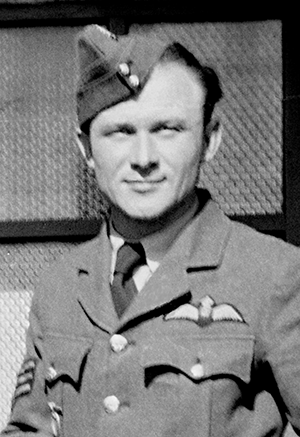
* 10.02.1911, Prague.
† 07.05.1995, Prague.
Pre WW2
Josef Vopálecký was born on 10 February 1911 in the Žižkov District of Prague. He completed 5 classes of primary school, 2 years of middle school and then 2 years of further education. On finishing his schooling, he was employed on a farm in Bulánky near Kostelec nad Černými lesy, some 17 south-east of Prague. However, like many other Czechoslovak young men, Josef was enchanted by aviation and aspired to join that elite group of men. In 1929, aged 18, he applied to join the Škola leteckého dorostu [ŠLD] the cadet school at the Military Aviation Academy at Prostějov. His application was successful and he joined there on 1 October and graduated in 1931.
Czechoslovak Air Force
For his mandatory military service Josef then joined the Czechoslovak Air Force in July 1929 and was assigned to the 10th Observation Squadron of the 3rd ‘M. R. Štefánik‘ Air Regiment deployed at Nitra airbase, Slovakia.

He was selected for pilot training, and on 1 April 1933 was assigned to the advanced fighter school at the Military Aviation Academy at Prostějov. He graduated from there in June and returned to his regiment, at the rank of Sgt, and was posted to the 38th Fighter Sqn who were deployed at Vajnory airbase, Slovakia.
Josef requested a transfer to the 6th Air Regiment deployed at Kbely airbase, Prague, where he served for the next three years. At their training unit he completed a course in night flying. From 22 May 1937 he served with the regiment’s 72nd [light bomber] squadron at Kbely airbase. That October he attended a training course at Milovice, from where he graduated and on 5 April 1938 he was posted to the Regiment’s 74th squadron who were deployed at Hradec Králové airbase and equipped with Avia B-71 (Tupelov SB-2) twin-engine light bombers.
Munich Dictat
Following the Munich Agreement, when the Sudetenland was ceded to Germany, Poland and Hungary also took some Czechoslovak territory. About 30% of Czechoslovakian territory had been lost, which included its border defences, and the new revised German border was now only some 30 km from Prague.
By the time of the German Occupation Josef had achieved 1007 flying hours and held the rank of Lieutenant.
German Occupation

Despite assurances given by Hitler at the Munich Agreement, that he had no further interest in territorial gains for Germany, just a few months later he extended his demands that the remaining regions of Czechoslovakia become part of Germany.
On the evening before the invasion, on March 14, 1939, Czechoslovak intelligence officers called a meeting where they announced that the threat of invasion was imminent and recommended measures which would prevent most important assets falling into German hands. However, no orders were handed down until too late. The Chief of the Czechoslovak Air Force General Fajfr and his deputy General Vicherek ordered that no aircraft were allowed to take off. III Department of the Ministry of National Defence started organising the transfer of the aircraft to several airfields in Moravia with the aim of getting the airfleet to Romania and Yugoslavia. None of these planned intentions came to be instigated.
The Germans occupied Czechoslovakia on 15 March 1939. Under pressure, Emil Hácha, the Czechoslovak President, had acceded to their demands and, in the early hours of that day, he had ordered all Czechoslovak military units to stand down, remain in their barracks and not resist the occupation. Germanisation of Bohemia and Moravia began immediately: they were now the Reich Protectorate of Bohemia and Moravia (Protektorat Böhmen und Mähren), while Slovakia in return for its allegiance to Nazi Germany, had become the puppet ‘independent’ state of Slovakia.
Resistance
Just four days later, on 19 March 1939, former Senior officers of the now-disbanded Czechoslovak military had started to form an underground army, known as Obrana Národa [Defence of the Nation]. Obrana Národa also worked in co-operation with Svaz Letců, the Airman Association of the Czechoslovak Republic. One of their objectives was to assist as many airmen and soldiers as possible to get to neighbouring Poland where they could be formed into military units to fight for the liberation of their homeland. These two organisations provided money, courier and other assistance to enable airmen to escape to Poland. Usually, this was by crossing the border from the Ostrava region.
To Poland
Josef was demobilised from the Czechoslovak Air Force. Like many other of his Air Force colleagues, he could not accept the Nazi occupation of his homeland and that Czechoslovakia couldn’t defend itself against Hitler’s Germany.
On 3 June 1939, with the assistance of the two underground organisations, Josef travelled with fellow airmen Leo Anderle, Miroslav Kopecký, Josef Kubak, Miroslav Mansfeld and Josef Šnajdr. They travelled by train to Ostrava in north-east Czechoslovakia. This was adjacent to the Český Těšín region which had been annexed by Poland following the Munich Agreement of September 1939. There they were met by a former presidential guard who guided them to the border from where they crossed into Poland. Shortly after crossing the border on 9 June, they were detained by Polish police and taken to the local Police Station. Here their details were taken and as the Police station was small and unable to accommodate the six, they were permitted, under parole not to try and return to Czechoslovakia, to leave the Police station and stay in a nearby hotel that night. The following day they returned to the Police station and were taken to Těšín Police station for further questioning. They were there for a week before they were released and travelled to Kraków, in southern Poland, where they reported for duty at the Czechoslovak Consulate.

Polish Disappointment
However, on reaching Poland, they were informed that the formation of Czechoslovak military units in Poland were just rumours because the Polish authorities would not allow Czechoslovak military units to be formed on its territory for fear of provoking Nazi Germany.
Instead, they learnt that Vladimír Znojemský, the Czechoslovak Consul, had, via his counterpart in Paris, negotiated with the French Government that the escaped Czechoslovak military would be permitted to travel to France. But there was a condition: as French Law did not permit foreign military personnel on its territory during peacetime, the Czechoslovaks would be required to enlist in the French Foreign Legion for a period of five years – but with the assurance that in the event of war being declared, they would be released from the Legion and transferred into French military units. The alternative was that they would be sent back to the German Protectorate of Czechoslovakia, where their execution or deportation to a concentration camp would be the most likely outcome.
Josef, like most of the Czechoslovak escapees, decided that his best choice was to go to France. At first Josef was accommodated at the ‘Dom Turystczny’, a cheap tourist hostel near the Czechoslovak Consulate whilst preparations were made for their onward journey to France.
He was then transferred to Bronowice Małe, a derelict former Polish Army barracks from the Austro-Hungarian era, on the outskirts of Krákow, which was then being utilised as a temporary transit camp for the escaped Czechoslovak military prior to their transfer to France. Josef arrived there on 11 June 1939, the 297th Czechoslovak escapee to arrive. The barracks, which were in poor condition, were already well inhabited by escapees whilst arrangements were made for their transportation, by sea, to France.

To France

After a short stay in Poland, Josef, along with 138 other Czechoslovak military escapees, 42 of whom were airmen, travelled by train to the Polish Baltic port of Gdynia, where on 17 June they boarded the ‘Sobieski’, a Polish passenger ship and sailed to Boulogne, France, arriving on 19 June.
France
The Czechoslovak escapees were met at Boulogne by the Air Attaché from the Czechoslovak Consulate, Paris. Each escapee was given 20 francs to cover their immediate needs and after two days there, they travelled by train to Place Balard, Paris, the Legion’s recruitment centre. Here medical examinations were undertaken and documentation prepared for their enlistment. While there they were required to attend French classes and so any free time was usually spent exploring the sights of Paris.
French Foreign Legion

Josef was accepted into the French Foreign Legion, on 28 June, at the lowest rank of soldat and transferred to their transit centre at Fort St Jean at Marseille, on the French Mediterranean coast. On 28 August, they boarded the ‘General Tirman’, a transport ship which sailed to Oran on the Mediterranean coast of Algeria. From there, they travelled on to the Legion’s training base at Sidi-bel-Abbès, some 35 miles south of Oran. Here, he was assigned to the 1st Battalion of the Legion’s 1st Regiment.

When Germany invaded Poland on 1 September 1939, Josef was with the Legion, at their base at Marrakesh, Morocco. Two days later Britain and France declared war on Germany resulting in the Czechoslovaks serving in the Legion being released from their Foreign Legion contract and transferred to French military units.
L’Armée de l’Air
For Josef this meant being transferred to the l’Armée de l’Air and moved to their airbase at Sidi Ahmed, near Bizerte, Tunisia, on 1 September 1939. There he started his re-training on French aircraft. On 14 September he was transferred to Algeria to their Centre d’Instruction at Blida airbase, their Base Aerienne no 140, some 25 miles south-west of Algiers for further flight training.
Josef and other Czechoslovak airmen were then transferred to mainland France to the l’Armée de l’Air’s BA 117 recruitment centre at Base Aerienne de Dugny, in the south-west outskirts of Paris. On 27 November he was posted, at the rank of sergeant, to the Centre d’Instruction de Chasse (CIC) at Chartres airbase, for re-training on French fighter aircraft and to continue learning rudimentary French. During this period of the Phoney War, they attended French classes and any free time was usually spent in Paris exploring the sights and practicing their newly learnt French with the girls they met.

The relative calm of the Phoney War ended at 05:35 on 10 May 1940 when Germany attacked Holland, Belgium, Luxembourg and France. In France they came through the dense Ardennes Forest to skirt around the main defence of the Maginot line and swept Northwards towards the English Channel.
The lightning speed and ferocity of their Blitzkrieg attack caused the French military to soon rapidly retreat Westwards. By 18 May Josef had completed his retraining and, at the rank of Adjudant [F/Sgt], was posted, with fellow Czechoslovak Jaroslav Kučera, to Patrouille DAT Étampes. The unit’s role was the defence of the Étampes airbase and its pilot training school, located 35 km south of Paris. The unit was part of GCD 1/55 and equipped with Morane-Saulnier MS-406 and Marcel Bloch MB-151 fighter aircraft. The following day they were joined by fellow Czechoslovak Miroslav Kopecký also from Chartres.
On 3 June, a formation of 15 Do 17’s of I/KG 76 attacked Étampes airbase. Josef was one of the pilots who managed to scramble his MS-406 into the air and attack them.
The Do 17’s were flying in groups of three and Josef swept into attack on one of them, and saw his bullets hitting the Do 17. He turned and came around for his second attack, but this time the Do 17’s gunners were firing their guns, the bullets hitting his engine causing it to stop and began to smoke. Josef’s cockpit filled with smoke, but it was too low to bail out and with a dead engine he was unable to gain altitude. He saw a field and tried to make an emergency landing in that open area. On impact with the ground, the MS-406 caught fire and he managed to get out of the cockpit. His overalls were on fire and he rolled around in the grass to extinguish the flames. However, his hands and face were burnt and his spine was hurting from the crash impact. With his limited French he tried to explain to some people that had gathered there, that he was not German, but a Czechoslovak flying in l’Armée de l’Air. Fortunately, the police arrived and took Josef to hospital where he was treated for his burns and injured back. He remained in hospital until 13 June when he discharged himself to avoid being captured by the advancing Germans.
The rapidity of the German Blitzkreig caused GCD I/ 55 to frequently change their airfields as they retreated westward. By mid-June they had moved three times and were now at Clermont Ferrand in southern France.
The expectation was that France would fall quickly because of intelligence failure, operational and tactical inferiority, and poor strategic leadership. With that expectation, it was becoming certain that the Czechoslovaks would be handed over to the German army if they remained in France.
Operation Aerial
Since 15 June, Operation Aerial, the evacuation of Allied military forces and civilians from ports in Western France had been in operation. With the French capitulation imminent, the Czechoslovak military in France were in danger of being interned by the Vichy regime or captured by the Germans. Winston Churchill, the newly appointed British Prime Minister (since May 1940), recognised the importance of experienced Czechoslovak airmen for the upcoming defence of Britain. He appealed to all the evacuated Czechoslovak airmen to come to Britain and continue the fight from there. The l’Armée de l’Air released the Czechoslovak airmen from their service so that they could make their journey to Britain via one of the evacuation ports, on mainland France or North Africa. For those in western France, they were instructed to get to the port at Bordeaux, on the Atlantic coast, before the Germans reached there, so that they could be evacuated to England from where they could carry on the fight against Nazi Germany. Josef was one of the airmen who made his way to Bordeaux.
At Bordeaux, the Czechoslovak airmen, were under the command of Staff Capitan Josef Schejbal, and with Poles and other nationalities they boarded the ship ‘Karanan’, a small 395 tonne Dutch cargo ship, for evacuation to Britain before the advancing German army reached the port. The ‘Karanan’ sailed on 19 June down the Gironde estuary to the Atlantic. The Luftwaffe attacked Bordeaux that night emphasising the importance of leaving swiftly. The route took them far out into the Atlantic, to avoid U-Boats and Luftwaffe attacks from German occupied Northern France. They then changed course East to Falmouth, Great Britain. They arrived on 21 June, the day before France capitulated.
RAF

On arriving at Falmouth, the Czechoslovak airmen were given a clean-up, a meal, a change of clothing, 5 shillings back pay and taken to Falmouth railway station for onward travel to RAF Innsworth, Gloucestershire, for security vetting and medical checks.
The Battle of Britain was now in progress and the RAF urgently needed trained pilots, and the Czechoslovaks, many of whom had already seen combat in France, were particularly valued. As a trained pilot, on 12 July, Josef swore his oath of allegiance to King George VI and was accepted into the RAF Volunteer Reserve, at the rank of AC2. Later the same day he was promoted to the rank of Sgt. and posted to the newly formed 310 (Czechoslovak) Sqn deployed at RAF Duxford and equipped with Hurricane Mk I aircraft. There he became one of the squadron’s founding members and was assigned to the squadron’s reserve of pilots for re-training onto Hurricanes.
At Duxford, they were re-trained by British officers who were the flying instructors. F/O Ladislav Češek, a Briton of Czech origin, was engaged as an interpreter to assist in overcoming the language barrier and Mr Louis de Glehn was brought in to give English lessons, three times a week, to the Czechoslovak pilots. For these pilots it was reminiscent of only a few months earlier when they were in France and had joined l’Armée de l’Air, converted to French aircraft and had learnt French before they could become operational pilots in that Air Force.
By 17 August, 16 pilots had been retrained to the required standard, enabling two operational Flights to be formed and the squadron was declared operational on 17 August.
Battle of Britain
Josef made his first operational flight of the Battle of Britain in Hurricane Mk I VP8814 on 24 August. Take-off was at 16:00 returning to RAF Duxford at 16:45. It was uneventful patrol of 45 min with no Luftwaffe encountered. During the Battle, Josef made a total of 29 operational flights, totalling 27 hours and 55 min, thus making him an eligible recipient for the coveted Battle of Britain clasp.

After the Battle
After the Battle of Britain ended on 31 October 1940, the Luftwaffe shifted its focus from daytime aerial battles to night bombing raids, to avoid RAF fighters, on strategic industrial locations and ports. This initiating a prolonged strategic bombing campaign against the UK known as ‘The Blitz’ with London, Liverpool, Manchester, Birmingham, Coventry, Glasgow, Belfast, Plymouth and others being the main targets. During this period 310 Sqn’s role was now daylight convoy patrols escorting Allied shipping on the East Anglia coast and the approaches to the Thames Estuary, but little engagement with the Luftwaffe.
Josef was promoted to the rank of W/O on 1 July 1941 and on 23 August 1941 was commissioned at the rank of P/O. He remained with 310 Sqn until 23 August 1941 when he had completed his operational tour. For his rest period he was posted to the Service Ferry Pool [SFP] at RAF Kemble, near Gloucester who were responsible for delivering aircraft, ferrying them between factories, Maintenance Units (MUs) and operational squadrons.
Josef sought to return to operational flying and volunteered for night-fighting, resulting in his posting, on 4 November 1941, to 54 OTU at RAF Church Fenton, some 12 miles east of Leeds for training on twin-engine Bristol Blenheim night-fighter aircraft. Here he crewed up with fellow Czechoslovak Sgt Rudolf Husár for his radar operator.
During a training flight on the night of 7/8 January 1942 his aircraft, Blenheim Mk IV R3752, began to ice-up about 30 miles from base. Josef attempted to land at RAF Church Fenton but overshot the runway due to high winds. The aircraft lost all power due to the icing-up and crashed into the ground at 01:05, near Caewood, about 3 miles north-east of RAF Church Fenton. The aircraft was badly damaged but Josef and Rudolf escaped with only slight injuries.

68 Sqn

Josef completed his training on 17 February 1942 and with Rudolf was posted to 68 Sqn at RAF Coltishall, near Norwich, Norfolk. who were equipped with Bristol Beaufighter Mk.IF twin-engined fighter aircraft. The squadron’s role was the night defence of the industrial Midlands and the Liverpool docks.
With 68 Sqn he achieved combat success:
During the night of 30 April- 1 May 1942 they claimed a damaged Do 217 whilst on patrol in Beaufighter Mk.IF, R2248 over the North Sea. The claim was later revised to a Ju 88.
On 11 March 1943, whilst flying Beaufighter Mk VIF V8656/G, Josef claimed a Ju 88 destroyed, at 23:45 over the North Sea about 65 km east of Cromer, Suffolk.
On the night of 28 March 1943, again flying Beaufighter Mk VIF V8656/G, they shot down a Ju 88 at 22:07 which crashed into the sea off Southwold, Suffolk.
But there were also flying accidents:
On 2 February 1943, when returning from a night-patrol in Beaufighter Mk.IF, X7575, on attempting to land at Coltishall, they had an undercarriage failure, but neither of the crew was injured in the crash.
On 30 May 1943, shortly after take-off in Beaufighter Mk VIF V8656/G, the starboard engine failed and on attempting to land, the aircraft skidded on the wet grass, veered off the runway and collided with stationary Beaufighter Mk VIF V8737/G. Josef was uninjured but F/Sgt Rudolf Husar suffered slight head injuries.

To Czechoslovak Inspectorate General
On completion of his operational tour, Josef was posted to the Czechoslovak Inspectorate General (CIG) in London. There he had an administrative role, being appointed as Liaison Officer with HQ [Air Defence of Great Britain] at Bentley Priory, Stanmore, Middx. His next promotion, to the rank of F/Lt was on 28 October 1943.
Return to 68 Sqn
He returned to 68 Sqn for flying duties on 1 January 1945, but with the Allied advance in Europe going well, Luftwaffe night bombing of the UK had rapidly declined and by Spring 1945 had ceased, and the RAF no longer needed night-fighter squadrons. With the end of the war now imminent, 68 Sqn redeployed, on 15 March 1945, to RAF Church Fenton and on 20 April 1945 was disbanded. On 2 May Josef was posted to the Czechoslovak Depot at RAF Cosford pending posting back to Czechoslovakia.
Post WW2
Josef returned to Czechoslovakia on 4 August 1945. He remained in the Czechoslovak Air Force at the rank of kapitán [F/Lt] and was posted to the 24th Aviation Regiment who were deployed at Plzeň airbase. Between 10 May and 13 July 1946, with 12 other Czechoslovak pilots, he returned to the UK to attend Course 136 at 13 OTU at RAF Middleton St George for retraining on Mosquito FB.Mk.VI aircraft.

Having completed the course, he returned to Czechoslovakia, and in October 1947 he was posted to the Air Transport Regiment who were deployed at Kbely airbase at Prague. Josef subsequently attended a training course for squadron Commanders and on graduation was appointed Commander of the regiment’s 3rd squadron and then its 1st squadron.
Communist putsch
Following the Communist take-over in February 1948, the Czechoslovaks who fought for the Allies in WW2 were regarded as being tainted by Capitalism and many were arrested, imprisoned and subjected to other persecution. In 1950 Josef was dismissed from the Air Force and only permitted to do menial work. With his family he was evicted from their Prague apartment to a rural cottage at Jílovište, some 13 miles south of Prague and in 1954 they moved to nearby Měchenice, but he was still only permitted to do menial work and was under the surveillance of the Státní bezpečnost [StB], the Czechoslovak Secret Police.

Josef Vopálecký died on 7 May 1995 in Prague, Czech Republic, aged 84.
Medals Awarded
Distinguished Flying Cross
1939 – 45 Star with Battle of Britain clasp
Air Crew Europe Star
Defence Medal
1939-1945 War Medal
General Service Medal
Válečný kříž 1939 and 2 bars
Za chrabrost and 4 bars
Za zásluhy I.stupně
Pamětní medaile se štítky F–VB
Croix de Guerre avec palme
Remembered
Great Britain:
Capel-le_Ferne:
He is commemorated, along with the other 2940 Battle of Britain aircrew, on the Christopher Foxley-Norris Memorial Wall at the National Battle of Britain Memorial at Capel-le-Ferne, Kent:

Hawkinge:
Josef is remembered on the Czechoslovak Battle of Britain pilots memorial at the Kent Battle of Britain Museum at Hawkinge, Kent. It was unveiled on 28 October 2025, to commemorate the 88 Czechoslovaks who flew in that battle.

London – Battle of Britain Memorial:
He is also commemorated on the London Battle of Britain Memorial:
Czech Republic:
Prague 1 – Klárov:
In November 2017, his name, along with the names of 2533 other Czechoslovak men and women who had served in the RAF during WW2, was unveiled at the Winged Lion Monument at Klárov, Prague 1.

Article last updated: 30.10.2025.
Discover more from Free Czechoslovak Air Force Associates ltd
Subscribe to get the latest posts sent to your email.
