
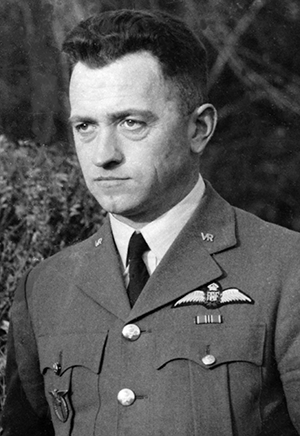
* 02.04.1903, Český Krumlov.
† 02.08.1973, Prague.
The Early Days
František Rypl was born on 2 April 1903 at Český Krumlov, a city in the South Bohemia region of Czechoslovakia, some 90 miles south of Prague. After his primary education he attended grammar school for four years, then continued his education for another four years at a commercial academy from which he matriculated.
Czechoslovak Army
In October 1923 he joined the Military Academy in Hranice and graduated from there in August 1925. He was then posted to the 52nd Artillery Regiment. In October of that year, he was sent to the Artillery School at Olomouc, and in July 1926 he was then posted to the III. Section of the 2nd Artillery Regiment, stationed at Stříbro, some 70 miles west of Prague, as a Junior Battery Officer, Adjutant to the Section Commander who was First Officer of the Battery.
Czechoslovak Air Force

In November 1928, František was sent to the Military Aviation Academy, at Prostějov, for training as an air observer. On graduation in November 1929, he was posted to the 64th Squadron of the 3rd ‘M. R. Štefánik’ Air Regiment deployed at Vajnory, Slovakia. Later, as a junior officer he was posted to the Regiment’s 9th Squadron who were stationed at Piešťany, Slovakia. František decided to transfer to the Air Force and in July 1930, he was officially transferred from Army to the Air Force.
In 1931 he completed a mechanics course for officers at Olomouc airbase. In 1932, František was selected for pilot training which he attended at Prostějov and then was sent to the Military Aviation Academy at Chleb for fighter pilot training. In 1935, he graduated from a night flying course at Piešt’any airbase, Slovakia. He then returned to the 3rd Air Regiment and in quick succession held positions of Adjutant to the Commanding Officer the 3rd Squadron, Junior Commander of 39th Squadron and Junior Officer of the training squadron. In July 1935 he was appointed Commander of the Air Defence Unit for the Hradec Králove region.
František was injured in a flying accident on 7 February 1938 when, in dense fog, the Avia B-534 biplane fighter aircraft he was piloting crashed in a field near Dvůr Králové. In the crash he suffered several fractures, but after hospital treatment and recuperation he was able to return to duty. In 1938 he was posted to the Provincial Military Command in Košice and at the end of September 1938 he was posted to the Ministry of the Interior.
Munich Dictat
The threatening overtures by neighbouring Nazi Germany regarding the Sudeten regions – the German speaking areas – of Czechoslovakia caused the Czechoslovak Government to declare a mobilisation on 23 September 1938.
Following this threat, Chamberlain, the British Prime Minister, Daladier, the French President, Hitler, the German Chancellor and Mussolini, the Italian Dictator, met in Munich. The outcome of this was the Munich Agreement of 30 September 1938 wherein the Sudeten regions were ceded to Germany. Eduard Beneš, the Czechoslovak President, was not invited to participate in the discussion concerning the future of his country, instead, he was merely told by Chamberlain and Daladier to either accept the agreement or Czechoslovakia would have to defend itself without any support from Britain and France, despite there being a tri-lateral defence agreement between the three countries. As a result of that Agreement, in addition to Germany being ceded the Sudeten regions, Poland and Hungary took this opportunity to take some Czechoslovak territory on ethnicity grounds. Thus, about 30% of Czechoslovakian territory had been lost, which included its border defences, and the new revised German border was now only some 30 km from Prague.
After the announcement of mobilisation, František was posted to the Ministry of the Interior from the end of September 1938.
German Occupation

Despite assurances given by Hitler at the Munich Agreement, that he had no further interest in territorial gains for Germany, just a few months later he extended his demands that the remaining regions of Czechoslovakia become part of Germany.
On the evening before the invasion, on March 14, 1939, Czechoslovak intelligence officers called a meeting where they announced that the threat of invasion was imminent and recommended measures which would prevent most important assets fall in German hands. However, no orders were handed down until too late. The Chief of the Czechoslovak Air Force General Fajfr and his deputy General Vicherek ordered that no aircraft were allowed to take off. The Department of the Ministry of National Defence started organising the transfer of the aircraft to several airfields in Moravia with the intention to get the airfleet to Romania and Yugoslavia. None of these planned intentions were carried out.
The Germans occupied Czechoslovakia on 15 March 1939. Under pressure, Emil Hácha, the Czechoslovak President, had acceded to their demands and, in the early hours of that day, he had ordered all Czechoslovak military units to stand down, remain in their barracks and not resist the occupation. Germanisation of Bohemia and Moravia began immediately: they were now the Reich Protectorate of Bohemia and Moravia (Protektorat Böhmen und Mähren), while Slovakia, in return for its allegiance to Nazi Germany, had become the puppet ’independent’ state of Czechoslovakia. With this new status for Slovakia, František and other Czech military personnel were returned to the new Reich Protectorate.
After the German occupation of Czechoslovakia, they disbanded the Czechoslovak military, and all personnel were dismissed. By the time of his dismissal František had attained the senior rank of štábní kapitán [S/Ldr] in the Czechoslovak Air Force.
Resistance
But just four days later, internal resistance organisations were being established. On 19 March 1939, former Senior officers of the now-disbanded Czechoslovak military had started to form an underground army, known as Obrana Národa [Defence of the Nation]. Obrana Národa also worked in co-operation with Svaz Letců, the Airman Association of the Czechoslovak Republic. One of their objectives was to assist as many airmen and soldiers as possible to get to neighbouring Poland where they could be formed into military units to fight for the liberation of their homeland. These two organisations provided money, courier and other assistance to enable airmen to escape. Whilst František was married and had a family, he was one of the many Czechoslovak airmen and soldiers who decided that it was their duty to escape to the west from where they could participate in efforts to achieve the liberation of their homeland, and he made preparations to leave.
The Balkan Route

On 9 January 1940, František escaped from the Reich Protectorate, over the border into Slovakia, but three days later he was arrested near Senec and imprisoned at Nové Zámky and then at the Fortress Komárno, southern Slovakia. After six weeks, he managed to escape and made his way to Hungary and reached the French Consulate in Budapest. There he was provided with French identification documents and visas. From there, with their assistance and accompanied by other Czechoslovak escapees, František crossed into Yugoslavia and reached Belgrade, where, at the Czechoslovak Consulate, he met more escapees. Next, they went by ship to Greece and then to Turkey from where they sailed around the southern Mediterranean Sea to avoid air attacks from the Regia Aeronautica (the Italian Airforce) to Beirut, Lebanon and then on to Marseille, France on 3 April 1940.

France
In France the escapees were taken to the Czechoslovak Depot at Agde where František was assigned to the air group there and accepted into l’Armée de l’Air. This was the period of the ‘phoney war’ with very little activity on the western front in France.

However, the relative calm of the Phoney War ended at 05:35 on 10 May 1940 when Germany attacked Holland, Belgium, Luxembourg and France. In France they came through the dense Ardennes Forest to skirt around the main defence of the Maginot line and swept Northwards towards the English Channel. The Battle of France had begun. However, the lightning speed and ferocity of the German Blitzkrieg attack caused the l’Armée de l’Air units to rapidly retreat westwards. On 23 May, František was transferred to their airbase at Mérignac, near Bordeaux, where he was made Commanding Officer of Czechoslovak airmen training there.
Evacuation from France
In between 28 May and 4 June, some 338,000 personnel from the British Expeditionary Force as well as French and Belgium military had been evacuated from Dunkirk – Operation Dynamo. The Allies realised that the war on mainland France was lost and the priority now was evacuation before the French capitulated.
Operation Aerial
Since 15 June, Operation Aerial, the evacuation of Allied military forces and civilians from ports in Western France had been in operation. With the French capitulation imminent, the Czechoslovak military in France were in danger of being interned by the Vichy regime or captured by the Germans. Winston Churchill, the newly appointed British Prime Minister (since May 1940), recognised the importance of experienced Czechoslovak airmen for the upcoming defence of Britain. He appealed to all the evacuated Czechoslovak airmen to come to Britain and continue the fight from there. The l’Armée de l’Air released the Czechoslovak airmen from their service so that they could make their journey to Britain via one of the evacuation ports, on mainland France or North Africa. For those in western France, they were instructed to get to the port at Bordeaux, on the Atlantic coast, before the Germans reached there, so that they could be evacuated to England from where they could carry on the fight against Nazi Germany. With the French capitulation imminent, Czechoslovak airmen in what was still unoccupied France, were evacuated to England. Approximately 95% were successfully evacuated, usually by ship on a long sea journey to England.

From Mérignac airbase, František and managed to escape by air. On 17 June 1940 he was one of a group of 38 Czechoslovak airmen, commanded by štábní kapitán Ferdinand Secký. They boarded a BOAC four-engined Armstrong Whitworth Ensign aircraft, G-ADSV, AV1160, to leave the bomb-damaged airbase at 4pm. After a flight lasting 4½ hours, at an altitude of only 150 to 200 mtrs, they landed at 20:30 at RAF Hendon, England.
RAF
After security vetting, František transferred to the Czechoslovak Depot at RAF Cosford. Despite his age of 37, as a trained fighter pilot, on 12 July 1940, he was admitted to the RAF Voluntary Reserve, swore his oath of allegiance to King George VI and was commissioned at the rank of P/O. As when joining l’Armee de L’air the previous year in France, the Czechoslovak airmen were given theoretical aviation training and language lessons, this time for British aircraft and the language was English.
Battle of Britain
That same day František, now at the rank of Acting F/Lt, and 23 other Czechoslovak were posted to the newly formed 310 Sqn (Czechoslovak) at RAF Duxford, thus becoming one of the squadron’s founding members, and appointed C/O of ‘B’ Flight. The following day nine more pilots arrived and on 17 August a further 20 pilots arrived.

At RAF Duxford, they were re-trained on Hawker Hurricane Mk I fighter aircraft and also given rudimentary English lessons. F/O Ladislav Češek, a Briton of Czech origin, was engaged as an interpreter to assist in overcoming the language barrier and Mr Louis de Glehn was brought in to give English lessons, three times a week, to the Czechoslovak pilots. For these pilots it was reminiscent of only a few months earlier when they were in France and had joined l’Armée de l’Air, converted to French aircraft and had learnt French before they could become operational pilots in that Air Force. On completion of his re-training course, he was awarded his RAF pilot’s wings.

The squadron was declared operational on 17 August 1940. That day, František made his first operational flight in the Battle of Britain; a 45 min uneventful patrol, taking off at 14:10 in Hawker Hurricane Mk I P3142 ‘M’, landing at 14:55, thus qualifying him for the coveted Battle of Britain clasp. With the further 23 operational flights in the Battle, he flew a total of 27 hrs 40min, all but one of those flights was uneventful with no Luftwaffe aircraft sighted.

That one eventful flight was on 9 September. That day, twelve Hurricanes from 310 Sqn, led by ‘A’ Flight Commander F/Lt Sinclair, took off from RAF Duxford at 17:05 and ordered to patrol North Weald at 20.000 feet where they joined up with 19 and 242 Sqns to form the Duxford Wing, on its 2nd appearance in the Battle. František was Green 1, flying Hurricane Mk I P3142. There they sighted a formation of about 75 Do 215’s escorted by about 150 Me 109’s, Me 110’s and He 112’s fighter aircraft, about 15 miles away, south of the Thames Estuary heading north-west. The squadron was ordered to form line astern in preparation for an attack on the main enemy formation. The attack was delivered south of London at 17:35 flying at 22,000 ft, and a series of dog-fights ensued. Bombs were dropped by the Luftwaffe bombers during this engagement which was now over the south-west suburbs of London. During the engagement, František’s Hurricane was attacked by some 10 Me 109’s and as a result of being chased by them, his Hurricane ran out of fuel and he had to make a forced landing in a field near Oxted, Surrey, at 17:58. He was unhurt and n the combat had fired 120 rounds of ammunition.
His combat report for this action reads:
‘As soon as I saw that some of the enemy were coming at us from above, I went straight after one and fired a short series from 150 yards. It was a Me 109. After the series, grey smoke began to come out of it and the plane escaped me by diving. Then I immediately climbed and wanted to attack the enemy bombers. When I reached a small elevation above the enemy swarm, I saw two or more Messerschmitts behind me. I immediately dived to escape, and I was pursued by them for a long time. In the process I turned the plane in various directions and only at an altitude of less than 3000 ft that, I discover that I was in a hilly, partly wooded terrain. Since I was already to the reservoir and therefore did not have much time to orient myself, and I could not find any airfield. I decided to land in a field…I was landing in a long field, with the landing gear extended, but there was a scaffolding of wires above the entire field that I couldn’t see from above. This damaged the machine.’

After the Battle
On 7 October František was assigned to 12 OTU [Operational Training Unit] at RAF Benson and on 11 December to No 4 Ferry Pilot Pool at RAF Kemble, some 80 miles west of London. The unit was part of the Air Transport Auxiliary (ATA) whose role was ferrying aircraft from factories, Maintenance Units (MUs), and storage depots to frontline squadrons. That posting was until 1 May 1941 when he was promoted to the rank of F/Lt.
Czechoslovak Inspectorate General
František was then assigned to the Czechoslovak Inspectorate General [CIG], in London as a Liaison Officer. On 11 August 1941, at the rank of Acting S/Ldr, he was appointed Flying Training Officer. On 11 November he held the rank of Acting W/Cmdr and on 15 December 1941, at the rank of S/Ldr, he was assigned to the Vojenské kanceláři prezidenta republiky – Military Office of the Czechoslovak President – also in London, where he remained until 23 June 1942.

Night Fighter
František requested to return to operational flying, but as he was now 39, he was too old for fighter aircraft. Instead, he was posted to 54 OTU at RAF Church Fenton for training on twin-engined Bristol Beaufighter night-fighters. František completed his training on 9 September 1942 and was posted to 307 (Lwowski) Sqn, a Polish night-fighter squadron deployed at RAF Exeter. Their role was the night aerial defence of the southwest of England.
His operational flying was curtailed following an accident at the end of a night training flight on 8 November 1942. František was pilot of Beaufighter Mk VIF X8149 and was returning to RAF Exeter at 22:00 after a training exercise in conjunction with a search-light battery. Due to poor visibility in the deteriorating weather conditions, he overshot the runway, hit a tree and the aircraft caught fire. In the crash he sustained a head injury and after briefly becoming unconscious managed to break the cockpit cover and roll away before the aircraft exploded. Unfortunately, his radar operator Sgt Wacław Gajek, a Polish emigré from the USA, was killed in the crash. František was seriously injured with burns and taken to hospital for treatment.
After recovering from his injuries in hospital, František returned for duty to the CIG on 1 February 1943 at the rank of Acting W/Cmdr. In August 1944, frustrated by being desk-bound and unable to return to operational flying in the RAF, František requested to be transferred to the 1st Czechoslovak Air Regiment in Russia and the transfer was approved.
1st Czechoslovak Air Regiment
In November 1943, W/Cmdr František Doležal, the current commanding officer of the Czechoslovak Wing, asked the pilots of that Wing for volunteers to go to the Eastern Front and fly for Russia. A total of 21 volunteers comprising pilots from 310, 312 and 313 Sqns were selected, amongst whom were former fellow Czechoslovak Battle of Britain pilots František Chábera, František Fajtl and Josef Stehlík. Their reason for volunteering was lack of combat opportunity now in the UK and that in Russia they would be fighting the Luftwaffe nearer their homeland and so would get home sooner.
On 21 February 1944, the 21 Czechoslovak volunteers sailed from Glasgow aboard the ‘Reina del Pacifico’ to Gibraltar and then onto Port Said, Egypt. From there to Cairo where they went by train to Damascus, Syria. From there by coach to RAF Habbányia near Bagdad, then by train to Tehran, Persia. From Tehran they were then flown to Ivanovo airbase, 325 km east of Moscow. On this journey, many of them took the opportunity to learn some Russian, the 3rd language they were having to learn since they left their homeland in 1939. It would also be the 4th Air Force that they had served in during that period.
On arrival at Ivanovo’ they were re-trained for Soviet Lavochkin La 5 FN fighter aircraft. On completion of their training the unit was declared operational on 3 May 1944 and renamed the 1st Czechoslovak Independent Fighter Aviation Regiment. The Slovak National Uprising had broken out on 15 September and after news of the uprising, the regiment redeployed to Stubno, Poland, to be closer to the front line. The Command in Moscow then ordered the regiment to fly to Slovakia to support the insurgents. Unfortunately, the Slovak National Uprising was ill-fated and by October had been suppressed, forcing the unit to evacuate from Slovakia back East to Soviet-held territory.
Russia
On 15 August František resigned his RAF commission and travelled to Russia via the same route as the previous 21 Czechoslovak volunteers. He arrived in Russia on 28 September 1944 and was posted to the 1st Czechoslovak Air Regiment who were equipped with Iljušin Il-2 aircraft. On 28 October he was promoted to the rank of podplukovník (W/Cmdr) and in January 1945 became the navigation officer for the 1st Czechoslovak Mixed Air Division, commanded by General Ludvík Svoboda. On 9 May 1945, he became the first Czechoslovak airman to return to Prague, along with Russian airmen of the bombardovací pluk Petljakov Pe-2 [Pe-2 Air Regiment] one of the light bomber unit of the 1st Czechoslovak Mixed Air Division.
On his return to his homeland, he was to learn that the Germans had interned his relatives at the Svatobořice internment camp, near Kyjov in Moravia, as a reprisal for him escaping to Poland to join the Allies.

Post WW2
František’s post-war career in the Czechoslovak Air Force was very influenced by the USSR. From 1 September 1945 he studied at the USSR Supreme Military Academy KJ Voroshilov in Moscow. In October 1945 he was promoted to the rank of plukovník [Gp/Capt] backdated to 1 August 1945. He returned from Moscow in August 1947 and was appointed Commander of the Military Academy at Hradec Králove. It was a politically motivated posting as he was an active Communist and left-wing focused.
Communist putsch

Following the Communist take-over in February 1948, the Czechoslovaks who fought for the Allies in WW2 were regarded as being tainted by capitalism and many were arrested, imprisoned and subjected to other persecution. On 1 December 1944, František had joined the Communist Party of Czechoslovakia, and after the communist coup in Czechoslovakia, he was one of the few former RAF airmen who collaborated with the new regime. From early March 1948 František had proposed several of his former RAF colleagues for expulsion from the Air Force and was instrumental in their subsequent persecution by the Communist authorities.
On 1 October 1948 František was promoted to the rank of brigádní general [Air Commodore], backdated to 1 September 1948. He remained as Commander at the Military Academy at Hradec Králove until June 1951 when he was posted to the Aviation Research Institute, at Prague-Letňany airbase, as its Deputy Commander and became its Commander in April 1952 until July 1954. Now aged 51, he then retired from the Air Force and moved to Kozly, a small village some 40 miles north of Prague.
W/Cmdr František Rypl died, aged 70, on 2 August 1973, at Prague, Czechoslovakia.
Medals
1939 – 45 Star with Battle of Britain clasp
Válečný kříž 1939
Za chrabrost x 2
Za zásluhy I.stupně
Pamětní medaile se štítky F–VB-SSSR
Remembered
Great Britain:
Capel-le_Ferne:
He is commemorated, along with the other 2940 Battle of Britain aircrew, on the Christopher Foxley-Norris Memorial Wall at the National Battle of Britain Memorial at Capel-le-Ferne, Kent:

Hawkinge:
František is remembered on the Czechoslovak Battle of Britain pilots memorial at the Kent Battle of Britain Museum at Hawkinge, Kent. It was unveiled on 28 October 2025, to commemorate the 88 Czechoslovaks who flew in that battle.

London – Battle of Britain Memorial:
He is also commemorated on the London Battle of Britain Memorial:
Czech Republic:
Český Krumlov:
He is named on a memorial plaque at Český Krumlov, which names the RAF airmen from that region.

Prague 1 – Klárov:
In November 2017, his name, along with the names of 2524 other Czechoslovak men and women who had served in the RAF during WW2, was unveiled at the Winged Lion Monument at Klárov, Prague 1.

Article last updated: 30.10.2025.
