
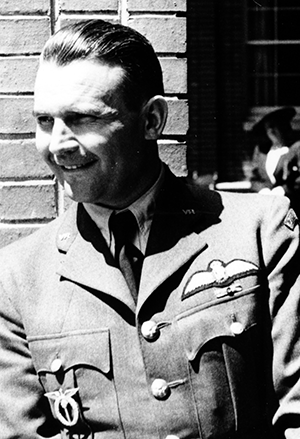
* 19.05.1899, Gorna Mitropolia, Bulgaria.
† 02.01.1994, Chicago, USA.
The Early Years
Ján Ambruš was born on 19 May 1899 at Gorna Mitropolia [Горна Митрополия] in the Plevenska region in northern Bulgaria. His parents belonged to an expatriate Slovak community that had been invited to settle in Bulgaria after its liberation from the Ottoman Empire in 1978.
On completion of four years of elementary education, Ján continued his studies for a further four years schooling at the small town of Nagyszentmiklós, Hungary, today called Sânnicolau Mare in western Romania, close to the Serbian and Hungarian borders, about 200 km south-east of Budapest. There, he was rated as an excellent student.
Austro-Hungarian Army
After completing his schooling, he joined the Austro-Hungarian army and enrolled for a four-year training course, as a cadet at the Artillery College at Traiskirchen, near Vienna, Austria. This was the time of WW1 in Europe and following the armistice of 11 November 1918, the Austro-Hungarian Empire was dissolved and Czechoslovakia was one of the new countries now founded. This meant that Ján now completed his cadet training at the Czechoslovak Military Academies at Hranice in 1919/1920 and then at Olomouce in 1921.
Czechoslovak Army
Ján graduated as an officer in the Czechoslovak Army on 21 August 1919 and was posted to the 21 Mountain Artillery Regiment stationed at Ružomberok, northern Slovakia. During his five-year service with that Regiment, he rose to become its Deputy Battery Commander and finally 2nd Adjutant to the Regiment’s Commanding Officer. Now at the rank of poručík [Lieutenant], in September 1924 he was posted to the 262 Artillery Detachment who were stationed at Vranov nad Topľou, Slovakia.
Czechoslovak Air Force
Ján transferred to the newly formed Czechoslovak Air Force on 31 March 1925 and, in January 1926, was assigned to the Military Aviation Academy at Chleb for training as an aerial artillery observer. On completion of that training, on 1 July 1926, he was posted to the 3rd ‘M. R. Štefánik’s Air Regiment, which was deployed at Nitra airbase, where he held the position of Tactical Adjutant of the I/3 Sqn and from September 1927, Deputy Commanding Officer of the Regiment’s 81st Bomber Group until the end of October 1927. His leadership and administrative skills had been noted by his superiors, and his next posting was to the Ministerstvo národní obrany – Ministry of National Defence – [MNO] in Prague until February 1929. He was then posted to the 1st ‘T.G. Masaryk’ Air Regiment deployed at Prague-Kbely airbase.
He then volunteered for pilot training and was assigned to the Military Aviation Academy at Prostějov on 1 June 1929. Ján completed his pilot training in November 1929 and then went to the Military Aviation Academy at Chleb for fighter pilot training. Now at the rank of kapitán [F/Lt], Ján was posted to the 6 Air Regiment at Prague Kbely airbase where he served as 2nd aide to the Regiment’s Commander until March 1930.
His professional skills led to him returning to the MNO, where he had an administrative role until Sept 1931 when he was posted to the 6th Air Regiment. Between October 1931 to September 1934 he held the position of Commanding Officer of the Regiment’s 43rd Fighter Sqn who were equipped with Avia BH-33 fighter aircraft.

Competition Flying
Ján was a skilled pilot and during the 1930s, distinguished himself as a skilled aerobatic at national and international events including the 1934 unofficial world championship held at the Vincennes Air Show, near Paris where he competed in an Avia B.122, finishing 8th amongst the world’s elite aerobatic pilots. Likewise in the same Avia B.122 at the 1936 Summer Olympics, held in Berlin where he again finished 8th.
Because of his piloting skills, Ján’s next appointment, in September 1934, was as Commander of the 1st Experimental Squadron at Prague-Letňany airbase. His role here was the testing of prototype aircraft for military use. During this time, he was also testing the Zlín XIII, a prototype aircraft designed by a subsidiary of Baťa, to evaluate its military potential. Ján was promoted to the rank Major on 1 July 1935 and during 1937 and 1938, he attended the Military College for Staff Officers.

He also achieved success at long-haul competition flying in Europe and Africa and in 1938, with Vojtěch Matěna, he flew the Tatra T.101, a two-seater monoplane, on its record-breaking flight from Prague to Khartoum, Sudan, a distance of 4,330km during which it achieved a height record of 23,337 feet. This was a record for a two-seater aircraft with an engine capacity of less than 4 litres – a record that was to remain unbroken for 40 years.
At this time, Ján was the highest-ranking Slovak national in the Czechoslovak Air Force.
German Occupation


When the Germans occupied Czechoslovakia in March 1939, Ján was stationed in Prague. Being a Slovak, he was repatriated to the newly formed independent state of Slovakia, promoted to the rank of podplukovník [W/Cmdr], and appointed to a senior role at the Slovak Ministry of Defence. In the following months, Ján soon realised that Slovakia was no more than a ‘German puppet’ State and without any actual independence. This, the poor equipment, personnel and internal politics caused him to resign from the Slovak Air Force on 1 August 1939.
The Balkan Route
Germany invaded Poland on 1 September 1939, and two days later, France and Britain declared war on Germany as their ultimatum to Germany to withdraw from Poland had been ignored.
On 3 Sept. 1939 with assistance from the Yugoslav Consul General in Bratislava, Ján escaped across the Slovak border into Hungary and went to Yugoslavia, then by ship to Greece, Turkey, Syria and Lebanon. He then sailed around the southern Mediterranean Sea to avoid air attacks from the Regia Aeronautica (the Italian Airforce) to Marseille, France.
France
There, on 15 October 1939, due to his high rank and command experience, he was assigned to Československa vojenská správa – ČSVS – (Czechoslovak Military Administration) in Paris, where he worked in the III. (Air) Department.
l’Armée de l’Air
On 15 April 1940 Ján transferred to the l’Armée de l’Air’s Centre d’Instruction de Chasse (CIC), their fighter pilot training centre at Chartres airbase for re-training on French equipment.
The relative calm of the Phoney War ended at 05:35 on 10 May 1940 when Germany attacked Holland, Belgium, Luxembourg and France. In France they came through the dense Ardennes Forest to skirt around the main defence of the Maginot line and swept Northwards towards the English Channel. The Battle of France had begun.
The lightning speed and ferocity of the German Blitzkrieg soon overwhelmed the fighter protection by the l’Armée de l’Air and RAF aircraft of their now rapidly withdrawing front line. This alarmed the French as they realised that they had no aerial protection for strategic French cities and factories and so quickly formed Patrouille Défense Aérienne du Territoire (DAT) – Air Defence Patrols – to protect them against Luftwaffe attack and which were equipped with MS-406c fighter aircraft. Pilots from various training units were used to equip these DAT units, one of whom was Ján, whose re-training was hastily completed by 16 May 1940. Ján, along with fellow Czechoslovaks Václav Bergman, František Březovský, Alexander Hess, Jaroslav Malý, Josef Pardus, Rudolf Ptáček, Jaroslav Štěrbáček and Antonín Zavoral, was transferred to the Patrouille Défense Aérienne du Territoire (DAT) at Chartres airbase which was equipped with MS-406 c-1 and MB-151 c-1 fighters. There they joined fellow Czechoslovak Stanislav Zimprich who had been posted there on 11 May. On 18 May they were joined by František Fajtj and Jaroslav Šodek and on 20 May Bohuslav Kimlička, František Mlejnecký, Miroslav Štandera and Vladimír Zaoral were also posted there. Ján became the only Czechoslovak pilot of Slovak nationality who took part in the Battle of France.

Between 28 May and 4 June, some 338,000 personnel from the British Expeditionary Force, as well as French and Belgian military personnel, were evacuated from Dunkirk – Operation Dynamo. The Allies realised that the war on mainland France was lost, and the priority now was evacuation.
Operation Aerial
On 13 June 1940, with the French capitulation imminent, Ján and the other Czechoslovak airmen were released from l’Armée de l’Air service. Since 15 June, ports in Western France had been in operation. To be in this evacuation, the Czechoslovaks had to make their way to Bordeaux before the Germans reached there. With other Czechoslovak airmen, Ján reached Bordeaux from where 300 Polish airmen and 89 Czechoslovak airmen were evacuated aboard the ‘Ary Schaeffer’. This small Dutch cargo ship provided cramped conditions for all onboard, and sailed at 13:30 on 19 June to Falmouth, England. After a prolonged voyage far out into the Atlantic, to avoid U-Boats and Luftwaffe attacks, before changing course East to Falmouth, they arrived four days later at Falmouth, England, which was good timing as France capitulated on 22 June 1940.

In the period from June to August 1940, 932 Czechoslovak airmen managed to be evacuated from France and get to England. Operation Aerial was concluded on 25 June.
RAF
After their arrival, the Czechoslovak airmen were transferred to RAF Innsworth, Gloucestershire, for security vetting. The Battle of Britain was now in progress and there was an urgent need for fighter pilots. As a trained pilot Ján was accepted into the RAF Volunteer Reserve, at the rank of P/O and was transferred to the Czechoslovak airmen’s depot at Cosford, near Wolverhampton, for basic training and English lessons. On 12 July, now at the rank of S/Ldr, with other Czechoslovak pilots, he was posted to the newly formed 310 (Czechoslovak) squadron at RAF Duxford.
Here they were re-trained to fly Hawker Hurricane fighter aircraft by British flying instructors and also taught rudimentary English, being tutored by Louis de Glehn for three lessons per week. By 17 August, 16 of the pilots had completed their re-training, enabling ‘A’ and ‘B’ Flights to be assembled and the squadron was declared operational.

6 OTU
With 310 Sqn becoming operational on 17 August 1940, it was no longer possible for re-training to be undertaken within the squadron due to shortages of aircraft and instructors. The reserve-pool pilots of 21 Czechoslovak pilots, including Ján, were posted to 6 OTU at RAF Sutton Bridge, in South-East Lincolnshire on 17 August to continue their re-training. There, Ján progressed to flying solo on a Hawker Hurricane fighter aircraft and, having completed the re-training course, was awarded his RAF pilot’s wings.
Battle of Britain

On 15 October 1940, whilst leading Yellow section on a routine patrol in three Hurricanes Ján became disorientated and was running low on fuel. F/O Comerford and P/O Vybiral decided to bale out and safely landed near Dalton-in-Furness, but their new Hurricanes were wrecked. Ján made a ‘wheel-up’ landing at Carnforth at 20:00. His Hurricane V6846 was slightly damaged.
However, despite having exceptional organisational skills he had lost the confidence of his fellow pilots following these two incidents and made no more operational flights that month.
During the Battle of Britain, he made 12 operational flights totalling 6 hours and was the only Slovak pilot to fly in the RAF during the Battle of Britain.
After the Battle

During November he made just one operational flight and in December just two. As a consequence of those two judgement errors in October that flight was his final operational flight with the RAF. On 12 December 1940, Ján was relieved of his command of 312 Sqn and was posted to the Czechoslovak Inspectorate General (CIG) in London. He worked there until June 1942, and on 7 March 1941 he had been promoted to the rank of W/Cmdr.
Canada
He was then sent to Canada as a member of the Czechoslovak Military Mission whose purpose was a recruitment drive amongst the Czechoslovak expat community in Canada and neutral USA.
In Canada and the USA there was a substantial number of Slovak emigrant young men whom the Czechoslovak government in Exile sought to attract into service. It was hoped that his smart and prestigious Ambrus image would pull in the ‘New World’ youth.

When the Military Mission ceased in 1943, Ján was appointed Czechoslovak Military and Air Attaché at the Czechoslovak Embassy in Ottawa till the end of the war.
On 24 January 1945 he was awarded the Order of the British Empire [OBE]. The citation for this award reads:
This officer has worked for 3.5 years as liaison officer at the United Kingdom Air Liaison Mission in connection with the air training of Czechoslovak nationals in Canada. Throughout this period, he has worked most loyally and in the best interests of co-operation both in the interests of his own country and this Mission. His relations with the Canadian Government and the RCAF have been most cordial.

Post WW2
Ján returned to Czechoslovakia and in December1 945 he was promoted to the rank of Brigadier General [Air Commodore]. He was placed in Command of the 4th Military Region in Bratislava, Slovakia; from his office there he was responsible for all Czechoslovak Air Force units in Slovakia.
Communist putsch
Following the Communist takeover of Czechoslovakia in February 1948, Ján had concerns regarding the direction his homeland was now being taken and requested his release from the Czechoslovak Air Force.
On 21 March 1948, with the assistance of US Military authorities, he escaped from Czechoslovakia to the American Zone in Germany. He then travelled on to England and then emigrated to the USA, settling in Chicago. There he worked as a design engineer, planning for highways, airports, air-pollution control systems and chemical plants. Whilst in Chicago he was pro-active member of the Czechoslovak emigree community.
W/Cmdr Ján Ambruš died 2 January 1994, aged 94, in a Nursing Home in Chicago, USA, where he had been a resident since 1985. His remains were later repatriated to Slovakia and interred at Bratislava.
Medals Awarded
Officer of the Order of the British Empire
Distinguished Flying Cross
1939 – 45 Star with Battle of Britain clasp
Defence Medal
1939-1945 War Medal
řád M. R. Štefánika III. třídy
Válečný kříž 1939
Za chrabrost před nepřítelem
Za zásluhy I.stupně
Pamětní medaile se štítky F–VB
Ordinul Coroana României
Remembered
Great Britain:
Capel-le_Ferne:
He is commemorated, along with the other 2940 Battle of Britain aircrew, on the Christopher Foxley-Norris Memorial Wall at the National Battle of Britain Memorial at Capel-le-Ferne, Kent:

Hawkinge:
Ján is remembered on the Czechoslovak Battle of Britain pilots memorial at the Kent Battle of Britain Museum at Hawkinge, Kent. It was unveiled on 28 October 2025, to commemorate the 88 Czechoslovaks who flew in that battle.

London – Battle of Britain Memorial:
He is also commemorated on the London Battle of Britain Memorial:
Czech Republic:
Prague 1 – Klárov:
In November 2017, his name, along with the names of 2524 other Czechoslovak men and women who had served in the RAF during WW2, was unveiled at the Winged Lion Monument at Klárov, Prague 1.

Slovakia:
Bratislava:
IHe is commemorated on a memorial plaque on the building of the 4th Air Force Command for Slovakia, where he was Commanding Officer in 1945.

Romania:
Nădlac:
At the Slovak Evangelical Lutheran church at Nădlac, are two memorial plaques for him.


Article last updated: 30.10.2025.
