

* 13.09.1911, Dolní Štěpanice.
† 21.04.1992, Langford, UK.
The Early Years
Josef Jan Hanuš was born on 13 September 1911 at Dolní Štěpanice, a small village near Jilemnice, which was close to the Polish border, and some 100km north-east of Prague. He was the eldest of his parents two sons, but sadly his mother died when he was 14 years old. He attended the local school for his primary education and then went to the Grammar school at Jilemnice, from where he matriculated in 1931. Josef then spent next 6 months as a teacher at Jestřebi, some 60km away, prior to starting his mandatory military service.
Czechoslovak Air Force

In October 1931, for that military service, he enlisted in the 2nd Observer Squadron of the 1st ‘Tomáš Garrigue Masaryk’ Air Regiment, who were deployed at Prague-Kbely airbase. After a week, he was assigned to the Reserve Officers’ School at the Military Aviation Academy at Prostějov, where he trained as an aerial observer in dual-seater biplanes. Amongst his fellow trainees on that course were Stanislav Fejfar, Josef Hybler, Vlastimil Vesely and Tomas Vybiral, who he were to meet again in the RAF in England. His training lasted for nine months, and on graduation, he was posted as an aerial observer to the 4th Observation Squadron of the 1st ‘Tomáš Garrigue Masaryk’ Air Regiment, who were deployed at Cheb airbase. Whilst there, he was promoted to the rank of četař aspirant (Sgt).
On completion of his mandatory military service, he decided that military life appealed to him and chose to make his career in the military. In June 1933, he was posted to the Military Academy at Hranice and a year later, back to Prostějov for a pilot training course. He graduated on 2 July 1935, ranked 5th of the 38 graduates of that course. As a junior officer, at the rank of poručík [P/O], he returned to the 4th Observation Squadron at Cheb. Josef was there for two years, during which time he completed a night-flying course.
In Czechoslovakia between 1935 to 1938, there was a plan called the ‘Akce 1000 pilotů republice’ – the training of ‘One thousand pilots for the Republic’. It was an initiative by the Czechoslovak Authorities who were alarmed by the rise to power of the Nazi Party in neighbouring Germany and sought to increase the size of its Air Force. The plan called for 1,000 young Czechoslovaks to receive flying training in their spare time at local civilian flying clubs, but with active military support. The scheme was described as a development of sports flying so that Germany would not be provoked into claiming it was war preparation by the Czechoslovaks. Whilst stationed at Cheb, Josef was one of the military instructors at the local civilian flying club which was participating in that covert training program.
Mobilisation

On 25 April 1938, Josef was seconded to the Ministry of the Interior to serve with the Gendarmerie Air Patrol, whose role was to patrol the country’s borders. Here he operated from airfields at Cheb, Terezín and Plzen Bory flying two-seater Letov Š-328 biplane reconnaissance aircraft.to patrol the country’s north-western borders with Germany.
The build-up of military forces by Nazi Germany, along the Czechoslovak borders, caused the Czechoslovak government to declare a partial mobilisation, on 20 May 1938, to counter that threat.
Later that year, the threatening overtures by neighbouring Nazi Germany regarding the Sudeten regions – the German speaking areas – of Czechoslovakia caused the Czechoslovak Government to again declare a mobilisation on 23 September 1938.
Munich Betrayal
Following this threat, Chamberlain, Daladier (the French prime Minister) Hitler and Mussolini met in Munich. The outcome of this was the Munich Agreement of 30 September 1938 wherein the Sudeten regions were ceded to Germany. Dr Emil Hácha, the Czechoslovak President, was not invited to participate in the discussion concerning the future of his country. He was merely told by Chamberlain and Daladier to either accept the agreement or Czechoslovakia would have to defend itself without any support from Britain and France, despite there being a tri-lateral defence agreement between the three countries.
An unfortunate consequence of the Munich Diktat or Munich Agreement was that Poland and Hungary took advantage of the situation and also annexed some Czechoslovak territory. About 30% of Czechoslovakian territory was lost and the new revised German border was now only 20 miles from Prague.
Despite assurances given by Hitler at the Munich Agreement, that he had no further interest in territorial gains for Germany, just a few months later he extended his demands that the remaining regions of Czechoslovakia become part of Germany.
The Germans occupied Czechoslovakia on 15 March 1939. Under pressure, Emil Hácha, the Czechoslovak President, had acceded to their demands. In the early hours of that day, he had ordered all Czechoslovak military units to stand down, remain in their barracks and not resist the occupation. By dawn the Germans began their occupation of Czechoslovakia. Germanisation of Bohemia and Moravia began immediately; they were now the Reich Protectorate of Bohemia and Moravia (Protektorat Böhmen und Mähren), while Slovakia in return for its allegiance to Nazi Germany, had become the puppet ‘independent’ state of Slovakia.
German Occupation

After the German occupation of Czechoslovakia, the Czechoslovak Air Force was disbanded by the Germans and all personnel dismissed. The airmen were given the opportunity to enlist in the Luftwaffe or join Lufthansa. Only a handful did. At the time of his dismissal, Josef had achieved 617 flying hours.
Resistance
For the military personnel and many patriotic Czech citizens, this was a degrading period. Many wanted to redress this shame and humiliation and sought the liberation of their homeland. But just four days later, on 19 March 1939, former senior officers of the now-disbanded Czechoslovak military had started to form an underground army known as Obrana Národa [Defence of the Nation]. Obrana Národa also worked in co-operation with Svaz Letců, the Airman Association of the Czechoslovak Republic. One of their objectives was to assist as many airmen and soldiers as possible to get to neighbouring Poland where they could be formed into military units to fight for the liberation of their homeland. These two organisations provided money, courier and other assistance to enable airmen to escape to Poland where Ludvík Svoboda, a former distinguished Czechoslovak Legionnaire from WW1, was planning the formation of Czechoslovak military units to fight for the liberation of their homeland. Within Czechoslovakia, former military personnel and civilian patriots covertly started to arrange for former Air Force and Army personnel to be smuggled over the border into Poland to join these newly formed Czechoslovak units. Usually, this was by crossing the border from the Ostrava region.
To Poland
Like many of his former Air Force colleagues, Josef could not reconcile himself to the Munich surrender and subsequent occupation and was determined to leave home to go abroad to fight for the liberation of his homeland. He finally made up his mind and with Josef Richter, Miroslav Diviš and Jindřich Vnoučekhe covertly escaped over the border to Poland on 14 July 1939 and reported to the Czechoslovak Consulate at Kraków.

Polish Disappointment
However, there they were informed that the formation of Czechoslovak military units in Poland were just rumours because the Polish authorities would not allow Czechoslovak military units to be formed on its territory for fear of provoking Nazi Germany.
Instead, they learnt that Vladimír Znojemský, the Czechoslovak Consul, had, via his counterpart in Paris, negotiated with the French Government that the escaped Czechoslovak military would be permitted to travel to France. But there was a condition: as French Law did not permit foreign military personnel on its territory during peacetime, the Czechoslovaks would be required to enlist in the French Foreign Legion for a period of five years – but with the assurance that in the event of war being declared, the Czechoslovaks would be released from the Legion and transferred into French military units. The alternative was that they would be sent back to the German Protectorate of Czechoslovakia, where their execution or deportation to a concentration camp would be the most likely outcome. Josef and his colleagues decided that their best choice was to go to France.

Initially, Josef and his fellow escapees were accommodated at the ‘Dom Turystczny’, a cheap tourist hostel near the Czechoslovak Consulate whilst preparations were made for their onward journey to France. The hostel was now overfull with Czechoslovaks, so they were then transferred to Bronowice Małe, a derelict former Polish Army barracks from the Austro-Hungarian era, on the outskirts of Kraków This was then being utilised as a temporary transit camp for the escaped Czechoslovak military prior to their transfer to France. Josef arrived there on 25 July 1939, the 1170th Czechoslovak escapee to arrive. The barracks, which were in poor condition, were already well inhabited by Czechoslovak escapees who stayed whilst arrangements were made for their transportation, by sea, to France. At the barracks, apart from keeping fit and exercising, there was very little to do and the Polish attitude caused some of the Czechoslovak escapees to become discontented and disillusioned. Some considering returning to their homeland. Fortunately, patriotic speeches by General Ludvík Svoboda, a Legionnaire veteran from WW1 and Senator Vojtěch Beneš, brother of former Czechoslovak President Eduard Beneš, now exiled in Britain, averted this return.
To France
With other 188 other escaped Czechoslovak airmen and soldiers, Josef travelled by train to Gdynia, Poland, where, on 17 August, they boarded the ‘SS Kastelholm’, a Swedish ship, which took them to France. This was to be the last departure from Gdynia of Czechoslovak military personnel to France as the German invasion of Poland would soon commence.

It was to be a dramatic voyage as the ‘SS Kastelholm’ was designed for coastal cruising, not sea voyages, and on the passage down the Baltic Sea they encountered a severe storm. To try and avoid the rough seas, the ship’s Captain steered his vessel to the calmer seas near the coast. However, the coast was Germany and this manoeuvre caused considerable concern to the Czechoslovaks on board.
A deputation of the escapees went to see the Captain. They expressed their concerns about being close to the German coast and reminded him that, with the Czechoslovak escapers on board, should the Germans board the ship, not only would the lives of the Czechoslovaks on board be at risk, but also there would be serious trouble for the ship’s Captain. Realising the predicament they were all now in, the Captain steered back out into the stormy seas and arrived at Calais, France on 21 August 1939.
France
Early the following morning, Josef and his fellow escapees disembarked onto French soil. After some food, they boarded a train for the thirteen-hour journey to Paris. They arrived there at 17:30 and were taken by coach to the Foreign Legion’s recruitment centre at Place Balard to complete enlistment formalities and undertake medical examinations. Josef was accepted into the Legion on 2 October at the rank of sergeant. With the formalities completed he and his colleagues awaited transfer to the Legion’s training base at Sidi-bel-Abbès, Algeria. This time was to serve as a familiarisation period to learn the ways of the Legion and to study French crash-courses, and they took every opportunity to practise their new language skills with French girls.
l’Armée de l’Air
With war having been declared on 3 September Josef was released from his Legion service and transferred, on 10 October, to the l’Armée de l’Air’s training airbase at École de Pilotage at Avord, about 20 km South East of Bourges where he trained on French NA-57, MS-225, D-500, D-501, and D-570 aircraft.

On 19 January 1940, he was posted to Centre d’Instruction de Chasse at Chartres, the l’Armée de l’Air training airbase, about 50 miles south-west of Paris. Here, Josef continued his retraining on French equipment, firstly on the Potez XXV and Morane-Saulnier MS.230 elementary trainers and then the Morane-Saulnier MS-406c fighter aircraft.
The Germans commenced their invasion of Western Europe on 10 May 1940, by invading Holland, Belgium, Luxembourg and then moving Westwards into France. By this time Josef had completed only 20 hours of re-training at Chartres. But with the now urgent need for operational fighter pilots to defend France, on 20 May, along with fellow Czechoslovaks Miroslav Jiroudek and Jan Plášil, he was posted to GC III /1 who by that time were deployed at Plessis-Belleville airbase, some 40km north-east of Paris and were equipped with MS-406c.1 fighter aircraft. A few days later, on 31 May, as part of a 7-man patrol, Josef shared in the destruction of a Luftwaffe observation Henschel 126 at Herbécourt, near Peronne, in northern France. This was Josef’s first combat success of the war and it was to be a further three years wait before he was able to achieve further success.
The speed of the German Blitzkreig quickly caused rapid retrenchment of Allied forces forcing them to retreat Westwards. By 19 June GC III/I were deployed at Valence, about 200 km North of Marseilles and the capitulation of France was imminent. The three Czechoslovaks, two Polish pilots and 10 Polish mechanics of GC III/I were released from their l’Armée de l’Air service.
Evacuation to England
The French put them on a coach which took them to Port Vendres, on the Mediterranean coast near the Spanish border, about 400 km away. There, on 24 June, they were evacuated aboard the Général Chanzy, which took them to Oran, Algeria.
There they learned that France had capitulated and that Winston Churchill, the British Prime Minister, was appealing to all the evacuated Czechoslovak airmen to come to Britain and continue the fight from there. The l’Armée de l’Air released the Czechoslovak airmen from their service so that they could make their journey to Britain.
From there, with more Czechoslovak airmen, Josef made the four-day train journey, across the desert, to Casablanca, Morocco, where, after a five-day wait, they boarded the ‘Gib-el-Dersa’, a collier ship which sailed at 15:12 on 29 June 1940 to Gibraltar, arriving at 11:00 on 30 June. There they transferred to the ’Neutralia’ which sailed, on 2 July, in a convoy of about 30 other ships, deep into the Atlantic, to avoid any attacks by Luftwaffe aircraft based on the west coast of France. They arrived at Liverpool on 12 July 1940.
RAF
On arrival to Liverpool, Josef’s path first, like for most of the Czechoslovaks, led to the Czechoslovak resettlement camp at Cholmondeley Park, near Chester. The first Czechoslovaks boarded a train to Nantwich, Cheshire , some 30 miles away, and from there marched to Cholmondeley Castle, 8 miles away, where in the grounds a tented camp where the evacuated Czechoslovak were being billeted and where they were security vetted.
After security vetting, Josef was transferred, on 21 July to the Czechoslovak Airman’s Depot at RAF Cosford, near Wolverhampton. There, on 2 August 1940, he was accepted into the RAF VR with the rank of P/O and he undertook RAF training and basic English lessons.
On 28 September, Josef and 18 other Czechoslovak pilots were posted to 6 OTU at Sutton Bridge for pilot re-training to RAF standard. Firstly, on the slow and forgiving Tiger Moth, a dual-seater biplane, then graduating to the dual-seater Miles Magister monoplane, and then the more powerful dual-seater Harvard monoplane. When, in his instructor’s opinion, the required standard had been achieved, Joseph progressed to flying solo on Hawker Hurricane fighter aircraft and was awarded his RAF pilot’s wings.
Battle of Britain

On completion of his re-training, he was posted to 310 (Czechoslovak) Sqn at RAF Duxford who were equipped with Hawker Hurricane Mk I fighter aircraft. His arrival at 310 Sqn was during the closing days of the Battle of Britain and his first operational flight was on 25 October, taking-off at 11:45 for an uneventful patrol with no Luftwaffe encountered, in Hurricane V6642, returning to RAF Duxford at 12:55. He flew a further two uneventful patrols, on the 27th and 28th before the Battle of Britain finished on 31 October 1940. During the Battle, Josef had achieved a total of 3 hrs 25min of operational flying.

After the Battle
With the Battle of Britain having finished, the 310 Sqn’s main role now was convoy protection of Allied shipping along the East Anglia coast and the approaches to the Thames Estuary. On 27 December 1940 he was promoted to the rank of F/O and on 18 June 1941 he was posted to 32 Sqn, who were deployed at RAF Angle, near Pembroke in South Wales. They were equipped with Hurricane MkI fighter aircraft and their role was convoy protection in the Bristol Channel. Josef soon became bored with this role and sought a more active participation in the war. To facilitate that, he applied to be posted to another squadron for night fighting.
Josef’s next promotion, to F/Lt, was on 1 September 1941 and on 18 September 1941, he was posted to 245 ‘Northern Rhodesia’ Sqn deployed at RAF Chilbolton, near Andover in Hampshire and equipped with Hurricane Mk I fighter aircraft. Their role was night flying offensive sweeps over northern France in pursuit of Luftwaffe bombers. Two of the squadron’s Hurricanes would fly in escort with a twin-engined Douglas Havoc A-20 night intruder aircraft which was equipped with onboard radar and searchlight in the nose of the aircraft. The British ground radar stations were supposed to bring the Havoc A-20 to the vicinity of the Luftwaffe bomber, and once it’s onboard radar had detected the Luftwaffe aircraft, the Boston would switch on its searchlight to illuminate the enemy aircraft and the Hurricanes would attack it and shoot it down. Josef found this to be a futile role and applied to be posted to another squadron for night fighting duties and left the squadron on 5 January 1942.
He was transferred to 54 OTU, who were stationed at RAF Church Fenton, near Leeds in Yorkshire, for a conversion course to twin-engined Beaufighters. Josef completed the course on 21 February 1942 and returned to 245 Sqn. He remained with the squadron until 1 April 1942.
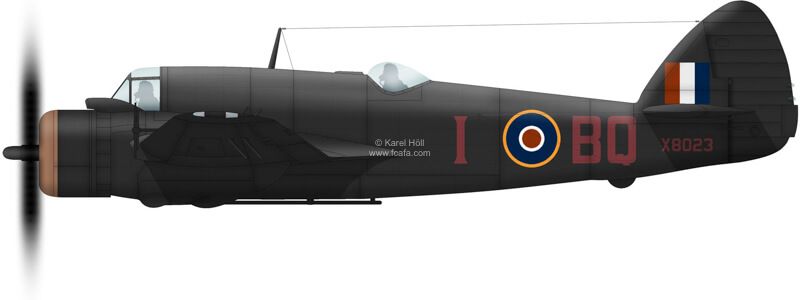
Josef’s next posting, was to 600 ‘City of London’ Sqn who were deployed at RAF Predannack in Cornwall and equipped with Bristol Beaufighters. Their role was the aerial night defence over south-west England. However, the Station Commander there decided that Josef did not have enough experience on twin-engined aircraft and on 17 April had him transferred to 125 Sqn, deployed at Colerne, near Cjppenham, Wiltshire. They were also a night-fighter squadron, but equipped with the turret-armed Boulton-Paul Defiant. There Josef flew some 30 hours in the 14 days he was there before returning back to 600 Sqn on 29 April. He remained with 600 Sqn, crewing up with P/O Ernest ‘Lofty’ Eyles as his radar-operator, until 1 September 1942, when the squadron was redeployed to RAF Church Fenton for retraining prior to redeployment to North Africa. Despite Josef’s request to remain with 600 Sqn. the Czechoslovak Inspectorate General [CGI] in London would not agree to Czechoslovak airmen being posted outside the United Kingdom for operational duties. Instead, they posted him 68 Sqn, another night-fighter squadron, who were deployed at RAF Coltishall, near Norwich, Norfolk.

68 Sqn

The squadron was equipped with Bristol Beaufighter Mk.IF twin-engined fighter aircraft. He was assigned to the squadron’s B Flight – otherwise known as the Czechoslovak Flight, as it was mainly manned by Czechoslovak aircrew. Here he crewed up with F/Sgt G. Jackson as his Radar operator/Navigator. The squadron’s role was the night defence of the industrial Midlands and the Liverpool docks. However, personality clashes with S/Ldr Vlastimil Veselý, the Flight Commander, became fraught and finally untenable, culminating in Josef requesting the CGI for a posting back to 600 Sqn.
North Africa
After persuasion, the CGI changed their stance of Czechoslovak RAF personnel operating only in the UK, and made an exception in the case of Josef and on 10 January 1943 he was posted back to 600 Sqn who were now deployed at Setif, Algeria, some 200km south-east of Algiers. Their role was to provide night cover over Allied bases and shipping in the Mediterranean.
There he crewed up again with P/O Ernest ‘Lofty’ Eyles and flew Beaufighter VIF night fighter aircraft. With the German forces defeated in North Africa, for the invasion of Sicily, 600 Sqn then redeployed to Luqa on Malta during June and July, then to Cassible, Sicily, from July to October and then, as the Allies progressed northwards in their invasion of Italy, to the mainland itself at Montecorvino, some 60km south-east of Naples.
During this period Josef and ‘Lofty’ achieved combat success:
| Date | Time | Aircraft | Action |
16.03.43 | 21:45 | V8697 | a Do 217 damaged over the Mediterranean. |
04.04.43 | 20:45 | V8697 | a Ju 88 destroyed, 160 Km SSE of Cap Bon |
21.04.43 | 20:45 | V8714 | a Ju 88 destroyed 90 km from Tobrouk. |
24.04.43 | 03:36 | V8714 | a Ju 88 destroyed off Pont du Fahs, Tunisia. |
16.09.43 | 22:34 | V8714 | a Ju 88 destroyed off Cap Campanella, Sicily |
These victories contributed to 600 squadron becoming the most successful night-fighter squadron in the RAF during WW2. Josef was promoted to the rank of Acting S/Ldr on 24 October 1943 and appointed C/O of ‘A’ flight, a position he held for only a few weeks as by 5 December 1943, he had already exceeded – by 25 – the permitted flying hours for his operational tour. During this posting, he had flown 79 sorties totalling 222.15 operational hours.
Czechoslovak Inspectorate General
For his rest period, he was posted back to England, arriving on 28 February 1944 aboard the ‘Elizabethville’ and transferred to the Czechoslovak Inspectorate General [CIG], in London as their Technical Liaison Officer with Air Defence of Great Britain at HQ Fighter Command, where he remained until the end of the war. His last RAF promotion, to Acting W/Cmdr, came was on 1 April 1945.

Return to Czechoslovakia
With the war in Europe finishing on 8 May 1945, the Czechoslovak RAF airmen were made to wait, by the Russian liberators of their homeland, until August. Josef resigned his RAF commission and returned to Czechoslovakia on 22 August 1945, and remained in the Czechoslovak Air Force with the rank of podplukovník (W/Cmdr), initially posted as a Staff-Officer to the Czechoslovak Air Force HQ in Prague. In October 1945 he was appointed as Commander of Prague-Ruzyně airbase, where the Letecká dopravní skupina [Air Transport Group] was deployed. In January 1946, he entered the Military War College [VŠV] in Prague and on 1 October he was appointed Chief of Staff of Anti-Aircraft Defence at the Ministry of National Defence. In 1948, he posted to Brno airbase as Chief of Staff of the 3rd Air Division.
Communist putsch
Following the Communist takeover on 14 February 1948, the Czechoslovaks who fought for the Allies in WW2 were regarded as being tainted by capitalism and many were arrested, imprisoned and subjected to other persecution. Josef was placed on ‘waiting leave’ from the Air Force on 14 April 1948 ‘as there was no room for an officer of his experience in the Air Force.’ Josef arranged, via the British Embassy in Prague, for Lilian Webb, his British, wife to return to England as she was going to have a baby, and gave her firm instructions, that no matter what happened, she was not to return to Czechoslovakia.
On 3 May, Josef was arrested for allegedly having knowledge of a planned escape by Czechoslovak RAF airmen to the American Zone in Germany and which he failed to report to the authorities. He was held in prison for two months before being released. On 8 July 1948, he made his own escape over the border to the American Zone in Germany.
2nd Exile
After security vetting by the US authorities, Josef was transferred to RAF Weisbaden, Germany. From there, with his wife’s assistance from England, he was able to join her there.
Since Spring 1948, the RAF had become aware of the plight of former Czechoslovak RAF airmen and their families who were often destitute. However, regardless of the airmen’s previous RAF rank, they now were only offered the rank of AC2 whilst the RAF established what roles these escapees could undertake in the post WW2 RAF Service and were transferred to No 2 RAF Cardington, Recruitment Unit near Bedford. Whilst there, usually for periods of between two to four months, while the RAF were ascertaining their future roles in the RAF, the men, many of whom had been awarded DSOs or DFCs for their wartime service, were kept fully occupied. They were required to undertake general service training, including taking instruction on service subjects, physical education, English lessons, but also to undertake menial tasks like sweeping floors, scrubbing tables, dishing up food and cleaning toilets at weekends for new recruits when civilian staff where not available. After completing the entrance formalities, Josef was offered a Short Service Commission for five years, but at the lower rank of F/O which he accepted.
Three months later, on 2 November 1948, he was posted to 23 Sqn, a night-fighter squadron deployed at RAF Coltishall, with the rank of F/Lt. In January 1949, he was posted to 141 Sqn, where he remained until May 1951. Now aged 40, the age limit for RAF flying duties. He was offered a permanent commission which he accepted and transferred for General Ground Duties. Josef then attended a Flight Control course at RAF Middle Wallop and served as an Air Traffic Controller until late 1954, when, due to health reasons, he was unable to continue flying. He re-trained as an Equipment Officer. That role involved in the supply and distribution of hardware items like aircraft, vehicles and electronic equipment to the various RAF sites, but also including uniforms and other personalequipment needs of serving airmen. He served at RAF Cranwell, in the Technical College there where they trained Technical Officers. He retired from the RAF, aged 57, on 19 September 1968 with the rank of S/Ldr.On retirement from the RAF, Josef initially he worked for ICL, a computer company, but after some two and a half years he joined an insurance company from where he retired aged 66.
S/Ldr Josef Jan Hanuš died 21 April 1992, aged 80, at Langford, Bedfordshire, UK.
Medals Awarded
Distinguished Flying Cross 28.07.42.]
1939 – 45 Star with Battle of Britain clasp
Air Crew Europe Star with Atlantic clasp
Africa Star
Italy Star
Defence Medal
1939-1945 War Medal
Válečný kříž 1939 and 2 bars
Za chrabrost před nepřítelem and 4 bars
Za zásluhy I.stupně
Pamětní medaile se štítky F–VB
Croix de Guerre avec palme
Remembered
Great Britain:
Capel-le_Ferne:
He is commemorated, along with the other 2940 Battle of Britain aircrew, on the Christopher Foxley-Norris Memorial Wall at the National Battle of Britain Memorial at Capel-le-Ferne, Kent:

Hawkinge:
Josef is remembered on the Czechoslovak Battle of Britain pilots memorial at the Kent Battle of Britain Museum at Hawkinge, Kent. It was unveiled on 28 October 2025, to commemorate the 88 Czechoslovaks who flew in that battle.

London – Battle of Britain Memorial:
He is also commemorated on the London Battle of Britain Memorial:
Czech Republic:
Dolní Štěpanice:
At his birth town of Dolní Štěpanice, there is a memorial plaque for him.

Prague 1 – Klárov:
In November 2017, his name, along with the names of 2524 other Czechoslovak men and women who had served in the RAF during WW2, was unveiled at the Winged Lion Monument at Klárov, Prague 1.

Article last updated: 31.10.2025.
Discover more from Free Czechoslovak Air Force Associates ltd
Subscribe to get the latest posts sent to your email.
Widgets
