

* 23.06.1915, Plzeň.
† 19.12.1941, Darvel, UK.
Pre WW2:
Jaroslav Kučera was born on 23 June 1915 at Plzeň, a town 50 miles west of Prague.
In Czechoslovakia between 1935 to 1938, there was a plan called the ‘Akce 1000 pilotů republice’ – the training of ‘One thousand pilots for the Republic’. It was an initiative by the Czechoslovak Authorities who were alarmed by the rise to power of the Nazi Party in neighbouring Germany and sought to increase the size of its Air Force. The plan called for 1,000 young Czechoslovaks to receive flying training in their spare time at local civilian flying clubs, but with active military support. The plan was proclaimed to be a development of sports flying so that Germany would not be provoked into claiming it was war preparation by the Czechoslovaks.
Only a limited number of candidates were accepted for this training programme, and then only those who were conscripted to join the army the same year and who had applied for admission to the school for Air Force officers in reserve. Admission was decided by the committee of the relevant aeroclub. Applicants who met the requirements were sent for medical examinations and those selected were called to attend a theoretical course at the relevant aeroclub. Those who passed the exams were called in in April to attend a three-month practical pilot training course, which took place during the morning and evening hours. After finishing their pilot training and pilot exams, they undertook maintenance flights (from July until September), until their military service started.

In 1936, Jaroslav was accepted to join that programme, which he completed in 1937, and then, for his mandatory military conscription, was accepted to join the Czechoslovak Air Force. There, he continued his pilot training to obtain his pilots wings and was then posted as a fighter pilot to the 1st ‘T.G. Masaryk’ Air Regiment of the Czechoslovak Air Force. This was deployed at Hradec Králove and equipped with Avia B-534 biplane fighter aircraft. By March 1939 he had achieved 120 flying hours.
German Occupation:

The Germans occupied Czechoslovakia on 15 March 1939. Under pressure, Emil Hácha, the Czechoslovak President had acceded to their demands. In the early hours of 15 March 1939, he had ordered all Czechoslovak military units to stand down, remain in their barracks and not resist the occupation. By dawn that day, the Germans began their occupied of Czechoslovakia. Germanisation of Bohemia and Moravia began immediately; they were now the Reich Protectorate of Bohemia and Moravia (Protektorat Böhmen und Mähren), while Slovakia in return for its allegiance to Nazi Germany, had become the ‘independent’ puppet state of Slovakia.
By the time of the occupation, Jaroslav had achieved 310 flying hours. Upon occupation, the Czechoslovak Air Force was disbanded by the Germans and all personnel dismissed. But just four days later, on 19 March 1939, former Senior officers of the now-disbanded Czechoslovak military had started to form an underground army, known as Obrana Národa [Defense of the Nation]. Obrana Národa also worked in co-operation with Svaz Letců, the Airman Association of the Czechoslovak Republic. One of their objectives was to assist as many airmen and soldiers as possible to get to neighbouring Poland where they could be formed into military units to fight for the liberation of their homeland. These two organisations provided money, courier and other assistance to enable airmen to escape to Poland. Usually, this was by crossing the border from the Ostrava region.
Jaroslav was one of the many Czechoslovak airmen and soldiers who regarded the German occupation as unacceptable and who saw it was their duty to go to Poland from where they could fight to achieve the liberation of Czechoslovakia.
Poland:
With the help of these two organisations, Jaroslav covertly escaped over the border to Poland on 1 May. He then travelled to Krakow and reported for military duty at the Czechoslovak Consulate there.

Disappointment in Poland:
However, here he was informed that the formation of Czechoslovak military units in Poland was just a rumour because the Polish authorities would not allow Czechoslovak military units to be formed on its territory for fear of provoking Nazi Germany.
Jaroslav was advised that the Czechoslovak Consul had, via his counterpart in Paris, negotiated with the French Government that the escaped Czechoslovak military would be permitted to travel to France. But there was a condition: as French Law did not permit foreign military personnel on its territory during peacetime, the Czechoslovaks would be required to enlist in the French Foreign Legion for a period of five years – but with the assurance that in the event of war being declared, they would be released from the Legion and transferred into French military units. The alternative was that they would be sent back to Czechoslovakia, now a German Protectorate, where execution or deportation to a concentration camp would be the most likely outcome.Jaroslav, like most of the Czechoslovak escapees, decided that their best choice was to go to France. Initially he was transferred to Bronowice Małe, a derelict former Polish Army barracks from the Austro-Hungarian era, on the outskirts of Krakow that was then being utilised as a temporary transit camp for the escaped Czechoslovak military prior to their transfer to France. He arrived there on 5 July 1939, the 788th Czechoslovak escapee to so. The barracks were in poor condition, and already well inhabited by Czechoslovak escapees whilst arrangements were made for their transportation, by sea, to France.
To France:

After a short stay at Bronowice Małe, Jaroslav was one of the 547 Czechoslovak escapees who went by train to Gdynia where they boarded the MS Chrobry, a Polish trans-Atlantic passenger ship owned by the Gdynia-America Shipping Lines Ltd for their routes between Poland and South America. This was its maiden voyage to South America and would stop in at Boulogne, France’ so that the Czechoslovak escapees could disembark there. The MS Chrobry arrived at Boulogne on the night of 31 July/1 August.

France:
Early the following morning, Jaroslav and his fellow escapees disembarked onto French soil. There, they were met by the Czechoslovak Defence Attaché from the Czechoslovak Embassy, Paris, who gave each of them a little French money for their immediate needs. After some food they boarded a train for the thirteen-hour journey to Paris. They arrived there at 17:30 and were taken by coach to the Foreign Legion’s recruitment centre at Place Balard in Paris to complete enlistment formalities and undertake medical examinations. By 26 August, these were completed and the men were awaiting transfer to their training base at Sidi-bel-Abbès, Algeria. This time was to serve as a familiarisation period to learn the ways of the Legion, to have crash-courses in French.
Fortunately for Jaroslav and his colleagues, before that process could be completed, Germany invaded Poland on 1 September resulting in England and France declaring war on Germany two days later.
l’Armée de l’Air:

Jaroslav was released from his Foreign Legion contract and transferred to the l’Armée de l’Air’s BA 117 recruitment centre at Base Aerienne de Dugny, in the South-West outskirts of Paris. On 29 September Jaroslav at the rank of caporal-chef, was posted to the Centre d’Instruction de Chasse at Chartres for re-training on French equipment.
During this period of the Phoney War, they attended French classes and any free time was usually spent in Paris exploring the sights and practising their newly learnt French with the girls they met.
The relative calm of the Phoney War ended at 05:35 on 10 May 1940 when Germany attacked Holland, Belgium, Luxembourg and France. In France they came through the dense Ardennes Forest to skirt around the main defence of the Maginot line and swept Northwards towards the English Channel.

The lightning speed and ferocity of their Blitzkrieg attack caused French military to soon rapidly retreat Westwards. By 18 May Jaroslav had completed his retraining and, at the rank of sereant, was posted with fellow Czechoslovak Josef Vopálecký to Patrouille DAT Étamps. The unit’s role was the defence of the Étamps airbase and its pilot training school, located 30 km south of Paris. The unit was part of GC 1/55 and equipped with Morane-Saulnier MS-406 and Marcel Bloch MB-151 fighter aircraft. The following day they were joined by Miroslav Kopecký also from Chartres. The expectation was that France would fall quickly because of intelligence failure, operational and tactical inferiority and poor strategic leadership. With that expectation it was becoming certain that the Czechoslovaks would be handed over to the German army if they remained in France.
Operation Aerial:
Since 15 June, Operation Aerial, the evacuation of Allied military forces and civilians from ports in Western France had been in operation. With the French capitulation imminent, on 13 June 1940, Jaroslav and the other Czechoslovak airmen were released from their l’Armée de l’Air service and instructed to get to the port at Bordeaux, before the Germans reached there, so that they could be evacuated to England from where they could carry on the fight against Nazi Germany. They reached Bordeaux, where,with 38 other Czechoslovak airmen, under the command of Lieutenant Colonel Vítěslav Rosík, they boarded the SS ‘Kmicic’ formerly the SS ‘Robur III’, a Polish cargo ship, and sailed on 19 June down the Gironde estuary. The Luftwaffe attacked Bordeaux that night emphasising the importance of leaving swiftly.

The route took them far out into the Atlantic, to avoid U-Boats and Luftwaffe attacks. They then changed course East to Falmouth, Great Britain. They arrived on 23 June, the day after France capitulated.
RAF:
After their arrival, the Czechoslovak airmen were transferred to RAF Innsworth, Gloucestershire, for security vetting and medical checks. Like most of the Czechoslovaks, Jaroslav’s path first led to the Czechoslovak resettlement camp at Cholmondeley Park, near Chester. The Battle of Britain was now in progress, and there was an urgent need for fighter pilots. As a trained fighter pilot, he was quickly accepted into the voluntary reserves of the RAF, swore his oath of allegiance to King George VI and transferred to the Czechoslovak Depot at RAF Cosford for basic training and a crash course of English lessons. On 21 September, with the rank of Sgt, Jaroslav and 19 other Czechoslovak pilots were posted to 6 OTU at Sutton Bridge for pilot re-training to RAF standard. Firstly, on the slow and forgiving Tiger Moth, a dual-seat biplane, then graduating to the dual-seat Miles Magister monoplane, and then the more powerful dual-seat Harvard monoplane. When, in his instructor’s opinion, the required standard had been achieved, Jaroslav progressed to flying solo on Hawker Hurricane fighter aircraft and was awarded his RAF pilot’s wings.

Battle of Britain:
On 9 October, along with fellow Czechoslovak Sgt Václav Foglar, Jaroslav, at the rank of Sgt, was posted to No 245 (Northern Rhodesian) Sqn which was deployed at RAF Aldergrove, Northern Ireland, for advanced training and where he participated in the final days of the Battle of Britain. RAF Aldergrove were in RAF 15 Group. The squadron was equipped with Hawker Hurricane Mk I fighter aircraft and had a defensive role to protect allied shipping in the Northern Irish Sea and in protecting Belfast from Luftwaffe air attacks.
Jaroslav’s first operational flight in the Battle was on 22 October for an interception scramble, taking off in Hurricane N2486 at 14:20 returning at 15:00 with no Luftwaffe aircraft encountered. Later that day, again flying Hurricane N2486, another scramble interception from 16:15 to 16:45 was flown, again with no Luftwaffe aircraft found.
Jaroslav was to make a further nine further operational flights, five of which were on 27 October, totalling 6.75 hours during the Battle.
After the Battle:
His next posting was on 2 December 1940, to 605 (County of Warwick) Sqn at Croydon in 11 Group and which was equipped with Hawker Hurricane Mk I fighter aircraft. Their role was defensive patrols over South-East England and convoy patrols for Allied vessels in the English Channel. On 26 February 1941 the squadron redeployed to RAF Martlesham Heath, near Ipswich, Suffolk. On 31 March, they redeployed to RAF Tern Hill, near Market Drayton, Shropshire and then to RAF Baginton, now Coventry airport, on 1 July. With the squadron, he was assigned to their ‘B’ Flight and flew numerous patrols during this period, but they were all uneventful. Jaroslav remained with the there until 13 September 1941 when he was posted to 312 (Czechoslovak) Sqn deployed at RAF Ayr, on the East coast of Scotland about 30 miles South-West of Glasgow.
312 Sqn:

The squadron had re-deployed to Ayr on 19 August 1941 from their previous base at RAF Martlesham Heath so that they could convert from their Hurricanes to Spitfires and retrain. He was assigned to the squadron’s ‘A’ Flight and made numerous non-eventful flights during this period.
Collision:
exercise with F/Sgt Vojtěch Smolík. They had both taken-off at 10:10 from 312 Sqn’s base at Ayr flying Spitfire Vbs, Jaroslav was flying BL293 and Sgt Smolík AD539. During a practise dog-fight the Spitfires collided at 10:45. Sgt Smolík managed to bail out and land safely, his aircraft crashing at Brown Hill Farm near New Milns. Jaroslav was unable to bail out and was killed when his aircraft crashed at Burnfoot Farm near Darvel. Some 17 miles North_East of Ayr.
Sgt Jaroslav Kučera was buried at grave 2217, Section M 1884 Div. at Holmstone cemetery, Ayr on 23 December 1941. He was 26 years old.

Medals Awarded:
1939 – 45 Star with Battle of Britain clasp
Pamětní medaile se štítky F–VB
Remembered:
Czech Republic:
Plzen:

Prague 1 – St Vitus Cathedral:
He is remembered in the Remembrance book at St Vitus Cathedral, Hradčany, Prague.
Prague 1 – Klárov:
In November 2017, his name, along with the names of 2533 other Czechoslovak men and women who had served in the RAF during WW2, was unveiled at the Winged Lion Monument at Klárov, Prague.

Prague 3 – The Army Museum:
He is remembered on the Memorial Plaque at the Military History Institute, at Žižkov Prague.

Prague 6 – Dejvice:
He is named on the Memorial for the fallen Czechoslovak airmen of 1939-1945, at Dejvice, Prague 6.

Prostejov:
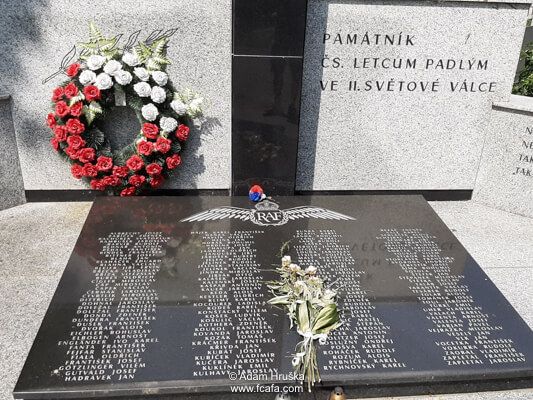
Great Britain:
Capel-le-Ferne:
He is commemorated, along with the other 2940 Battle of Britain aircrew, on the Christopher Foxley-Norris Memorial Wall at the National Battle of Britain Memorial at Capel-le-Ferne, Kent:

Hawkinge:
Jaroslav is remembered on the Czechoslovak Battle of Britain pilots memorial at the Kent Battle of Britain Museum at Hawkinge, Kent. It was unveiled on 28 October 2025, to commemorate the 88 Czechoslovaks who flew in that battle.

London – Battle of Britain Memorial:
He is also commemorated on the London Battle of Britain Memorial:
London – St Clement Danes:
Jaroslav Kučera is remembered in the Remembrance book at St Clements Danes Church, London.
London – West Hampstead / Londýn – West Hampstead:
He is remembered on the Memorial Plaque at the Bohemia House, he former Czechoslovak National House, at West Hampstead, London.

Article last updated: 31.10.2025.
