

* 03.03.1916, Německý Brod.
† 12.04.1942, Sea off Perranporth.
Pre WW2:
Stanislav Zimprich was born on 3 March 1916 to Josef and Františce, neé Ševcové, at Německý Brod, now Havlíčkův Brod, Czechoslovakia, a town about 50km South-West of Prague. He spent his childhood there being educated for 5 years at the general school and a further 4 years at the Municipal school. He joined the Scout movement and was a very active sportsman, participating in field sports, football, swimming and cross-country sking. On completing his school education, he continued his studies for a further 4 years, at the Business Academy at Chrudim about 50 km North from Německý Brod. However. on graduating, he was unable to find employment and decided to join the military.
Czechoslovak Air Force:
Stanislav enlisted on 10 July 1935 at Čáslav Air Force base and was sent to the School for Reserve Air Force Officers at Prostějov for his basic military training and pilot instruction. On 30 June 1936 he was first posted to the 1st Air (T.G. Masaryk) Regiment and then on 30 September to the Military Academy at Hranice in Moravia, from which he graduated on 28 August 1937. He was then posted as an operational pilot to the 5th Air Regiment who were deployed at Brno and then to the 2nd Air (Dr Eduard Beneš) Regiment who were deployed at Olomouc and equipped with Avia B-534 biplane fighter aircraft. By March 1939 he had achieved 224 flying hours.
German Occupation:

The Germans occupied Czechoslovakia on 15 March 1939. Under pressure, Emil Hácha, the Czechoslovak President, had ceded to their demands. In the early hours of 15 March 1939, he had ordered all Czechoslovak military units to stand down, remain in their barracks and not resist the occupation. By dawn that day, the Germans began their occupation of Czechoslovakia. Germanisation of Bohemia and Moravia began immediately; they were now the Reich Protectorate of Bohemia and Moravia (Protektorat Böhmen und Mähren), while Slovakia, in return for its allegiance to Nazi Germany, had become the ‘puppet’ independent state of Slovakia. Within a few days of their occupation, the Germans disbanded the Czechoslovak military and all personnel were dismissed.
Germanisation of Bohemia and Moravia began immediately after the occupation, but just four days later, on 19 March 1939, former Senior officers of the now-disbanded Czechoslovak military had started to form an underground army, known as Obrana Národa [Defence of the Nation]. Obrana Národa worked in co-operation with Svaz Letců, the Airman Association of the Czechoslovak Republic. One of their objectives was to assist as many airmen and soldiers as possible to escape to neighbouring Poland where they could be formed into military units to fight for the liberation of their homeland. These two organisations provided money, courier and other assistance to enable airmen to escape. Usually, this was by crossing the border from the Ostrava region into Poland.
Like many of his former Air Force colleagues, Stanislav could not reconcile himself to the Munich surrender and subsequent occupation. Amongst the now demobilised former members of the Czechoslovak military, rumours were being heard that Czechoslovak military units were being formed in Poland for the purpose of fighting for the freedom of their homeland. Stanislav was one of many who responded to this news and investigated further. He was put in contact with the Obrana Národa.
Stanislav was one of the many Czechoslovak airmen and soldiers who saw it was their patriotic duty to voluntarily go to Poland from where they could participate in efforts to achieve the liberation of Czechoslovakia.
To Poland:
With four other former Air Force colleagues – Karel Mrázek, Egon Nezbeda, Jaroslav Podroužek and Felix Zbořil – they made their decision to escape. The group travelled to Bílý kříž near the Slovak border and then posing as hikers went on foot, through the forests, and crossed over the border into Poland, near Horní Lomná, on 29 May. Their guide was Cyril Mach, a patriotic teacher from Rožnov pod Radhoštěm who also covertly guided military escapees to Poland.

After a short internment at Cieszyn by the Polish Authorities, they were transferred to Kraków on 3 June and reported for duty to the Czechoslovak Consulate there.
Disappointment in Poland:
At this time, the Polish Authorities, whilst recognising the new puppet State of Slovakia, showed little support for the Czechoslovak military who were escaping into their country. They would not allow independent Czechoslovak units to be established on its territory as they were concerned about antagonising neighbouring Nazi Germany. Thus, with this disappointment and uncertainty about their future, the morale amongst the escapees was low.
Only after lengthy negotiations between Czechoslovak Diplomats in France and Great Britain, and the French Government, did the French agree to admit 4,000 Czechoslovaks into the French Foreign Legion – French law did not allow for foreign military units to be on its territory in peacetime, and the Czechoslovak escapers would be required to join the French Foreign Legion for a five-year period with the agreement that, should war be declared, they would be transferred to French military units. The alternative was to be returned to occupied Czechoslovakia and face German retribution for escaping – usually imprisonment or execution with further persecution of their families.
The barracks, which were in poor condition, were already full of other escapees whilst arrangements were made for their transportation, by sea, to France.
Stanislav arrived at Bronowice Małe on 3 June and after a short stay, along with 138 other Czechoslovak military escapees, 42 of whom were airmen, travelled by train to the Polish Baltic port of Gdynia, where on 17 June they boarded the ‘Sobieski’, a Polish passenger ship and sailed to Boulogne, France, arriving on 19 June.

France:
From Boulogne, Stanislav and his fellow escapees were transferred to Place Balard, the Foreign Legion’s Recruitment Centre in Paris, to undergo medical checks, whilst the necessary documentation was prepared for their enlistment into the Legion pending their transfer to the Legion’s training base at Sidi bel Abbes, Algeria. During this period, they attended French classes and any free time was usually spent in Paris exploring the sights and practising their newly learnt French with the girls they met.
French Foreign Legion:
On 12 August, he was accepted into the Foreign Legion at the rank of soldat and transferred to Sidi-bel-Abbes.

Shortly after war was declared on 3 September, Stanislav was released from his Foreign Legion contract and transferred to l’Armée de l’Air.
l’Armée de l’Air:
Via the airbases at Oran and Blida, he returned to mainland France and transferred to the l’Armée de l’Air B117 recruitment centre at Dugny, near Paris. There he was promoted to the rank of sergent and on 1 December was posted to Centre d’Instruction de Chasse at Chartres airbase for re-training on French MS-406c aircraft.

The Germans invaded France on 9 May. Stanislav’s re-training was completed on 11 May and he was posted to Patrouille DAT (Groupe de Chasse de Défense), who were equipped with MS-406c fighters and based at Chartres. In this posting he flew a total of 3hrs 20 min. On 18 May he was posted, to GC I/8 who were based at Chantilly-les-Aigles airbase, north of Paris, and equipped with MB-151C and MB-152C fighter aircraft. The rapidity of their Blitzkreig caused GC I/ 8 to frequently have to move their airfields as they retreated westward. By mid-June they had redeployed numerous times and were now at Corme-Écluse airbase at Royan, about 100km North of Bordeaux, in south-west France. With GC I/8 he had flown a total of 26 hrs 40 min.
Evacuation from France:
On 19 June, with France’s capitulation imminent, Stanislav and the remaining Czechoslovak airmen in GC I /8 – Eduard Prchal, Otto Špaček, Rudolf Holeček and Jaroslav Šika – were released from their l’Armée de l’Air service.
Since 15 June, Operation Aerial, the evacuation of Allied military forces and civilians from ports in Western France had been in operation. To be included in this evacuation, the Czechoslovak made their way to the port of Bayonne, about 160 km South of Bordeaux, where, on the 22 June, they boarded the ‘Königin Emma‘, a Dutch passenger ship, which two days later brought them to Plymouth, England.
RAF:
On arrival in England, Stanislav and his fellow Czechoslovak airmen were initially taken in a transit camp, where after security checks, they were accepted into the RAF Volunteer Reserve, being commissioned at the rank of P/O.
The Battle of Britain was now about to commence and there was an urgent need for fighter pilots. As a trained pilot, Stanislav was quickly transferred to the Czechoslovak RAF Depot, Cosford, for some basic English lessons to RAF standards and theoretical aircraft training. On 12 August 1940, he was posted to the newly formed 310 (Czechoslovak) Sqn as one of its founding members. The squadron was based at RAF Duxford and equipped with Hurricane Mk I fighter aircraft and jointly commanded by S/Ldr Alexander Hess, the first Czechoslovak to command an RAF squadron, and S/Ldr George D.M Blackwood.
There they were rapidly re-trained on Hurricane aircraft and also had English lessons three times a week. By 17 August, 16 officers and Sergeant pilots had completed their training which was sufficient to constitute two flights and the squadron was declared operational. The reserve pilots who had not completed their retraining by that day were posted to 6 OTU [Operational Training Unit] at Sutton Bridge to complete there.

Battle of Britain:
The following day, Stanislav made his first operational flight in the Battle of Britain, thus becoming one of the 88 Czechoslovaks who flew in that Battle. That day, a large number of Luftwaffe aircraft were engaged in bombing objectives in the Thames Estuary. Twelve Hurricanes from the squadron took-off at 17:45 and were ordered to patrol the North Weald area below cloud base. The squadron was led by S/Ldr Blackwood and Stanislav was flying Hurricane P3888 as Green 3 to Sgt Josef Hubáček and Sgt Josef Řechka. It was an uneventful patrol, with no interceptions. They returned at 18:35 not having sighted any Luftwaffe aircraft but reported that the sky was full of Spitfires and Hurricanes.
During the Battle of Britain, Stanislav made 15 operational flights and achieved combat success with 1 destroyed, 4 probables and 1 damaged Luftwaffe aircraft. The first of these was a Me 109 damaged at 13:15 on 31 August 1940 about 10 miles North-East of London. His successes during that battle were:
| Date | Time | Spitfire | Action |
| 31/08/40 | 13:15 | P3165 | Me 109 probable, 10 miles NE of London. |
| 07/09/40 | 17:15 | R4087 | 2 Me110 probable, Thames Estuary. |
| 09/09/40 | 17:40 | V7304 | Do 215 destroyed, Me110 damged SW London. |
| 18/09/40 | 17:00 | P3162 | Do 215 probable Thames Estuary. |
Stanislav’s most successful combat day was 9 September when he achieved a Do215 destroyed and a Me110 damaged, That day 12 Hurricanes from 310 Sqn, led by S/Ldr Blackwood, took-off from Duxford at 17:05 to patrol the North Weald area at 20,000 ft. Stanislav was flying in ‘B’ flight in Hurricane V7304. The squadron joined up with 19 and 242 Sqn for form a Wing, with 242 Sqn taking the lead. At about 17:35, a formation of 75 Do215, escorted by about 150 Me109s Me 110s and He112s were sighted South of the Thames estuary heading North West. The main formation consisted of bombers and fighters flying in a close herring-bone formation with alternate lines of Do215s and Me110s, protected by further Me110s, Me109s and He112s.
S/Ldr Blackwood ordered his squadron into line astern in preparation for an attack on the main formation from the rear. The attack was delivered South of London at 17:35 hrs at 22,000 ft. Stanislav’s combat report in the attack is:
“I wanted to make an attack on a formation of Do215s with the leader of my section, but I lost him in a sharp turn. When I tried to attack the formation myself, I sighted a Me110 I attacked him from the starboard side ay 300 – 50 yards. I saw black smoke pouring from his port engine. I wanted to make another attack on him, but I sighted a Me110 in my rear, and I could not find any details about the result of my first attack. I broke away, lost sight of the other Me110 as well, and then I climbed to attack the e/a formation. I picked up a Do215 which was a certain distance from his formation and delivered an attack on him from above, and from starboard at 300 – 50 yards, and saw him do gown in a steep dive. I attacked him again from the front and port at about 50 yards and noticed that the gunner did not fire at me anymore. I repeated the attack from the starboard and fired a long burst. I saw the engines stopped and the Do215 gliding. Then I saw something fall out of the E/A probably bombs. Then thus E/A landed without undercarriage down near Westerham. I circled above him, and as I the army approaching his crew, I landed at the Biggin Hill aerodrome.”
After the Battle:
After the Battle of Britain was deemed finished on 31 October 1940, Stanislav remained with 310 Sqn, with no further combat success. Engagement with the Luftwaffe was now infrequent and the squadron’s role was still patrolling the South-East of England and also interspersed with ‘Kipper’ patrols – patrols to protect British fishing boats in the North Sea against Luftwaffe attacks. He was promoted to the rank of F/O in February 1941. That month the squadron commenced offensive sweeps over northern France and also night patrols. These were to continue until July when the squadron was re-deployed to Martlesham Heath, near Ipswich, Suffolk, and now coming under 11 Group Fighter Command.
For a rest period, the squadron was redeployed to Dyce in North-East Scotland which was a lower key operational area when compared to Southern England. There the squadron’s role was to protect the port of Aberdeen against Luftwaffe raids and also to provide convoy patrols.

A highlight for the squadron after many non-ev entful patrols had been the escort of an aircraft flying a VIP passenger to the Shetland Islands on the 9 August and also on its return flight two days later. Shortly after that, the squadron were informed that the VIP they had been escorting was none other than King George VI.
In late 1941 the squadron converted to Spitfires and on 20 December, they redeployed south to Perranporth, Cornwall, as part of 10 Group Fighter Command. At Perranporth, 310 Sqn was mainly flying convoy patrols and also escorting PRU Spitfires to the Brest peninsular. Occasionally this routine would be broken with the interception of incoming Luftwaffe intruders. In February 1942 Stanislav was promoted to the rank of F/Lt.
Fateful Flight:
Stanislav lost his life on 11 June 1942 during a combat training exercise using on-board cine-cameras, with six 310 Sqn Spitfires, over the sea near Perranporth airfield. At 11:30, flying Spitfire Mk Vb BL497 ‘Y’, he appeared to make a mock attack coming from the port-side rear on the Spitfire Mk Vb AD402 ‘N’ flown by Sgt Stanislav Halama. He clipped the tail of Sgt Halama’s aircraft causing it to go into a near vertical dive into Gear Sand killing the pilot outright.
Stanislav’s Spitfire was seen flying very low from the sandhills towards the beach, its undercarriage up, but with the flaps down and engine cut. He overshot the beach and landed in the sea about 50 metres from the shore. For some minutes observers on the beach saw the tail of the Spitfire sticking out from the sea and a dark object, wearing a mae-west, floating away from it. The beach observers attempted to form a human chain to reach the aircraft but were beaten back by the sea. His body was washed ashore on 14 July 1942 at Combe Martin, Devon.
F/Lt Stanislav Zimprich, 26, was buried on 22 July 1942 at grave 14, row N at St. Augustine churchyard, Heanton Punchardon, Devon.

Medals:
1939 – 45 Star with Battle of Britain clasp
Air Crew Europe Star
Válečný kříž 1939 [Czechoslovak War Cross 1939]
Za chrabrost před nepřítelem
Za zásluhy 1. stupně
Pamětní medaile se štítky F–VB
On 28 October 2023, Czech National Day, it was announced that he was awarded the Czech State medal of Za hrdinství – For Heroism – by the country’s President Petr Pavel.
Remembered:
Czech Republic:
Havlíčkův Brod:
He is symbolically remembered at the family grave at Havlíčkův Brod.

Prague 1 – St Vitus Cathedral
He is remembered in the Remembrance book at St Vitus Cathedral, Hradčany, Prague.
Praha 1 – Klárov :
In November 2017, his name, along with the names of 2533 other Czechoslovak men and women who had served in the RAF during WW2, was unveiled at the Winged Lion Monument at Klárov, Prague.

Prague 3 – The Army Museum, Žižkov:
He is remembered on the Memorial Plaque at the Military History Institute, at Žižkov Prague.

Prague 6 – Dejvice :
He is remembered on the Memorial for the fallen Czechoslovak airmen of 1939-1945, at Dejvice, Prague 6.

United Kingdom:
Capel-le-Ferne:
He is commemorated, along with the other 2940 Battle of Britain aircrew, on the Christopher Foxley-Norris Memorial Wall at the National Battle of Britain Memorial at Capel-le-Ferne, Kent:

Hawkinge:
Stanislav is remembered on the Czechoslovak Battle of Britain pilots memorial at the Kent Battle of Britain Museum at Hawkinge, Kent. It was unveiled on 28 October 2025, to commemorate the 88 Czechoslovaks who flew in that battle.

London – Battle of Britain Memorial:
He is also commemorated on the London Battle of Britain Memorial:
Perranporth:
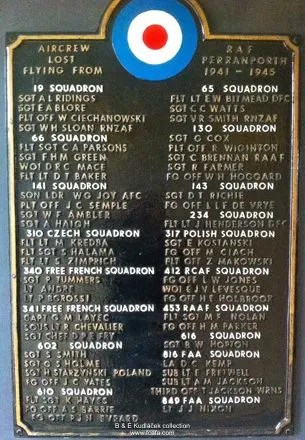
He is commemorated on a memorial plaque to commemorate the aircrew lost flying from RAF Perranporth 1941 -1945, located at the former airfield.
London – St Clement Danes :
Stanislav Zimprich is remembered in the Remembrance book at St Clements Danes Church, London.
London – West Hampstead / Londýn – West Hampstead:
He is remembered on the Memorial Plaque at the Bohemia House, he former Czechoslovak National House, at West Hampstead, London.

Article last updated: 31.10.2025.
Widgets
